
A blueprint
for the future
The history and stories
which explain how the
long-term EU budget
works for Europe.


A budget for the recovery
The next long-term EU budget – the multiannual financial framework (MFF) – for 2021-2027 is being finalised at a time when the EU faces an unprecedented challenge from the COVID-19 pandemic.
The impact of the coronavirus and lockdowns across the EU and globally have precipitated the most severe economic crisis in seven decades of European cooperation.
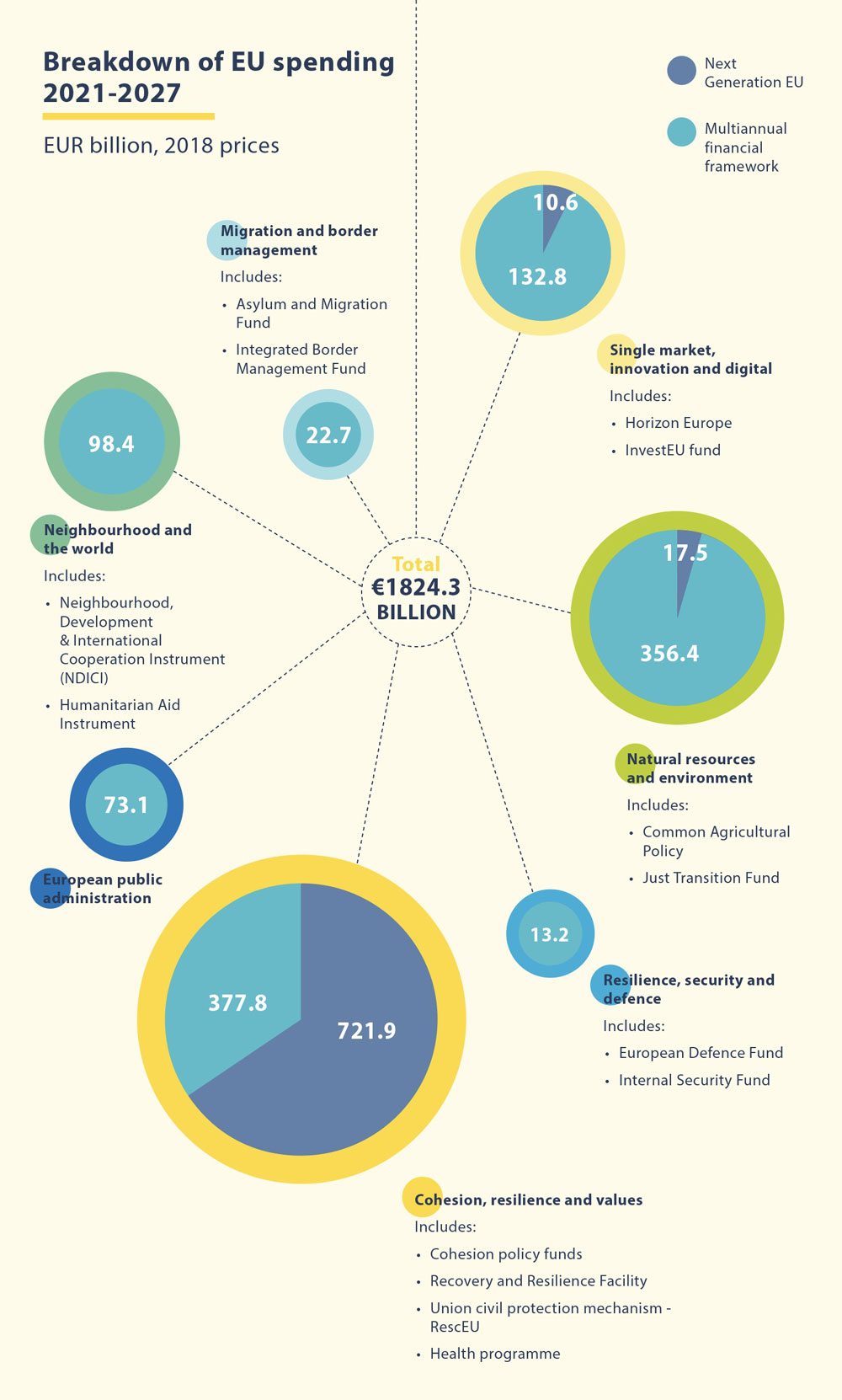
EU leaders have responded quickly with a massive coronavirus recovery plan of €1.824 trillion. It combines the long-term EU budget with an extraordinary, €750 billion recovery effort destined to tackle the effects of an unprecedented crisis in the best interest of the EU.
We showed collective responsibility and solidarity and we also showed our belief in our common future. And this agreement sends a concrete signal that Europe is a force for action.
That is where the next EU budget comes in: the EU budget is the blueprint that shapes a shared future across the 27 member states.
Covering the upcoming seven years, it has been designed not only to build on the work that has contributed to creating Europe as we know it today, but also to ensure that the Union is able to address the challenges and seize the opportunities presented by the digital and climate transitions, while recovering from the COVID-19 fallout.
More than ever, we need this double project of major transformation for Europe: climate neutrality by 2050 – our Green Deal – and the digital transition, destined to put Europe at the forefront of using data, the natural resource of the digital world.
The recovery fund – Next Generation EU – will be channelled together with the multiannual budget into seven policy clusters, which reflect the Union's political priorities.


Just as today, the EU budget has always evolved with the needs of the Union, responding to changing political, social and economic contexts.
Its history is a fascinating story of evolution and adaptation, of compromise and of a vision for a shared future. It is a story of transformation in Europe and of positive impact on the lives of millions of people.


Towards the EU budget as we know it
It may be true the budget is rather small in absolute terms – just over 1% of the gross national income (GNI) of its member states – as big areas of public expenditure such as education, public health and social welfare are the competence of member states.
However, it has great political significance.
On the one hand, the budget is where EU leaders agree on how much to spend on each of the priority areas of EU action. On the other hand, the budget negotiations are where visions of the EU's future are discussed and aligned, where EU heads of state and government set the ambition for the years ahead.
It is a great achievement to find consensus across a number of member states. And indeed, the challenges of reaching such agreements have been present since the first steps were taken towards creating what we now know as the European Union.
Today’s long-term approach to EU spending offers security and stability well beyond what a yearly budget can provide, supporting better planning for strategic investment.
Let us take a look at the steps that have shaped it.


1951
In 1951, the Treaty of Paris agreed to create a European Community for Coal and Steel to regulate those industries and create a single market for their products across Belgium, Luxembourg, the Netherlands, West Germany, France and Italy.
Crucially, it was given financial autonomy, being financed through levies on the production of coal and steel, loans and fines.


1957
Six years later, in Rome, the same six nations set out a vision of continued integration and economic growth by agreeing to create a common market, with free movement of goods, people, services and capital.
They envisaged a European Economic Community (EEC) financed by a mix of levies and contributions from participating member states.


1965
The first major change to the budgetary system was the Merger Treaty which merged three separate budgets (Euratom, ECSC, EEC) into one. The merger would increase the community’s efficiency.


1970s
It would not be until 1970 that the 'own resources' system, which was meant to gradually replace the contributions of member states, would come into force. The own resources included:
- customs duties
- agricultural levies
- VAT-based contributions
The 1970s, during which Denmark, Ireland and the UK joined the community, also saw an extension of the European Parliament’s budgetary powers.
With the Brussels Treaty of 1975, the European Parliament obtained the power to reject the annual budget.
After 1979, when MEPs were directly elected by EU citizens for the first time, the Parliament was demanding more influence over the budget.


1980s
The 1980s saw the accession of three new member states: Greece (1981), Portugal and Spain (1986).
The EU institutions were overseeing a larger budget, covering agricultural, social and regional development policies. The agricultural budget in particular was growing at a faster pace than predicted.
Several new policies were also launched in the 1980s, including the common fisheries policy and the first framework programme for research.
The Parliament rejected the 1980 budget, eventually approving it seven months later. A similar stand-off was to follow in 1985, with discussions re-opening on decision-making and how the money was to be spent.
By 1985, around 70% of the budget was spent on the Common Agricultural Policy (CAP). This fuelled tensions between member states, opening discussions that still persist. In a nutshell, certain countries that paid into the budget more than they received back in financial terms considered the benefits to be unequal.


1984
This situation led the then-British Prime Minister Margaret Thatcher to demand a rebate on the UK’s contributions to the EU budget: 'I want my money back!', she famously declared.
At the same time, the budgetary resources agreed in the 70s were not generating enough income to cover the EU's obligations. The Commission was proposing to increase the VAT own resource.
The stand-off encapsulated what, by the early 1980s, had become an annual tussle over financial contributions.
At the European Council summit in the French town of Fontainebleau in 1984, EU leaders agreed to increase the VAT levy.
EU leaders also agreed on a formula reducing the UK contribution – known as the UK’s rebate. The costs were shared between other member states.
Over the following years, the countries most heavily affected by the cost of the UK's rebate were granted a ‘rebate on the rebate’. Starting with Germany, this was extended to Denmark, Austria, the Netherlands and Sweden.


1988
The Single European Act, in 1987, was to prove the catalyst for the move towards multiannual planning.
To finance new ambitions for the community, such as the creation of the internal market, the European Council in 1988 agreed that it should be given sufficient, stable and guaranteed resources to be able to operate until 1992.
To improve the efficiency of budget talks, the Council, the Commission and the European Parliament also agreed on budgetary discipline rules and a fixed ‘financial perspective’ for the 1988-1992 period.
This first multiannual package was the starting point of the EU’s long-term budget planning.
The EU also gained a new resource based on the gross national product of each member state (replaced by gross national income, a similar accounting definition, from 2007). This made for a more equitable level of contributions to the budget, linked to member states’ prosperity. From then on, this ‘balancing resource’ provided most of the necessary financing for the budget.


1988 – 1992
Since 1988, all of the EU's annual budgets have been set within the limits agreed in the financial perspective – which became the multiannual financial framework with the Lisbon Treaty: 1988-1992, 1993-1999, 2000-2006, 2007-2013 and 2014-2020. This means that subsequent annual budgets were to be negotiated within agreed multiannual spending envelopes, speeding up the process and providing stability.
The first financial perspective – known as the Delors I package, after the Commission president Jacques Delors – ran from 1988-1992. It prioritised policies aimed at regional development (cohesion policies) and aimed to put a brake on agricultural spending.
The 1989 budget was adopted, in the words of Delors – ‘on time and without fuss’.
As the Berlin wall came down and the end of the Cold War declared that year – and Germany reunited in 1990 – some argued the world was witnessing the ‘end of history’.
For sure, it would not be the end of EU budget history.


1993 – 1999
The decision made in 1988 to base annual budgets on a multiannual financial perspective was not a permanent fixture. However, its success led to the conclusion that the interinstitutional agreement should be renewed for a further period: the 1993-1999 Delors II package.
It was the budget that would support the first steps of the EU after the Maastricht Treaty. In particular the new:
- cohesion fund aimed to finance infrastructure
- powers in fields such as trans-European networks, industry, education and culture
- common foreign and security policy cooperation
- justice and home affairs cooperation
Three new countries joined in 1995: Austria, Finland and Sweden.


2000 – 2006
The long term budget for 2000-2006, was aimed at supporting the enlargement of the Union. In 2004, 10 central and southern European countries became EU member states. Followed by Bulgaria and Romania on 1 January 2007.
The so-called Agenda 2000 took into account the enlargements, reforming the agricultural policy in view of the expected rise in agricultural expenditure on which new member states would rely.
It also guaranteed the expansion of EU structural and regional funds that aim to reduce disparities between regions.


2007 – 2013
The dynamics of the 2004 enlargement brought new questions to the table. And a number of countries requested a stabilisation or even reduction in contributions to the EU budget.
Long and tough negotiations between member states finally led to an agreement on the 2007-2013 budget.
A slightly lower expenditure ceiling and limited shifts in the budget structure marked this new perspective. In addition, new flexibility instruments were built in, such as the Globalisation Adjustment Fund, to support workers affected by the closure of companies in Europe.


2014 – 2020
The Lisbon Treaty of 2009 had formalised the multi-year budgeting once and for all. The multiannual financial framework had been until then only included in agreements between institutions.
The after-effects of the 2007 global financial crisis and the European sovereign debt crisis hit the European Union hard. Member states’ finances suffered from the crisis.
In October 2010, the European Council indicated that the EU multiannual financial framework should ‘reflect the efforts made by member states to bring deficit and debt onto a more sustainable path’.
Indeed, under the 2014-2020 multiannual financial framework 47% of total expenditure was allocated to smart and inclusive growth. In particular tackling youth unemployment, at a high after the crisis, and investing in research, innovation and small businesses were front and centre.
The second largest envelope (close to 40%) was for sustainable growth. It included traditional agricultural policy spending but also covered environment and climate action.


2021 – 2027
Months into the 2020s, the EU is again negotiating its long-term budget against the backdrop of a crisis – the most severe economic crisis it has ever faced.
Triggered by the COVID-19 coronavirus pandemic and subsequent lockdowns, this crisis comes after the UK's departure from the EU, which left a gap in the budget.
EU leaders agreed on an overall package of €1 824.3 billion. Combining the multiannual financial framework (MFF) and an extraordinary recovery effort – Next Generation EU, it will help the EU to rebuild after the COVID-19 pandemic, and will support investment in the green and digital transitions.
This agreement will be seen as a pivotal moment in Europe's journey, but it will also launch us into the future. It is the first time in European history that our budget will be clearly linked to our climate objectives. (...) And the first time that we are jointly re-enforcing our economies against a crisis.

Who benefits?
The stories behind the figures
If you go beyond the history, the procedures and the headlines to speak to ordinary Europeans, you will find evidence of how the collective investment of EU nations has transformed the continent and beyond.
Directly or indirectly, the EU budget positively affects the lives of the 446 million people living in the EU today – the world’s third largest population after China and India.
The impact of EU spending over the years is perhaps most visible in the infrastructure that has modernised communities from Cabo da Roca (Portugal) to Nuorgam (Finland), with roads, railways, electricity grids and gas pipelines – from the smallest countries, such as Malta with fewer than half a million inhabitants, to Germany with over 83 million.


Take Stephanie Borg, a Maltese designer and painter whose work is inspired by her country's heritage.

EU investment in regional development has made it possible to restore the country’s cultural heritage, transforming it into an attractive holiday destination, and boosting tourism and the island’s economy. It has also created exciting opportunities for small businesses such as her own which are built on Maltese traditions.


On a personal level, the positive impact of the EU budget might be felt most keenly by those who have benefited from funding aimed at improving skills, studying abroad, or helping companies to create jobs and expand their markets.
Take Jelena Moro and her brother, Frano. They had grown accustomed to seeing people leave their rural area in Croatia’s Split region in search of a better life. After she graduated in law, and Frano completed his master's degree in economics, they could have gone elsewhere to look for work.
But when their country joined the EU in 2013, the emphasis on boosting the economy of Croatia’s depopulated areas changed their outlook. ’Everyone was talking about rural development and EU funds,’ said Frano. ‘We just joined the dots.’
The training gave them access to experts in the field and plugged them in to a network of young organic farmers who regularly share advice.

Discussions often focus on how much each country pays into the EU budget. But this debate fails to take into account the indirect benefits of EU programmes, or the hard-to-measure economic gains arising from the internal market. Even conservative estimates put the latter at five times that of a nation’s annual contributions to the budget.

Luca Celeghini says he sees those benefits every day in his work as a partner in a company producing machinery for processing cereals. Its main factory is in Germany but production also takes place in Spain and in his native Italy.
During Luca’s career as an entrepreneur, negotiating exchange-rate fluctuations, customs checks and divergent national product classifications have become a thing of the past. The removal of internal borders made regular meetings in different nations a realistic possibility.


The EU constantly adapts to a changing world.
Whereas those early steps towards integration revolved around coal and steel, the most recent budgets have seen a focus on research and innovation, as well as action to address challenges such as climate change, sustainable transport and mobility, renewable energy or food security. But they also aim to help member states remain competitive in the digital economy and successfully embrace the green transition.
The imperative to tackle climate change, and the plan to make Europe the first climate-neutral continent by 2050, mean that the EU’s role in funding environmental research is more important than ever.
René Forsberg is one of those involved in the research which helps inform the EU’s climate action. He has been visiting Greenland for 40 years and as professor at the Danish National Space Institute conducts measurements of the coverage of sea ice. What happens in the Arctic and in the Antarctic are key indicators of the worrying advance of climate change.

Over the years, more funds have also been allocated to dealing with defence and security.

Border protection, for example, is an important pan-EU concern. Portuguese-born Enio Silva is at the heart of it.
He has made Warsaw, in Poland, his second home since he began leading a team there for the European border agency, Frontex, which was established in 2004.
His staff monitor live feeds from surveillance planes. If they spot something unusual, such as a suspect cargo ship, they relay the information in real-time to member states, allowing local investigators to be on site within minutes.


These are only a handful of examples of the impact of the EU budget.
On taking over as European Council President in 2019, Charles Michel spoke of the powerful effect EU spending can have in shaping the future.
I want Europe to become a global leader of the green economy with jobs, innovation and a high quality of life. We have to find a way forward that works for all member states. And their people.
By setting a long-term budget, with a strategic focus on the priorities of its member states and citizens, EU leaders aim to do just that.


 Built with Shorthand