- Blog post
- 8 marzo 2018
'Standing up for Equality' conference
The session was opened by the Secretary-General of the Council, Jeppe Tranholm-Mikkelsen, who expressed his support for equal opportunities, emphasised the GSC's policy of zero tolerance towards sexual harassment in the workplace and stressed the importance of initiatives in this area.
Then Cristina Gallach, the Council's Equal Opportunities Officer, introduced Michèle Mees, an expert in balanced organisational culture and co-founder of the Centre for Balanced Leadership – a platform that incites companies to close the gender gap and promotes inclusion. In her keynote speech, Mees invited the audience to take part in a live survey, answering questions using their mobile devices. The questions were as follows:
- 1.The ideal gender balance in a team is:
a) The numbers do not matter;
b) 50-50;
c) 40-60.
- 2.What is the main barrier to gender balance at the General Secretariat of the Council (GSC):
a) Not enough attention to work-life balance;
b) Bias against women taking leadership roles;
c) Not enough mentoring/coaching of women;
d) Women are less ambitious than men.
- 3.Do you feel women need to adopt a masculine style in order to advance: agree/disagree.
- 4.Describe the GSC culture in one word.
- 5.Do you feel that the organisational culture in the GSC is inclusive: agree/disagree.
- 6.Do you feel that women need to prove themselves more to get the same opportunities as men at the GSC: agree/disagree.
In some cases, the split between how the questions were answered was very even; in others less so. In response to the second question mentioned, for instance, 12% of the participants replied that women have less ambition than men. Even though this option was only chosen by a minority, the fact that it was chose at all is still worrying, according to the co-founder of the Centre for Balanced Leadership. "Hierarchical", "conservative", "inclusive", "challenging" and "diversity-oriented" were some of the words chosen by audience in answer to the fourth question.
Mees also highlighted the importance of improving diversity and inclusiveness across organisations, supporting her arguments with a number of real-life examples and eye-opening statistics. One of the things that these examples illustrated was that not only do men and women often face different attitudes in their working lives, but they also perceive equality in a workplace differently. According to the findings of a recent McKinsey report, if entry-level women were promoted at the same rate as their male peers, the number of women at senior vice president and C-suite levels would more than double. Mees then went on to discuss some of the stereotypes that hurt women throughout their careers, describing concepts such as the "revolving door of workplace culture" and the "Queen Bee" stigma.
The "revolving door of workplace culture", Mees explained, refers to situations in which women begin working in a male-dominated sector, such as IT, but do not remain in their jobs very long because they don't feel valued. The concept of the "Queen Bee" stigma, meanwhile, refers to the notion that women "block the door for other women" – but Mees challenged this notion, maintaining instead that "women empower other women to succeed".
The solutions, according to Mees, to issues of gender inequality in the workplace are diversity, inclusion, and for companies to embrace in their modus operandi and culture the "masculine" and "feminine" energy that every single woman and man have. Engaging men in the conversation so that it is inclusive and encompasses all of us, and respecting women's nature and individuality – both these approaches, in Mees' opinion, are part of the solution: "If we want to bridge the gender gap, we need to look beyond gender to the masculine and feminine in ourselves and our organisations".
Challenges facing women in the workplace were also addressed in a panel discussion that followed. The panel speakers were five female professionals working to improve gender diversity. The discussion, moderated by Cristina Gallach, proved that while there are still plenty of equality issues women have to tackle in their everyday lives, the recent growth in the number of women's support movements, networking groups and communities gives us hope for the future.
"These new social media, the fact that people feel more participative in public life – this is bringing change in two ways," said Carmen Vera García, a board member of Leadarise. "I'd say this is a call to action for people – to ask yourself what you can do, not just to blame others but 'What can you actually do, how can you take action?' – and networks are an example of how you can actually contribute. But I think that it is also a call for the policymakers to make a move. I believe it must go two ways: bottom-up and also top-down," she added.
Mees summed up the discussion thus: "History shows that we have come some way, but there is still a long way to go, so we need the experiences of women – and also of the men – we need all of us, if we want to tackle this. […] You feel that there is a change, there is a transformation, and it is a big one, it is in a society, and it is huge."
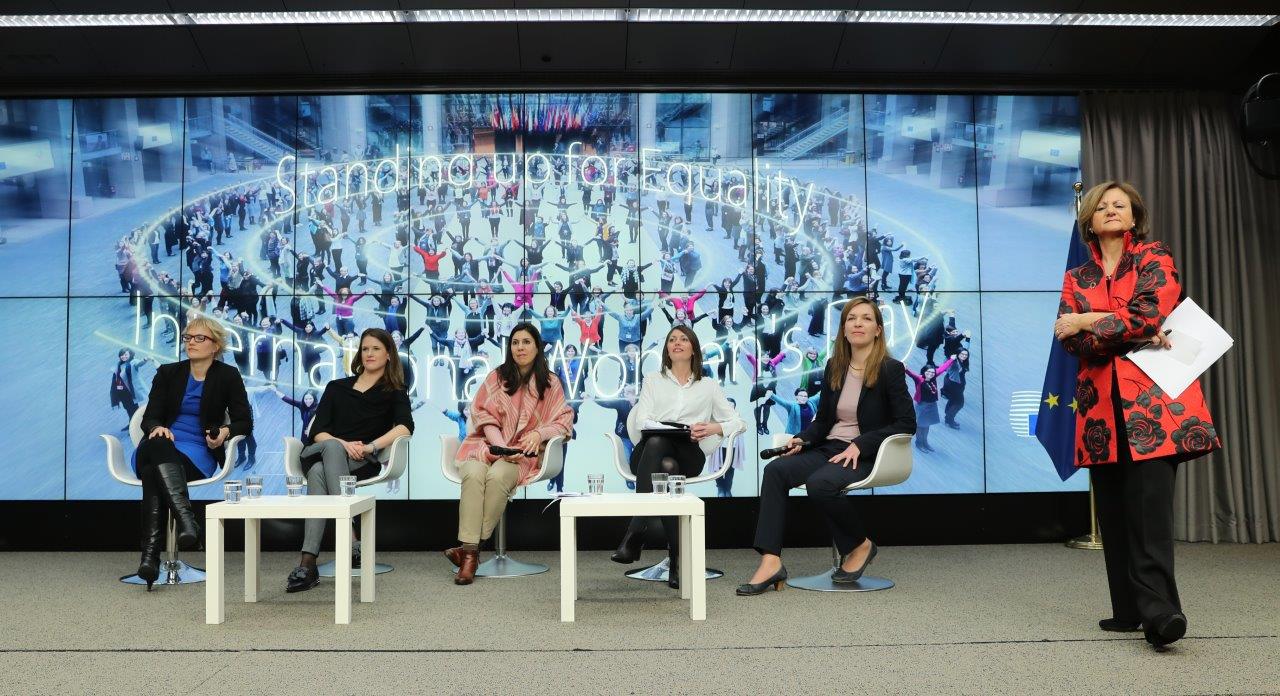
'Standing up for Equality' conference - panel
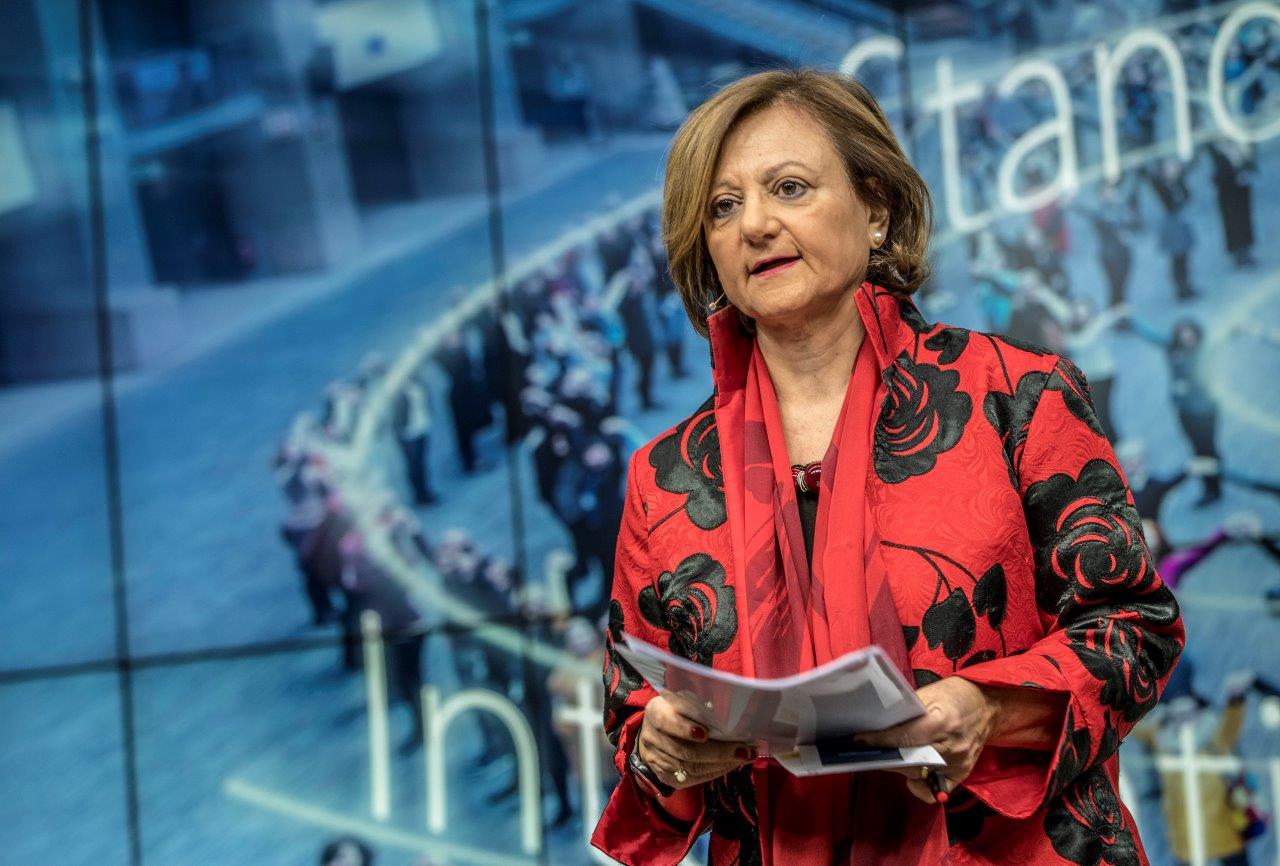
'Standing up for Equality' conference - Cristina Gallach