
Timeline: History
Film: 'From fireside chats to key decision-maker'
This documentary traces the history of the European Council from its foundation down to the present day. It shows important milestones from the last decades that have shaped the way EU leaders make decisions.
The story is told through the eyes of those who witnessed the European Council's transformation to the decision-making centre that it is today.
Find out more about the events and treaties which have shaped the roles of the European Council, the Council of the EU, the Eurogroup and the Euro Summit.
-
1950
The Schuman Declaration
French foreign minister Robert Schuman announced the creation of a European Coal and Steel Community placed under the control of a common high authority. The foundations were laid for the European Union, based on two core principles: peace and solidarity.
-
1952
23 JulyThe Paris Treaty
The Paris Treaty establishes the European Coal and Steel Community (ECSC) which creates a common market for coal and steel. This eases distrust and tensions between neighbouring European countries following World War II. The ECSC treaty, which expired in 2002, is the first founding treaty of the European Community.

-
1952
8 SeptemberFirst meeting of the Special Council of Ministers of the ECSC
The first meeting of the Special Council of Ministers of the European Coal and Steel Community, which was to later become the Council of the European Union, takes place in Luxembourg.
-
1958
1 JanuaryTreaties of Rome
The Rome treaties establish the European Economic Community (EEC) and the European Atomic Economic Energy Community (Euratom). The first meeting of the Council of the EEC takes place on 25 January 1958 under the chairmanship of Victor Larock, the Belgian Foreign Affairs Minister.
-
1965
2 JulyEmpty chair crisis
In 1965 France announces it will not attend Council meetings due to disagreement with negotiations on the financing of the Common Agricultural Policy. The crisis is later resolved thanks to the 1966 Luxembourg compromise, which implements unanimity voting when major interests are at stake.

-
1967
1 JulyThe Merger treaties
These two treaties (1967 and 1971) introduce a singe Council, a single Commission and a single budget for the three Communities (ECSC, Euratom and EEC. Coreper is formalised as a preparatory body of the Council.
-
1973
1 JanuaryFirst enlargement
Denmark, Ireland and the United Kingdom join the European Communities, raising the number of member states to nine.

-
1975
11 MarchFirst meeting of the European Council
The new European Council meets for the first time in March 1975 in Dublin.

-
1981
1 JanuaryGreece joins the EU
Membership of the EU reaches double figures when Greece joins.
-
1985
14 JuneSchengen Agreement
The Schengen Agreement on the elimination of border controls is signed by Belgium, Germany, France, Luxembourg and the Netherlands in Schengen (Luxembourg).
The Schengen Agreement will gradually allow people to travel without having their passports checked at internal borders. Implementation of the Schengen Agreement starts later, in 1995.
-
1986
1 JanuarySpain and Portugal become EU members
Spain and Portugal join the EU, increasing membership of the European Communities to 12.

-
1987
1 JulySingle European Act
The Single European Act (SEA) establishes the internal market, which provides for the free movement of goods, persons, services and capital. It launches foreign policy cooperation and extends the use of qualified majority voting for decision-making within the Council.
The Single European Act also gives the European Council a legal basis, formalising meetings of the heads of state or government.
-
1992
11 DecemberPublic sessions
The 1992 Edinburgh European Council launches public debates, a practice which has been substantially extended over the years, most recently by the Lisbon Treaty.
The Council's public debates and deliberations can today be followed on the website.
-
1993
1 NovemberThe Maastricht Treaty
The Maastricht Treaty comes into force creating the European Union based on an enlarged 'Community' pillar. It creates the economic and monetary union and sets two new pillars: common foreign and security policy (CFSP) and cooperation in the fields of justice and home affairs (JHA).
The European Council acquires a formal status in the Treaty of Maastricht. It is defined as providing the impetus and general political guidelines for the EU's development.
The Maastricht Treaty also starts the move towards the euro and launches Common Foreign and Security Policy (CFSP).

-
1995
1 January4th EU enlargement
Austria, Finland and Sweden join the EU. The 15 members now cover almost the whole of western Europe.
-
1997
13 DecemberCreation of the Eurogroup
The European Council endorses the creation of the Eurogroup, an informal body that brings together the finance ministers of countries whose currency is the euro. The first Eurogroup meeting is held on 4 June 1998 at the Chateau de Senningen in Luxembourg.
-
1999
1 MayAmsterdam Treaty
The Amsterdam Treaty establishes an area of freedom, security and justice, and integrates the Schengen Agreement into EU law. The treaty modifies the role of Secretary-General of the Council, who also becomes High Representative for Common Foreign Security Policy.

-
2002
1 JanuaryThe euro enters circulation
On 1 January 2002 the euro starts circulation as banknotes and coins, replacing national currencies.

-
2003
1 FebruaryTreaty of Nice
The Treaty of Nice introduces the reform of EU institutions, in preparation for a future enlarged EU of 27 member states. The Council is reformed to extend the use of qualified majority voting, and to introduce the principle of enhanced cooperation between member states.
-
2004
1 MayThe EU's biggest enlargement
Ten new countries join the EU together: the Czech Republic, Estonia, Cyprus, Latvia, Lithuania, Hungary, Malta, Poland, Slovakia and Slovenia. This is the EU's largest single enlargement in terms of people and number of countries.
There are now 25 EU member states.
-
2007
1 JanuaryBulgaria and Romania join the EU
Bulgaria and Romania become EU members, bringing the number of member states to 27.

-
2009
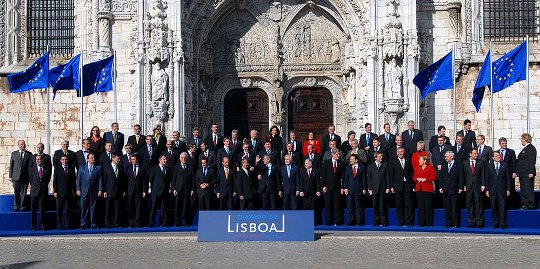
1 DecemberLisbon Treaty
The Treaty of Lisbon enters into force, reforming the structure of the EU and the way in which it functions.
It extends the use of qualify majority voting at the Council.
The European Council becomes a fully-fledged institution with its own President. Previously, the European Council had been an informal body and the head of the European Council was an unofficial position. The role was held by the head of state or government of the member state holding the rotating presidency of the Council of the EU.
-
2012
10 DecemberEU receives the Nobel Peace Prize
The EU receives the 2012 Nobel Peace Prize for advancing the causes of peace, reconciliation, democracy and human rights in Europe.
When awarding the Nobel Peace Prize to the EU, the Norwegian Nobel Committee says its decision is based on the stabilising role the EU has played in transforming most of Europe from a continent of war to a continent of peace.

-
2013
1 JulyCroatia joins the European Union
Croatia becomes the second country from ex-Yugoslavia to join the EU, after Slovenia.
The EU now has 28 member states.
-
2020
31 JanuaryThe United Kingdom leaves the European Union
Following a national referendum on 23 June 2016 and the ratification of the withdrawal agreement by both parties in January 2020, the United Kingdom leaves the European Union.
Last review: 29 May 2026
