Visit the Council
There are many ways to visit the Council:
- explore our visitors' centre and the public areas of the Council on your own
- request a tailor-made information session with a Council official for groups of 20 or more participants
- join a guided tour of the Council's buildings on Fridays
All the visits to the Council are free of charge and subject to prior booking.

Group visits
Groups of at least 20 participants can visit the Council and request an optional exclusive information session by a Council's member of staff.
Group visits can be organised on most weekdays between:
- 09:00 and 11:00
- 13:30 and 16:00
There are no group visits during the month of August.
All groups must book their visit online. The booking request must be made at least 20 working days in advance of your visit. Once we receive your request, a member of our visits team will contact you to confirm your visit.
Information sessions
Groups can request an exclusive information session where a Council expert will share their knowledge, as well as their experience of what it's like to work in the Council, the 'house of the member states'.
Our information sessions:
- last between 1 and 2 hours (depending on the programme)
- are available in any of the 24 official languages of the EU
- are suitable for everyone over the age of 15
A group information session will allow you to engage in an interactive conversation with one of our experts and to learn and broaden your knowledge about the EU, the role of the Council of the EU and the European Council.
How to book your group visit
The booking request should be made by the group leader or a representative of the educational establishment or student body. The group leader provides information about the group during the registration process and acts as the main point of contact for the group.
We reserve the right to put two compatible groups together for organisational purposes.
Our group visits and information sessions are very popular and we recommend booking well in advance.
For a higher chance of reserving your preferred date and time, we recommend that you submit your booking request at least three months in advance. You can view the calendar of available dates once you start your booking process.
In any case, we cannot guarantee that your request can be met.
Individuals or small groups
Individuals and small groups (fewer than 20 people) can:
- visit the Council's visitors' centre
- book one of our weekly guided tours of the Council's buildings
The Council's visitors' centre
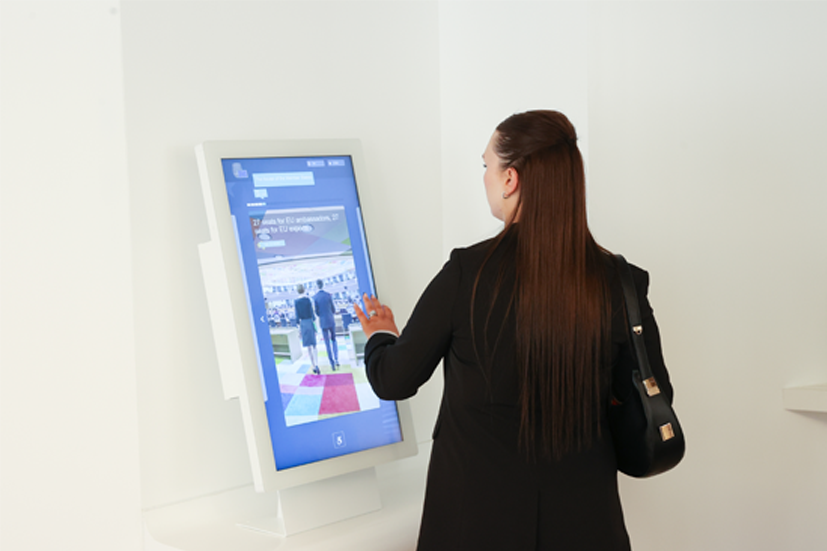
Visit the Council's visitors' centre to learn about the Council's work and the EU through an immersive multimedia experience.
Admission to the Council's visitors' centre is free of charge.
Opening hours
Monday to Friday: 10:30-16:00 (10:00-13:00 in August)
The visitors' centre is closed:
- on Belgian public holidays
- when the EU institutions are closed
- on days when there are European Council meetings
- on 10-14 August 2026 due to works
How to book your visit
When planning to visit the Council's visitors' centre, please consider that:
- visits may take up to one hour
- the content is available in all 24 official EU languages
- the experience is suitable for everyone over the age of 15
- each visitor must be registered individually
A visit to the visitors' centre does not include a guided tour of the Council's buildings. However, as a visitor, you will have access to the public areas of the Council's premises, including the ground floor of the architecturally acclaimed lantern-shaped space in the Europa building.
You need to book online at least seven working days in advance to visit the Council's visitors' centre.
Weekly guided tours
Every Friday morning at 08:00, you can join a guided tour of the Council's buildings, led by a Council staff member.
On a guided tour you get a chance to see the inner workings of the Council and learn more about the architecture of the Justus Lipsius and Europa buildings. The tour includes a visit to the architecturally acclaimed lantern-shaped space in the Europa building.
The tour is suitable for everyone over the age of 15 and free of charge.
Guided tours last about one hour and are offered in French and English.
The early start ensures that visitors can see the most important parts of the Europa building, which are closed to visitors the rest of the day.
As the Council is a working institution, certain areas of buildings may sometimes be closed to the public at short notice.
Booking for the tour is required. You must make your booking request at least seven working days in advance. Slots are subject to availability.
Guided tours in August
During the month of August, guided tours are available three times per week, as follows:
- Tuesdays from 09:00 to 10:00
- Thursdays from 14:00 to 15:00
- Fridays from 09:00 to 10:00

Europa: the beating heart of Europe
Circles, ellipses and squares; a lantern within a cube; a blend of old and new… The Europa building unites form and function and has become a political and architectural icon since it opened for work in 2017.
Join us on a fascinating tour of this landmark building.
Practical information
Where to come
Information sessions and guided tours take place in the Council's buildings in Brussels.
Please be aware that security controls may take some time. For that reason, an arrival time at the relevant Council's building is given for all group visits and it must be respected.
The Council's buildings are easily reachable by public transport. There are train and metro stations and bus stops nearby.
As of February 2025, the Schuman roundabout is undergoing phased redevelopment, which may affect access to the Council's buildings.
We strongly advise using public transport, as parking is extremely limited and car mobility in the European district is restricted due to the ongoing construction work.
Security and accessibility
Each group member or visitor must bring a valid passport or national ID card to enter our premises. We accept originals only, copies are not accepted. We will not accept any other type of personal identification.
School groups must be accompanied by at least one adult for every 10 students.
The Council's buildings are accessible to people with reduced mobility.
Cancellation
We reserve the right to cancel a scheduled visit for any group that does not meet our security and access requirements.
We may be forced to cancel visits that have already been confirmed, even at short notice, in exceptional circumstances resulting from political developments or unplanned Council meetings.
Beyond your visit to the Council
Visit the EU Council Expo
The Council organises mobile exhibitions on the role of the Council and the presidency, which travel to different EU countries.
The expos have had several stops: Strasbourg, Prague, Luxembourg, Granada, Brussels, Budapest, Krakow, and Nicosia.
From July to December 2026, the mobile expo will welcome visitors in Dublin, Ireland.

Visit member states' representations in Brussels
As the Council is the 'house of EU member states', we work closely with member states' permanent representations to the EU. We suggest you combine your visit to the Council with a visit to a member state's permanent representation.
Visit the other EU institutions
European Parliament
The European Parliament is based in Brussels, Strasbourg and Luxembourg. Each location offers a range of activities for visitors, which cater for different age groups and interests. Visitors can see how the European Parliament works, how it developed and the role that it plays. See the European Parliament's website for information.
European Commission
The European Commission visitors' centre welcomes visitor groups (minimum 15 people). It gives presentations and hosts discussions on the European Commission's role as the EU's political executive. Visits should be booked at least 10 weeks in advance and can be adapted to suit interests and age groups.
European Committee of the Regions
The European Committee of the Regions offers engaging presentations to visitor groups (minimum 15 people, older than 14 years) on the role of Europe's regions and cities in shaping European Union legislation. Visits should be booked at least eight weeks in advance.
European Economic and Social Committee
Visit the house of organised civil society for an interactive talk. Discover its three groups — representing employers (group I), workers (group II) and civil society organisations (group III) — and how they assert their rights in the European Union.
Complaints procedure
We strive to offer highest standards of service. You have the right to lodge a complaint with the European Ombudsman if you consider that the Council service you have been in contact with has not delivered a high standard of service.
However, before the Ombudsman can accept a complaint, you should first raise your concerns with the service that dealt with your initial request. We will endeavour to remedy the cause of your dissatisfaction, where possible and as appropriate.
Photos and videos

The Visitors’ Centre offers an interactive digital experience

Learn about the EU and the Council via a tailored information session

Explore the Council buildings and capture the moment during our weekly guided tours

Take a walk around the Europa lantern

Enjoy the Visitors’ Centre and create memories
Last review: 27 July 2026
