EU-Republic of Korea trade: facts and figures
Trade relations between the EU and the Republic of Korea are based on a free trade agreement ratified in December 2015.
About the Republic of Korea
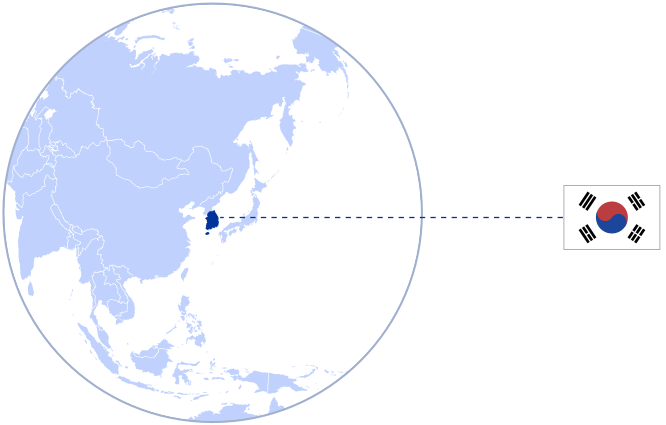
The Republic of Korea is the 13th-largest economy in the world, with a population of over 51 million people.
The country has achieved one of the most spectacular development transformations in modern history, becoming a high-income, innovation-driven economy. Between 1980 and 2024, real GDP grew by an average of 5.6% annually. The Republic of Korea spends 4.9% of its GDP on R&D, compared to 2.3% in the EU.
The country's industrial strengths include high-tech and R&D-intensive products such as semiconductors, pharmaceuticals, biotechnology and consumer electronics, as well as the shipbuilding and automotive sectors, including EV batteries (batteries for electric vehicles).
Trade in goods (2025)
Trade in goods between the EU and the Republic of Korea was worth over €124 billion in 2025. The EU was the Republic of Korea's third-largest trade partner, responsible for 10% of its trade. The Republic of Korea was the EU's eighth-largest trade partner.

€69.7 billion worth of imports to the EU


€54.5 billion worth of exports from the EU
Top goods traded between the EU and the Republic of Korea

machinery and transport equipment

chemicals and related products

miscellaneous manufactured items
Trade in services (2024)
In 2024 (the last year with data available), trade in services between the EU and the Republic of Korea was worth almost €33 billion.
€12.2 billion worth of imports to the EU

€20.8 billion worth of exports from the EU
Top services traded between the EU and the Republic of Korea

transport

telecommunications, computer and information services

R&D, professional and management consultancy services

maintenance and repair services (for the EU's imports)
EU-Republic of Korea free trade agreement
The EU-Republic of Korea free trade agreement (FTA) began to apply provisionally in July 2011 and was formally ratified in December 2015.
Since the FTA entered into force, bilateral trade and investment have expanded remarkably. On average, trade in goods has grown 5.3% per year between 2011 and 2025.
Key benefits of the agreement include:
- no tariffs on imports of industrial and agricultural goods from the EU
- easier access for EU companies to the Republic of Korea's services market
- more opportunities for EU companies to tender for government contracts issued by the Republic of Korea
- better protection of intellectual property rights and for food and drinks covered by a geographical indication
EU–Republic of Korea digital trade agreement
To complement this free trade agreement, since 2022 the EU and the Republic of Korea have been working on closer ties in digital trade. In March 2025, the two sides concluded negotiations on a digital trade agreement.
The aim of the deal is to further boost digital trade in services and goods by increasing legal certainty for both businesses and consumers. It creates common rules for areas such as data flows, electronic contracts, digital signatures, consumer protection and online trade.
Foreign direct investment
The EU is the largest foreign direct investor in the Republic of Korea, with the cumulative value of EU foreign direct investment (FDI) stocks in the Republic of Korea standing at €53 billion in 2024. The cumulative value of the Republic of Korea's FDI stocks in the EU was €41.8 billion. The Republic of Korea's investments are particularly concentrated in Germany, Hungary and Poland.
Data sources
The data used on this page was extracted in May 2026 and comes from the following Eurostat datasets:
See also

EU trade legislation

EU trade agreements

EU trade negotiations
Last review: 12 June 2026