- EU Council bibliography
- 2020 m. kovo 5 d.
'Decentring European Governance' edited by Mark Bevir and Ryan Phillips
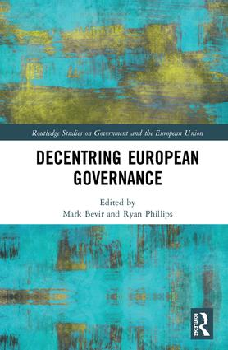
Decentring European Governance advocates the adoption of a decentred approach for studying European governance. Decentred theory looks at public policies 'as constructions of actors inspired by beliefs rooted in different traditions' and explains changes in public policies ‘by focusing on actors' own interpretations of their actions and practices and by locating these interpretations in historical contexts’. In other words, decentred theory focuses on meanings in actions rather than institutions. It suggests that policies arise as the result of diverse practices being generated, sustained and transformed by conflicting beliefs, competing traditions and varied dilemmas.
In adopting a decentred approach to the study of European governance, the authors of this volume cover a wide range of European policies - including consensus-seeking in the Council of the EU, agricultural cooperation, cultural policy, the Open Method of Coordination, higher education policy, recent Eurozone reforms, policymaking by the Commission, and security governance - and investigate them by providing historical explanations and focusing on meanings behind actions.
With specific regard to the ‘tradition of consensus’ in the Council of the EU, Chapter 8 assesses the Council's culture through the lens of a decentred approach. The author, Jeffrey Lewis, defines the Council as a ‘meta-network of ministers, civil servants and experts organized by policy sector and designed to represent national interests in the process of negotiating and adopting EU laws’. The central claim is that the institution has ‘an autonomous culture at the transnational level that over time is internalized and reproduced as an inherited tradition with its own rules, norms and operating procedures’. In terms of consensus-seeking mechanisms in the Council, the author addresses two key aspects. Firstly, he points out that consensus culture is not uniform as there is a wide diversity of governance practices that vary depending on the institutional setting - i.e. at the ministerial, preparatory and expert levels. Secondly, the author observes that consensus is neither fixed nor immutable. Ultimately, the chapter aims to highlight how, in line with decentred theory, the Council's organisational culture ‘is the contingent result of situated agents who are acting on beliefs and values that are drawn from inherited traditions’.
In the context of the numerous European policies looked at in the volume, decentred theory highlights meanings and topics rooted in different traditions - namely narratives, rationalities, and resistance.
- Narratives include stories that explain practices and events, justify recommendations, identify solutions and obstacles, and operate as a way to measure why certain actions are more or less successful. For example, Chapter 9 shows ‘how the narrative of human security led EU officials to push for changes in how policymaking occurred with respect to the regulation of landmines and small arms and light weapons’, illustrating how different narratives can influence new policies and new policymaking.
- Rationalities, on the other hand, refer to ‘social scientific beliefs and associated technologies that govern conduct’. They cover the processes by which governments and other social actors draw on knowledge to construct policies, actions and practices. Chapter 7 looks at how EU leaders and officials have acted in order to strengthen 'economic governance', drawing on a range of principles and beliefs about the role of governments in regulating markets. In other words, the authors demonstrate how social science beliefs have influenced European governance.
- When talking about resistance, social scientists observe how ‘subordinate actors can resist the intentions and policies of elites by consuming them in ways that draw on their local traditions and their local reasoning’. Chapters 4 and 9 provide examples of resistance and struggles against the agendas of the elite - for instance, in the context of security and development, and in democratisation of policymaking.
By analyzing these three sets of elements in the context of EU policymaking, the volume successfully demonstrates how useful it is to apply a decentred approach to the study of contemporary European governance. It does so by offering historical explanations of policies, and analyzing the narratives of ruling elites and the ways in which these actors have interpreted and forged policies.
Council Library users can borrow the book via Eureka.
About the editors:
The volume is edited by Mark Bevir, professor in the Department of Political Science and Director of the Center for British Studies at the University of California, and Ryan Phillips, assistant professor of Political Science at Lycoming College.
This book review does not necessarily represent the positions, policies, or opinions of the Council of the European Union or the European Council.
- The Council library is located in the Justus Lipsius building, at JL 02 GH, Rue de la Loi/Wetstraat 175, 1048 Brussels (Froissart entrance) – opening hours Monday to Friday 10.00 – 16.00.
- It is open to all staff of the Council of the European Union and the European Council, trainees, permanent representations of member states, staff of other EU institutions and bodies, and researchers and students upon request. Access to some library holdings may be restricted to on-site consultation.