- Think tank review
- 20. maj 2026
Think Tank Review 141 - May 2026
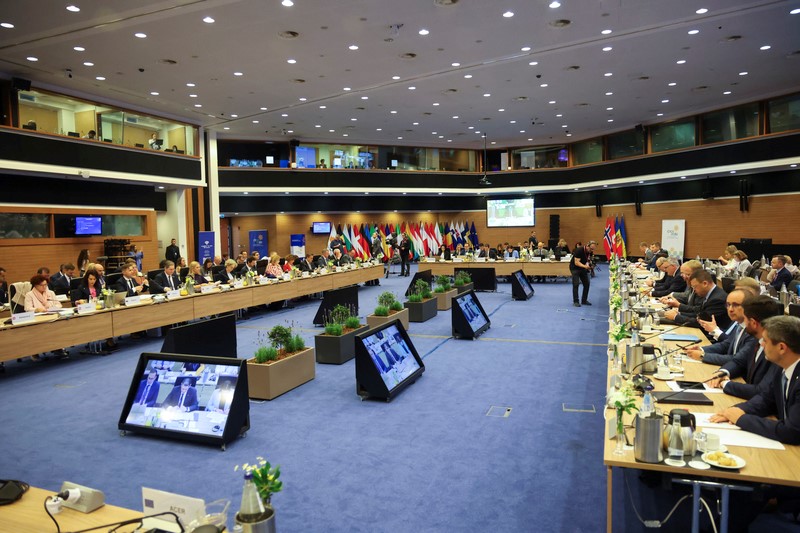
EU politics and institutions
A broad analysis is given of the Hungarian elections and the victory of the centre-right Tisza party, with reports underlining the desire for change on the part of a large proportion of the Hungarian population; in particular, young people -weary of Viktor Orbán's posturing and rhetoric, the corruption issues and Orbán's unsuccessful attempts to overcome the economic crisis - overwhelmingly chose to change the country's leadership in the hope that the economy will improve and the country will emerge from its isolation. Papers point out that proof of this lies in the very high voter turnout (78.99%), the highest since the 2002 parliamentary elections (70.5%). They also speculate about Péter Magyar's next steps and whether he will deliver on his promises for 'regime change' in Hungary: combating corruption and state capture by the Fidesz party, boosting economic growth, increasing funding for public services and social policies, improving wages and pensions and restoring the rule of law to unlock EU funds. As regards Ukraine's accession to the EU, articles note that this is unfolding against a backdrop of mounting geopolitical tensions, primarily Russia's war against Ukraine and the escalation of conflict in the Middle East. The uncertainty surrounding peace negotiations is seen as a threat, as is the unpredictability of Washington's policy and shifts in US geopolitical priorities.
Hertie School - Jacques Delors Centre
Brussels Institute for Geopolitics
Hungary steps out of Orbán’s shadow
Fondation Robert Schuman
European Policy Centre
Hungary after Orbán? The case for phased rule-of-law conditionality
Centre for European Reform
What Orbán's departure means for Hungary and for Europe
Institut Montaigne
Hongrie, Pologne, Italie: les nationaux populistes à l'épreuve du pouvoir
Stiftung Wissenschaft und Politik (German Institute for International and Security Affairs)
The Geopolitics and Security Studies Center
Центр Разумкова (Razumkov Center) / Hanns Seidel Stiftung
Ukraine’s path to the EU: current state, challenges, prospects
Stiftung Wissenschaft und Politik (German Institute for International and Security Affairs)
The rule of law in Ukraine: more than combating corruption
European Policy Centre
Unlocking Bosnia and Herzegovina’s EU accession path
Centrum Analiz Społeczno-Ekonomicznych (Center for Social and Economic Research)
The territorial dimension of the reform and growth facility for the Western Balkans
Ośrodek Studiów Wschodnich (Centre for Eastern Studies)
The president’s new clothes: Bulgaria ahead of parliamentary elections
Hertie School - Jacques Delors Centre
Raising the cost of rule of law breaches: rule of law conditionality in the next EU budget
EU policies
An extensive assessment is made of the financing of the EU budget based on the five Commission proposals for new own resources: papers endorse - subject to with adaptations - the four 'own resources' proposals based on the emissions trading system, carbon border adjustment mechanism revenue, the tobacco excise duty and uncollected electrical and electronic equipment waste. Their primary justification lies in supporting EU-wide objectives. Studies explain why Europe needs securitisation, as securitisation can strengthen the EU's financial system by expanding lending, supporting the green and digital transitions and improving financing resilience, particularly in periods of stress. Leaving coal behind by proposing international carbon credits could contribute to the EU's 2040 climate target. Papers note that the emerging role of international carbon credits raises important policy choices. Taking a strategic approach to international carbon credits could help align the EU's own climate ambitions and broader economic and geopolitical interests while supporting the overall global clean transition. At a time when decarbonisation is increasingly linked to energy security and affordability, industrial competitiveness and geopolitical priorities, reports explore how to make the EU's climate and energy policy fit for the 2030s. Countering foreign information manipulation in the Baltic Sea region is examined, and in particular how the Russian Federation and other actors use propaganda and disinformation as part of a broader strategy of influence. Articles describe the benefits and costs of website-blocking legislation; they suggest that piracy is a complex phenomenon that cannot be solved solely by technical measures such as blocking. They also explore how Europe can power the AI revolution and remain competitive; by using all available technologies and cutting energy costs, Europe could secure affordable electricity for AI, strengthen energy security and maintain its economic and geopolitical influence. Publications discuss how Europe should respond to the Iran gas shock: while the EU's gas supply is not in immediate danger, if the conflict persists ? and given the EU's dependence on gas imports ? its energy import bill may be heavily impacted.
Agriculture and Fisheries
European Centre for Development Policy Management
Are EU agri-food policies Paris-compatible?
Competitiveness (Internal Market, Industry, Research and Space)
Institut der deutschen Wirtschaft (German Economic Institute)
Making transformation risks measureable
Brussels Institute for Geopolitics
EU merger control in an age of geopolitics
Ελληνικό Ίδρυμα Ευρωπαϊκής και Εξωτερικής Πολιτικής (Hellenic Foundation for European Foreign Policy)
The EU’s strategic dependence on critical raw materials
Nederlands Instituut voor Internationale Betrekkingen - Clingendael (Netherlands Institute of International Relations)
Why European industry needs carbon diplomacy in the age of CBAM
Economic and Financial Affairs
Bruegel
Financing the EU budget: an assessment of five proposals for new resources
Centre for European Policy Studies
More credit, better risk sharing: why Europe needs securitisation
Fundación de Estudios de Economía Aplicada
Evaluación de las respuestas fiscales europeas al bloqueo del Estrecho de Ormuz
Bruegel
The growing impact of political risk on financial markets
Leibniz Institute for Financial Research SAFE
Public discourse on retail payments and the case of CBDC
Institut der deutschen Wirtschaft (German Economic Institute )
Ökonomische Folgen autoritären Regierens am Beispiel Ungarn
Centrum Analiz Społeczno-Ekonomicznych (Center for Social and Economic Research)
Wealth taxation, including net wealth, capital and exit taxes
Bruegel
Risks for Europe of US dominance of global asset management
Education / Youth / Culture / Sport
Ελληνικό Ίδρυμα Ευρωπαϊκής και Εξωτερικής Πολιτικής (Hellenic Foundation for European Foreign Policy)
Sport, heritage and cultural diplomacy: the heyday road experience in Sparta
Center for European Policy Analysis
Mapping the spread of child safety rules
Employment / Social Policy / Health and Consumer Affairs
Atlantic Council
Navigating the European Union’s AI and health data framework
Svenska institutet för europapolitiska studier (Swedish Institute for European Policy Studies)
Does gender equality fuel regional growth in the European Union?
Centre for European Policy Studies
How to integrate social and climate objectives into the EU’s housing policy
Environmental Issues
Centre for European Policy Studies
Leaving coal behind: international carbon credits under the EU’s 2040 climate target
Ecologic Institute
Challenges for assessing and implementing nature-based solutions at landscape-scale
E3G
Making the EU’s climate and energy policy fit for the 2030s
E3G
Securing Europe against climate risks: the case for EU action
Institut für Weltwirtschaft Kiel (Kiel Institute for the World Economy)
Carbon leakage due to EU climate policy? An overview
Justice and Home Affairs
The Geopolitics and Security Studies Center
Countering foreign information manipulation in the Baltic sea region: patterns, responses and gaps
Centre for European Policy Studies
The benefits and costs of website-blocking legislation: an economic, legal and policy assessment
Forum for research on Eastern Europe and Emerging Economies (FREE Network)
Post-2020 Belarusian permanent migration to the EU and beyond: an empirical assessment
Transport / Telecommunications / Energy
European Council on Foreign Relations
Fast energy: how Europe can power the AI revolution and stay competitive
Institute for Public Policy Research
European Centre for Development Policy Management
Building a European industrial offer on digital connectivity
European Centre for Development Policy Management
Sovereignty in European international digital policy
Rahvusvaheline Kaitseuuringute Keskus (International Centre for Defence and Security)
The ties that bind: energy connectivity in the age of geopolitical turbulence
Bertelsmann Stiftung
Digitale Räume sicher gestalten: Schutz ohne Ausschluss
Zentrum für Europäische Wirtschaftsforschung (Centre for European Economic Research)
Unleashing productivity growth in the age of digitalisation: evidence from German SMEs
Ulkopoliittinen instituutti (Finnish Institute of International Affairs)
Ecologic Institute
European energy security or acquiescence?
European Policy Centre
Preparedness can’t wait: AI pushes cybersecurity into a new era
İstanbul Politikalar Merkezi (Istanbul Policy Center)
The EU’s energy diversification framework: can the role of the southern gas corridor expand?
Economic and Social Research Institute
A descriptive comparison of Irish and European electricity prices: 2018–2024
Bruegel
How Europe should respond to the Iran gas shock – and how it shouldn’t
Център за изследване на демокрацията (Center for the Study of Democracy)
The last stronghold: Hungary can complete Europe’s energy decoupling from Russia
Institut français des relations internationales
L'Allemagne maintient sa zone de prix unique dans l'électricité: implications
Forum for research on Eastern Europe and Emerging Economies (FREE Network)
Critical minerals and the new geopolitics of the green transition: insights from energy talk 2026
Foreign and security policy / Defence
Debating the way in which the Global Gateway can redefine the EU's external profile, papers note that it marks a significant shift in Europe's approach to development, economic policy and geopolitics, with a particular focus on its relations with Africa. They see it as a promising but complex trend that balances the promotion of European interests against outreach to foreign partners. Papers ask why and how Europeans must prepare for US retrenchment, arguing that restraintist forces will continue to influence US foreign policy. Europe therefore urgently needs to establish an autonomous security architecture. Transatlantic cooperation on AI and national security are analysed, as the links between AI and national security constitute a key test of the transatlantic relationship. Europe's place in the global permacrisis is discussed, including in relation to President Trump's threats to weaken or abandon NATO and the risk of any chaos that could lead to reduced global prosperity, sustainability and security, thereby making the world a much more dangerous place for future generations. Papers propose constructing a new global architecture in which Europe can play a decisive role. The success of European trade policy is discussed in the light of three recent cases - Mercosur, India, and Australia - which are not only successful trade negotiations but also demonstrate the Union's capacity to act politically when it possesses clear competencies. Articles ask what comes next for the multilateral trade order following the failure of the World Trade Organization's ministerial conference in Yaoundé.
Ośrodek Studiów Wschodnich (Centre for Eastern Studies)
Gains amid mounting challenges: the consequences of the war in Iran for Russia
Istituto Affari Internazionali
Russia’s frozen assets: a litmus test for the EU
Ośrodek Studiów Wschodnich (Centre for Eastern Studies)
Konrad-Adenauer-Stiftung
Außenpolitische Fragen der Republik Zypern während der EU-Ratspräsidentschaft
Deutsches Institut für Entwicklungspolitik (German Development Institute)
Back to the future: the pact for the Mediterranean and the mirage of Euro-Mediterranean integration
European Council on Foreign Relations
The full monty: why the Mediterranean pact needs to offer the works
Trans European Policy Studies Association
How can the Global Gateway redefine the EU’s external profile?
Nederlands Instituut voor Internationale Betrekkingen - Clingendael (Netherlands Institute of International Relations)
Indonesia’s parallel engagement with BRICS, the OECD and the EU
Atlantic Council
The shadow fleet is undermining the maritime order more brazenly than ever
Ulkopoliittinen instituutti (Finnish Institute of International Affairs) et al.
The circles of security: the role of the NB8 in (Northern) European security
Deutsche Gesellschaft für Auswärtige Politik (German Council on Foreign Relations)
Why and how Europeans must prepare for US retrenchment
Stiftung Wissenschaft und Politik (German Institute for International and Security Affairs)
Real Instituto Elcano (Elcano Royal Institute)
Atlantic Council
Transatlantic cooperation on AI and national security
Atlantic Council
Fusion on paper or in practice? Making the cloud work for ISR and NATO
Ulkopoliittinen instituutti (Finnish Institute of International Affairs)
Theatre nuclear weapons in NATO’s deterrence: towards the revival of flexible response
Magyar Külügyi Intézet
Deepening European and Latin American security cooperation
Institute for National Security Studies
Watching from the sidelines and still affected: Europe and the war in Iran
European Centre for Development Policy Management
Strategic choices to connect peace, defence and deterrence
Brussels Institute for Geopolitics
Intergovernmental cooperation in defence
European Policy Centre
Could defence cooperation generate a spillover effect for Türkiye–EU relations?
European Policy Centre
Europe’s place in the global permacrisis
Ελληνικό Ίδρυμα Ευρωπαϊκής και Εξωτερικής Πολιτικής (Hellenic Foundation for European Foreign Policy)
Implications of the Iran crisis for Greece’s defence policy
Center for European Policy Analysis
Transatlantic action: sanctioning third-country enablers of Russia’s war economy
Wilfried Martens Centre for European Studies
Responding to crises in Europe
Център за изследване на демокрацията (Center for the Study of Democracy)
From Arctic exceptionalism to strategic confrontation
Brussels School of Governance - Centre for Security, Diplomacy and Strategy
Intergovernmental cooperation in defence
European Policy Centre
Could defence cooperation generate a spillover effect for Türkiye–EU relations?
Nederlands Instituut voor Internationale Betrekkingen - Clingendael (Netherlands Institute of International Relations) et al.
Catching up: Europe’s path to strategic autonomy in the defence industry
Institut français des relations internationales
Finlande, l'allié venu du froid
The German Marshall Fund of the United States
Reforms first, candidacy later
European Policy Institute in Kyiv
The day after: six post-war challenges for Ukraine
Egmont – Royal Institute for International Relations
From deal to rules: an EU offer for TRIPP and middle corridor governance
Fondation Robert Schuman
Quel avenir pour la relation euro-insulaire?
Deutsches Institut für Entwicklungspolitik (German Development Institute)
Zusammen ist man weniger allein: mit Team Europe 2.0 die europäische Entwicklungspolitik stärken
Migration Policy Institute
From exile to return: rebuilding lives and states after conflict
Bruegel
The European Union’s external imbalances: past, future and policy
LUISS School of European Political Economy
European trade policy: the Union’s change of pace
European Policy Centre
After the breakthrough: charting the future of EU–India relations
Centre for European Reform
WTO reform after Yaoundé: what next for the multilateral trade order?
Institut Montaigne
Relations UE-Taiwan et semi-conducteurs: bâtir une confiance durable
Centre for European Reform
One year llberation day: the delusion of transatlantic economic divorce
Dansk Institut for Internationale Studier (Danish Institute of International Studies)
Global affairs
The questions as to what the ceasefire means for Iran, President Trump, the Strait of Hormuz and the UK, and how the world should respond to challenges to the humanitarian legal order, as well as the strategic outcome during the ceasefire, and whether a Hormuz toll could solve the oil crisis and who would pay such a toll are commented on. With regard to the US on the global stage, papers argue that the Iran war shows the limits of US power, and that if Washington cannot adapt to the ongoing transformations of a multipolar world, then its superiority will become a liability. Articles look at US-China interaction on trade affairs, arguing that the trade war has created new power dynamics around a supply chain race that centres on leveraging chokepoints in critical minerals and advanced technologies.
The German Marshall Fund of the United States
Chatham House - The Royal Institute of International Affairs
US–Iran ceasefire: what it means for Trump, Tehran, Israel and US allies
Chatham House - The Royal Institute of International Affairs
The Strait of Hormuz, shipping, and law
Chatham House - The Royal Institute of International Affairs
How a surge in defence and dual-use technology investment could reconfigure the global AI race
Carnegie Europe
Rewiring the South Caucasus: TRIPP and the new geopolitics of connectivity
Κυπριακό Κέντρο Ευρωπαϊκών και Διεθνών Υποθέσεων (Cyprus Center for European and International Affairs)
15 χρόνια μετά την καταστροφή στη Φουκουσίμα: τι μάθαμε και πού πάμε;
Peterson Institute for International Economics
US-China cooperative interdependence: opportunities and obstacles
Carnegie Endowment for International Peace
The Iran war shows the limits of U.S. power
Carnegie Endowment for International Peace
Amid Iran war, Gulf countries slow the pace of reforms
Rahvusvaheline Kaitseuuringute Keskus (International Centre for Defence and Security)
Asia’s fallout from Russia’s war against Ukraine: North Korea’s rise in the Russia–China balance
Barcelona Centre for International Affairs
Raíces regionales, contribuciones globales: la voz de América Latina en la IA
National Bureau of Asian Research
A new era of U.S.-China interaction: from competing to racing
Forum for research on Eastern Europe and Emerging Economies (FREE Network)
Breaking free of Russia's energy grip: how much will it cost Belarus?
Council on Foreign Relations
The U.S.-China trade relationship: what’s behind the competition?
Bruegel
Could a Hormuz toll solve the oil crisis and who pays?
Nederlands Instituut voor Internationale Betrekkingen - Clingendael (Netherlands Institute of International Relations)
America and Israel against Iran: strategic results during the ceasefire
Nederlands Instituut voor Internationale Betrekkingen - Clingendael (Netherlands Institute of International Relations)
The Saudi economy amidst war, competition and reassessment
Institut français des relations internationales
Trump contre la gouvernance numérique: une croisade aux Etats-Unis et en Europe
Institut français des relations internationales
Vers une nouvelle politique étrangère démocrate ? Enjeux et recompositions pour 2028
Institut de relations internationales et stratégiques
Forces, faiblesses et ambiguités du système économique des Emitats arabes unis
Institut de relations internationales et stratégiques
International Crisis Group
Rising stakes, upgrading forces: Seoul in the new Asian order
This post does not necessarily represent the positions, policies, or opinions of the Council of the European Union or the European Council.
The Council Library reading room is open on Monday to Friday from 12.30 to 15.30. The Info Desk operates during office hours from Monday to Friday.
If you are a researcher or university student, you are welcome to visit our reading room for on-site consultation of our collections.