We use cookies to improve your browsing experience. Necessary cookies are required to support essential features of the Council's website. Optional cookies help us produce anonymous and aggregated statistical reports to better serve your needs.
With your permission, we will use cookies to produce aggregated, anonymous data about our visitors' browsing and behaviour on our website. We will use this data to improve your experience on our website.
Video conference of economic and finance ministers, 16 April 2020
Main results
Economic impact of the COVID-19 crisis and policy response
Ministers discussed the latest assessment of the economic impact of the COVID-19 pandemic and the policy response.
The recovery of the European economy poses a major challenge. We will act together in solidarity and deliver solutions which will together enable us to make the progress needed to strengthen the European Union.
Zdravko Maric, deputy Prime Minister and Minister of Finance of Croatia
On 9 April, the Eurogroup put forward a package of measures to tackle the COVID-19 crisis. The package is composed of three immediate safety nets for workers, businesses and member states worth about €500 billion. It also prepares the ground for a recovery fund to relaunch the economy and ensure solidarity with those member states most affected.
Ministers called for the speedy implementation of the emergency measures, in line with the principles agreed by the Eurogroup. The Croatian presidency undertook in particular to proceed quickly with negotiations on the Commission's proposal for a temporary instrument to mitigate unemployment risks in an emergency (SURE).
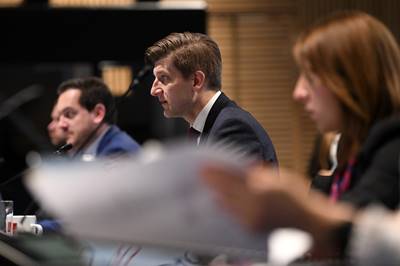
EU ministers discuss economic impact of COVID-19 and policy response.
Bank lending for households and corporates
The flow of bank loans to households and corporates, including small and medium-sized enterprises, is one of the most significant ways for the EU to tackle the socio-economic consequences of the COVID-19 outbreak.
Ministers endorsed a statement in which they support the flexible application of EU rules in the banking sector, and invite banks to refrain from distribution of dividends.
Ministers agreed on the simplification of information requirements for this year's cycle of the European Semester.
Given the high degree of uncertainty as a result of the socio-economic fallout of the COVID-19 pandemic, the Commission has put forward a simplified process for this year's European Semester exercise. This is intended to preserve the European Semester's main milestones, while taking into account the challenging times member states are facing. In particular, there would be a streamlined approach for the submission of national reform and stability or convergence programmes (NRPs and SCPs) by member states. The Commission expects to present its Spring forecast, as well as draft country-specific recommendations in early May 2020.
The Croatian presidency and the Commission debriefed ministers on the international Spring meetings, including G7 and G20 meetings of finance ministers as well as the International Monetary and Financial Committee which took place via video conference in the week of 13 April 2020.
 The recovery of the European economy poses a major challenge. We will act together in solidarity and deliver solutions which will together enable us to make the progress needed to strengthen the European Union.