EU-CELAC relations: facts and figures
Relations between the European Union and the Latin American and Caribbean States (LAC) focus on enhancing political cooperation as well as boosting trade and investment.
About CELAC
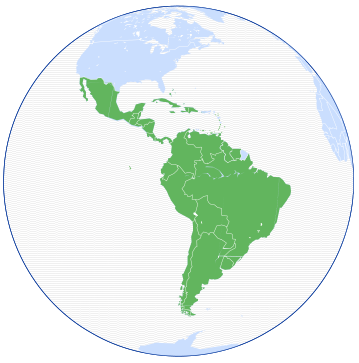
CELAC (Community of Latin American and Caribbean States) is an intergovernmental mechanism for dialogue and political agreement. It brings together 33 countries with a combined population of around 650 million people in a permanent structure.
The EU has association, trade or political and cooperation agreements with 30 of the 33 LAC countries.
Together, the European Union and the Latin American and Caribbean States represent 14% of the world’s population and 21% of global GDP. They make up more than a third of UN membership and are a force for a strong rules-based multilateral system.
EU-LAC Global Gateway Investment Agenda
Launched in 2021, the EU–LAC Global Gateway Investment Agenda (GGIA) is a roadmap for strategic investments to meet Latin America and the Caribbean’s infrastructure needs, foster local value creation, and promote sustainable growth, jobs, and social cohesion. It reflects a joint commitment to advance fair, green, digital, and infrastructure investments across the region.
The investments are grouped under four pillars:

a fair green transition

an inclusive digital transformation

human development

health resilience and vaccines
The initiative brings together the EU, its member states, financing institutions such as the European Investment Bank and export credit agencies, who work together in partnerships with the private sector.
There are over 100 projects within the GGIA. The European Union and its member states have committed around €45 billion until 2027 towards that goal.
Trade and investment relations
Trade in goods
In 2024 the EU’s trade in goods with CELAC was worth over €290 billion, with 138.6 billion in imports and 153 billion in exports.
In the last decade, trade in goods with CELAC has grown by over 52%.
More than one million jobs in the EU are linked to exports to Latin American and Caribbean States.

€138.6 billion worth of imports from CELAC countries


€153 billion worth of exports to CELAC countries
Trade in services
In 2023 (the last year with available data) EU-CELAC trade in services was worth over €124 billion – over €77 billion in exports and almost €47 billion in imports.
Between 2013 and 2023, trade in services between the EU and CELAC almost doubled (+92.7%)
€46.9 billion worth of imports from CELAC countries

€77.4 billion worth of exports to CELAC countries
Foreign direct investment
The EU is the leading investor in the Latin American and Caribbean region, with foreign direct investment (FDI) stocks at over €810 billion This is comparable to EU investments in China, Canada, Japan and Singapore combined.
European investments are concentrated in strategic sectors such as renewable energy and telecommunications.
EU investments support 2.75 million jobs in the LAC region.
Cooperation on security and justice
At the third EU-CELAC Summit in 2023, leaders pledged to cooperate more on issues like organised crime, corruption and money laundering. The cooperation is happening through a number of tailored actions. Cooperation with EU agencies like Europol, Eurojust or the EU Drugs Agency plays an important role. The EU supports also AMERIPOL, the Police Community of the Americas, and works hand in hand with the Latin American Committee for Internal Security (CLASI), a coalition of 16 Latin American countries against organised crime.
Programs like COPOLAD III help improve drug monitoring and public health strategies in LAC countries, while initiatives such as EUROFRONT protect vulnerable groups, such as migrants, from criminal networks.
In addition to law enforcement, the EU and LAC are strengthening judicial cooperation to close legal gaps that allow criminals to evade justice. Projects like EL PACcTO 2.0 and CRIMJUST help countries share evidence and take coordinated action against organised crime. The partnership is also preparing for future threats like cyberattacks, disinformation, and environmental crimes.
Humanitarian aid
The European Union remains the key humanitarian actor and has provided over €1 billion in humanitarian aid for Latin America and the Caribbean over the past two decades. This year alone the EU has contributed over €120 million to address the main crises in the region.
In May 2024, the EU and three intergovernmental organisations from the region, as well as three individual countries signed a memorandum of understanding on disaster risk management. The goal was to increase cooperation in this area by:
- strengthening response capacities
- strengthening prevention, preparedness, response and early recovery capacities
- exchanging knowledge, experiences and good practices.
See also


Last review: 4 November 2025