We use cookies to improve your browsing experience. Necessary cookies are required to support essential features of the Council's website. Optional cookies help us produce anonymous and aggregated statistical reports to better serve your needs.
With your permission, we will use cookies to produce aggregated, anonymous data about our visitors' browsing and behaviour on our website. We will use this data to improve your experience on our website.
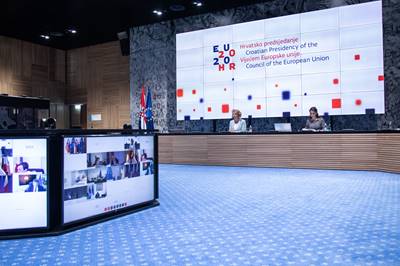
Video conference of ministers for European affairs, 16 June 2020
Main results
Preparations for the video conference of EU leaders
Ministers exchanged views on the Commission's modified proposal for the next multiannual financial framework (MFF) and the recovery plan in order to prepare for the video conference of the members of the European Council and their orientation debate on 19 June.
The discussion covered a broad range of issues, including the basic architecture of the recovery plan, needs assessment and allocation criteria, governance framework, the new Commission proposals regarding the next MFF and the proposed increase of the current MFF as a bridging solution.
Ministers outlined their positions, highlighting their main priorities for the negotiations and overall approach. There was a shared readiness to address the consequences of the COVID-19 crisis using the EU budget, while different views were expressed on the detailed proposals of the Commission, including the size and timeframe of the recovery instrument, allocation criteria, and the issue of loans and grants.
Several speakers pointed out that they saw the MFF and the recovery plan as a package. Many ministers stressed the importance of reaching an agreement as soon as possible.
Ministers also discussed EU-UK relations. They were briefed by Michel Barnier on the state of negotiations and on the implementation of the withdrawal agreement.
Ministers took note of the information and reaffirmed their unanimous support and confidence in the EU Chief Negotiator. They stressed the importance of the full implementation of the withdrawal agreement by both sides.
On 16 June 2020, EU and UK leaders met via video conference to discuss mutual relations. They agreed to intensify the negotiations on the future partnership, with a view to concluding and ratifying a deal by the end of 2020. Negotiating rounds will take place in July, August and in September.
The incoming Council presidency trio (Germany, Portugal and Slovenia) presented to the ministers the 18-month programme of the Council, running from 1 July 2020 to 31 December 2021.
The content of the programme is influenced by the commitment to address the COVID-19 crisis and recovery. It is built around the main priorities outlined in the strategic agenda for 2019-2024 agreed by the EU leaders last year:
protecting citizens and freedoms
developing a strong and vibrant economic base
building a climate-neutral, green, fair and social Europe
promoting European interests and values on the global stage
The programme also highlights the importance of reaching agreement on the next MFF and the related sectoral programmes as soon as possible, and striving for a comprehensive partnership with the UK by the end of 2020.
The 18-month programme is expected to be endorsed by the Council after the video conference by written procedure.
At the end of the video conference the Croatian presidency issued a press release.
It has been an honour and a privilege to preside over the General Affairs Council during the time of an unprecedented crisis for the EU. We must move forward together as a team and come up with a robust response to reach a quick economic and social recovery. Yet I have no doubt that we are, as our Presidency slogan says ‘a strong Europe in a world of challenges’, and that we will overcome this challenge, recover and develop further for the benefit of the EU, its member states and their citizens.
Andreja Metelko-Zgombić, Croatian State Secretary for European Affairs
 It has been an honour and a privilege to preside over the General Affairs Council during the time of an unprecedented crisis for the EU. We must move forward together as a team and come up with a robust response to reach a quick economic and social recovery. Yet I have no doubt that we are, as our Presidency slogan says ‘a strong Europe in a world of challenges’, and that we will overcome this challenge, recover and develop further for the benefit of the EU, its member states and their citizens.