We use cookies to improve your browsing experience. Necessary cookies are required to support essential features of the Council's website. Optional cookies help us produce anonymous and aggregated statistical reports to better serve your needs.
With your permission, we will use cookies to produce aggregated, anonymous data about our visitors' browsing and behaviour on our website. We will use this data to improve your experience on our website.
The Council meeting started by commemorating the fourth dark anniversary of Russia’s full-scale invasion and war of aggression against Ukraine, with a symbolic one minute of silence.
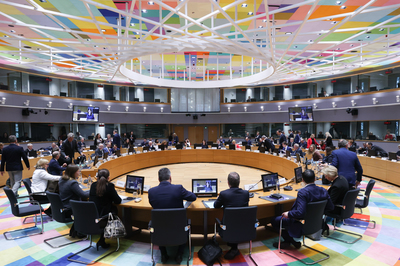
Ministers responsible for European affairs started preparations for the March European Council meeting by discussing an annotated draft agenda, and held an exchange of views to mark the launch of the European Centre for Democratic Resilience.
Following the leaders’ informal retreat, we are stepping up our work to advance the EU’s competitiveness and deepen our single market. The Cyprus presidency will take the work forward and remains focused on the goal for a stronger, more autonomous Europe which is open to the world.
Marilena Raouna, Deputy Minister for European affairs of the Republic of Cyprus
EUCO preparation
The Council started preparations for the March European Council meeting by discussing an annotated draft agenda. Leaders are expected to discuss:
Russia’s war of aggression against Ukraine
latest developments in the Middle East
competitiveness and the single market
the next Multiannual Financial Framework (MFF) 2028-2034
Over an informal lunch, ministers held an exchange of views to mark the launch of the European Centre for Democratic Resilience, as part of the European Democracy Shield, which was presented by the Commission on 12 November 2025.
Ministers discussed priority areas in 2026 for the European Centre for Democratic Resilience, which is conceived as a hub for cooperation among member states, with the support of EU institutions and bodies, by sharing of expertise and experience in the development of effective responses to threats to democracies and in strengthening democratic resilience.
The Austrian and Hungarian delegations highlighted the importance of strengthening European cooperation against non-violent extremism, foreign influence and online radicalisation.
The French delegation raised the Council’s attention to the upcoming Commission’s legislative initiative on the 28th regime in EU company law.
Finally, the Council adopted without discussion:
the directive simplifying corporate sustainability reporting and due diligence requirements (Omnibus I)
a decision authorising the signature of a broad package of agreements with Switzerland
a regulation implementing enhanced cooperation on the establishment of the Ukraine Support Loan for 2026 and 2027