We use cookies to improve your browsing experience. Necessary cookies are required to support essential features of the Council's website. Optional cookies help us produce anonymous and aggregated statistical reports to better serve your needs.
With your permission, we will use cookies to produce aggregated, anonymous data about our visitors' browsing and behaviour on our website. We will use this data to improve your experience on our website.
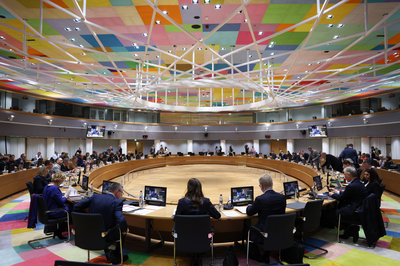
Ministers responsible for European affairs started preparations for the December 2025 European Council by discussing its annotated draft agenda. The Council discussed the new Multiannual Financial Framework (MFF) 2028-2034 and took note of the state of play of EU-UK relations. The Commission presented its work programme for 2026, and ministers held an exchange of views. In the context of the annual rule of law dialogue, the Council held country-specific discussions on the rule of law situation in Bulgaria, Czechia, Ireland and Germany.
The next multiannual financial framework must be simpler, more flexible and more effective if we want to ensure a stronger and more competitive Europe. Today’s discussion in the General Affairs Council marked a key step to address specific national and regional challenges in the next MFF. I am encouraged by our constructive dialogue and looking forward to continuing our debate in the next General Affairs Council in December.
Marie Bjerre, Minister for European affairs of Denmark
December European Council preparation
The Council started preparations for the European Council meeting of December 2025 by discussing an annotated draft agenda. Leaders are expected to discuss:
The Council held a third policy debate on the EU’s MFF for 2028-2034.
Based on a presidency note, ministers exchanged views on issues related to the proposed ‘Heading 1’ of the framework which aims, through a dedicated fund, to support economic, social and territorial cohesion, agriculture, rural and maritime, prosperity and security in the EU. Financing would be underpinned by national and regional partnership plans (NRPPs) prepared by member states themselves, taking into account their specific national and regional challenges.
Among other angles, ministers discussed how regional and local administrations can be appropriately involved in the preparation and implementation of the future NRPPs and how support for policies stemming from Treaty obligations can be given greater visibility under the Plans while preserving the overall ambition of simplification and agility in financing.
The debate will inform the first negotiating box, the document which aims to identify elements for political consideration and facilitate their discussion by EU leaders. The Danish presidency intends to table this first negotiating box without numbers ahead of the December 2025 meeting of the European Council.
The Council took note of the state of play of EU-UK relations. At the 19 May summit, leaders of the EU and the UK committed to a renewed agenda for strengthening cooperation in several areas.
Today, the Commission updated the Council on the implementation of the existing agreements and post-summit developments. Ministers welcomed that negotiations on a common sanitary and phytosanitary area (SPS agreement), as well as on an agreement to link the EU-UK greenhouse emissions trading systems (ETS linking agreement) can now start. In the ensuing exchange of views, many ministers underlined that, as a matter of principle for the EU, relations can only be strengthened based on a full, faithful and timely implementation of existing agreements: the Trade and Cooperation Agreement and the Withdrawal Agreement.
The Commission presented its work programme for 2026, and ministers held an exchange of views. This was an opportunity for the Council to identify key policy areas and legislative proposals to be included in the joint declaration on the EU legislative priorities for 2026 and highlight those proposals that should be prioritised. Ministers also expressed their views on the proposed withdrawal of legislative proposals. Following this discussion, the three institutions are set to agree on the joint declaration on EU’s legislative priorities by the end of this year.
In the context of the annual rule of law dialogue, ministers held a country-specific discussion focusing on the rule of law situation in Bulgaria, Czechia, Ireland and Germany.
This was the third round of country-specific discussion this year. For each country, the Commission first presented the main findings of the respective country-specific chapter in its 2025 rule of law report. The delegations concerned then presented key national developments and particular aspects of their national rule of law framework. This was followed by a round of comments and questions in which other delegations shared their experiences and best practices about the developments mentioned. Afterwards, the delegation whose situation was being discussed had the opportunity to present additional remarks.
The Commission informed the Council on its proposal for a ‘democracy package’, including the European Democracy Shield and the EU strategy for civil society, which was presented on 12 November 2025.
The French, German and Polish delegations informed the Council about the ‘Information Shield’ initiative jointly launched by their public international broadcasters with the aim to combat disinformation abroad.
The Lithuanian delegation informed the Council about recent hybrid attacks from Belarus.
The Hungarian delegation raised the Council’s attention on the Commission’s strategy to fight antisemitism.
The Council also adopted without discussion its position at first reading on the directive on alternative dispute resolution for consumer disputes (ADR).