We use cookies to improve your browsing experience. Necessary cookies are required to support essential features of the Council's website. Optional cookies help us produce anonymous and aggregated statistical reports to better serve your needs.
With your permission, we will use cookies to produce aggregated, anonymous data about our visitors' browsing and behaviour on our website. We will use this data to improve your experience on our website.
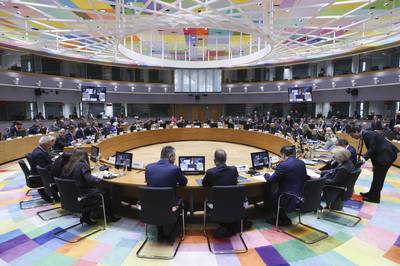
Ministers responsible for European affairs continued preparations for the March European Council meeting by discussing draft conclusions, held a policy debate on the governance aspects of the next multiannual financial framework (MFF) 2028-2034 and focused on the 2026 European Semester.
In the run-up to the European Council later this week, and against the backdrop of significant geopolitical challenges, the Cyprus presidency is stepping up its efforts to advance a more competitive Europe with a long-term EU budget that is fit for the future. We remain focused and results-oriented in working towards a stronger and more resilient Union, capable of acting autonomously while remaining open to the world.
Marilena Raouna, Deputy Minister for European affairs of the Republic of Cyprus
Preparation of the March European Council
The Council continued preparations for the March European Council meeting by discussing draft conclusions. Leaders are expected to discuss:
Russia’s war of aggression against Ukraine
latest developments in the Middle East
competitiveness and the single market
the next Multiannual Financial Framework (MFF) 2028-2034
In a public session, the Council held a policy debate on the next MFF 2028-2034 with a focus on governance aspects. The MFF is the EU’s long-term budget, covering a period of seven years.
Since the presentation of the Commission proposals in July and September 2025, work has continued within the Council at both political and technical level with a view to achieving a unanimous agreement between member states by the end of 2026. The Commission’s proposals put forward a more streamlined structure than that seen in previous frameworks, with a reduced number of headings and programmes. The proposed structure also foresees enhanced flexibility within and between MFF programmes through mechanisms such as reprogramming possibilities, financial buffers, special instruments and increased unallocated margins.
A debate on governance was therefore especially timely given that member states seem to currently agree on the need for flexibility in the next MFF, while ensuring adequate predictability for long-term investments. During the discussion, and based on a presidency steering note, ministers exchanged views on the governance arrangements pertaining to the three main funds under the next MFF – namely, the National and Regional Partnership Plans, the European competitiveness fund, and the Global Europe instrument.
Separately, ministers held an exchange of views on the next MFF with members of the European Parliament over an informal lunch in the margins of the Council.
Ministers held an exchange of views on a synthesis report on Council contributions on the 2026 European Semester and the presidency presented an updated roadmap. The Council also agreed to forward a draft recommendation on the economic policy of the euro area to the European Council for endorsement.
The French delegation raised the importance of the new own resources in the next MFF, whereas the Spanish delegation informed the Council about a pilot project on the digital age verification system.
During consecutive informal meetings over breakfast, ministers held an exchange of views on reform and integration efforts, took stock of the results achieved so far and shared reflections on the next steps with the Ukrainian Deputy Prime Minister, Taras Kachka, and the Moldovan Deputy Prime Minister, Cristina Gherasimov.
Finally, the Council agreed, without discussion, on a decision amending the European electoral act concerning the election of Members of the European Parliament by direct universal suffrage. The amendment introduces the possibility of proxy voting in plenary sessions of the European Parliament, supporting work–life balance and promoting gender equality by enabling members to fully exercise their mandates in the periods immediately before and after childbirth.