We use cookies to improve your browsing experience. Necessary cookies are required to support essential features of the Council's website. Optional cookies help us produce anonymous and aggregated statistical reports to better serve your needs.
With your permission, we will use cookies to produce aggregated, anonymous data about our visitors' browsing and behaviour on our website. We will use this data to improve your experience on our website.
Economic and Financial Affairs Council, 8 November 2022
Main results
Basel III
The Council agreed its position (general approach) on the two remaining legislative acts for the implementation of the Basel III agreement, reform measures intended to help reinforce the resilience of the EU banking sector and strengthen its supervision and risk management.
We are boosting the strength and resilience of banks operating in the Union. As we are finalising the implementation of the international Basel III reforms, it is important that we take into account the specificities of the EU banking sector and the specific situation in our member states. I am confident that the updated texts which we agreed today aim to achieve these objectives.
Zbyněk Stanjura, Minister of Finance of Czechia
The Council discussed those parts of the Eurovignette directive which concern the taxation of heavy goods vehicles for the use of road infrastructures.
We had a good discussion on how to amend current taxation rules in order to best achieve our shared objectives: encourage cleaner road transport and reduce congestion. It is important that we remove any obstacles which remain for member states to fully apply the ‘polluter pays’ and ‘user pays’ principles for trucks. While we made good progress, this issue is complex and will require further work.
Zbyněk Stanjura, Minister of Finance of Czechia
Ministers discussed the economic and financial impact of the Russian aggression against Ukraine. Since the start of the war, this is a regular agenda item for Economic and Financial Affairs Council meetings.
Ministers gave political guidance regarding the way forward on a more structural solution for the EU’s financial assistance for Ukraine in 2023. They overwhelmingly underlined the urgency of this issue and favoured a framework providing the predictability and flexibility that would allow the Commission to mobilise resources through bond issuance within agreed budgetary limits. The aim is to start the monthly disbursements to Ukraine in January 2023.
The EU will stand by Ukraine for as long as it takes, also financially. As the President of the Council, I shared with my colleagues my personal experience from my visit to Kyiv last week. My goal is to set up regular disbursements to Ukraine starting from January 2023. If we want to meet this target, we must act very fast. Today, the ministers gave political guidance to the Commission so that it can propose the required legislative package without delay. We will spare no efforts to reach agreement on these proposals at the December meeting of the Economic and Financial Affairs Council.
Zbyněk Stanjura, Minister of Finance of Czechia
Recovery and Resilience Facility
Economy and finance ministers took stock of the implementation of the Recovery and Resilience Facility (RRF).
The Council approved conclusions on EU statistics, welcoming the response of the European Statistical System (ESS) to the need for new and timelier statistics prompted by the Russian war of aggression against Ukraine, notably with respect to statistics on energy, supply chains, migration and the labour market.
The Commission informed ministers on the inflation reduction act and on the consequences of this new US legislation for the EU.
International meetings
The Presidency and the Commission informed ministers on the outcome of the G20 meeting of Finance Ministers and Central Bank Governors on 12-13 October 2022 and the IMF annual meetings.
Taxation: revised code of conduct
As an item without discussion, EU finance ministers today agreed on a revised code of conduct for business taxation: a political, intergovernmental commitment by member states to apply reinforced screening rules when looking for and remedy tax measures that could be harmful to the tax bases of other member states.
We confirmed today our commitment to a fairer tax environment in the EU by reinforcing the rules we apply when tackling harmful tax practices in an evolving economy. Our experts in taxation constantly look out for harmful tax practices. Since starting its work in 1997, the code of conduct group succeeded in eliminating around 140 harmful tax practices within the EU. The code of conduct of business taxation has not been amended since 1997 and today´s agreement further improves its effectiveness also in the light of the recent international tax reform.
Zbyněk Stanjura, Minister of Finance of Czechia
As an item without discussion, the Council today decided to fully suspend the visa waiver agreement with Vanuatu due to the risks posed by its investor citizenship schemes (‘golden passport’ schemes).
In the margins of Ecofin, a macroeconomic dialoguemeeting was held with social partners, focusing on energy prices.
At an annual dialogue between EU and EFTA ministers for finance and economy, participants exchanged views on energy prices and inflation in the context of the current geopolitical situation.
The Council also adopted without discussion the items on the lists of legislative and non-legislative A items.
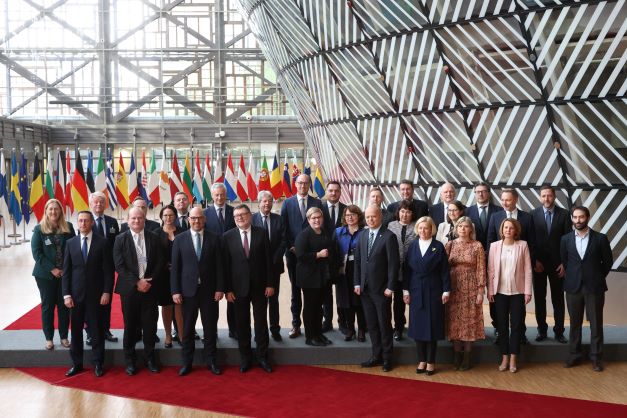
EU and EFTA ministers for finance and economy met on 8 November 2022 in Brussels
 We are boosting the strength and resilience of banks operating in the Union. As we are finalising the implementation of the international Basel III reforms, it is important that we take into account the specificities of the EU banking sector and the specific situation in our member states. I am confident that the updated texts which we agreed today aim to achieve these objectives.
 The EU will stand by Ukraine for as long as it takes, also financially. As the President of the Council, I shared with my colleagues my personal experience from my visit to Kyiv last week. My goal is to set up regular disbursements to Ukraine starting from January 2023. If we want to meet this target, we must act very fast. Today, the ministers gave political guidance to the Commission so that it can propose the required legislative package without delay. We will spare no efforts to reach agreement on these proposals at the December meeting of the Economic and Financial Affairs Council.