We use cookies to improve your browsing experience. Necessary cookies are required to support essential features of the Council's website. Optional cookies help us produce anonymous and aggregated statistical reports to better serve your needs.
With your permission, we will use cookies to produce aggregated, anonymous data about our visitors' browsing and behaviour on our website. We will use this data to improve your experience on our website.
Economic and Financial Affairs Council, 16 May 2023
Main results
Taxation
The Council agreed its position (general approach) on the ‘DAC8’ directive which concerns administrative cooperation in the field of taxation. The amendments mainly concern the reporting and automatic exchange of information on crypto-assets and advance tax rulings for the wealthiest individuals. The aim is to strengthen the existing legislative framework by enlarging the scope for registration and reporting obligations and overall administrative cooperation of tax administrations.
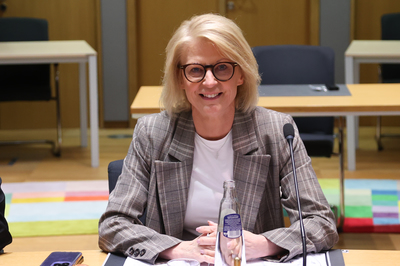
Today we are strengthening the rules for administrative cooperation and closing loopholes that have previously been used to avoid taxation of income. This reduces the risk of crypto-assets being used as a safe haven for tax avoidance and tax fraud. The agreement is yet another example of the EU as a leader in the implementation of global standards.
Elisabeth Svantesson, Minister for Finance of Sweden
Bank Crisis Management and Deposit Insurance framework
The Commission presented its proposals on the review of the Bank Crisis Management and Deposit Insurance framework (CMDI). Ministers gave their initial reactions. The in-depth analysis of the proposals will now continue at the level of experts of member states.
The Presidency presented the state of play of legislative proposals in the field of financial services.
The Council also adopted the regulation on markets in crypto-assets (MiCA) as well as one of the regulations of the legislative package on anti-money laundering. The latter will improve the availability of information regarding crypto-asset transfers and make it more difficult to misuse crypto-assets for money laundering purposes.
I am very pleased that today we are delivering on our promise to start regulating the crypto-assets sector. Recent events have confirmed the urgent need for imposing rules which will better protect Europeans who have invested in these assets, and prevent the misuse of crypto industry for the purposes of money laundering and financing of terrorism.
Elisabeth Svantesson, Minister for Finance of Sweden
The EU is making it more difficult to misuse crypto-assets for money laundering purposes
Economic and financial impact of Russia's aggression against Ukraine
The Council took stock of the economic and financial impact of Russia’s war against Ukraine, focusing in particular on customs-related issues. The Commission updated ministers on the implementation of sanctions against Russia, focusing on the possible circumvention of restrictive measures on the export and import of goods from a customs perspective.
Concerning the Recovery and Resilience Facility (RRF), the Commission updated ministers on the state of play on its implementation and ministers had the opportunity to exchange views, including as regards the demand for RRF loans and the experiences with the RRF’s performance-based structure.
The Presidency and the Commission informed the Council of the main outcomes of the G20 meeting of finance ministers and central bank governors and the IMF spring meetings held on 10-16 April 2023.
European Semester: Economic policy of the euro area
Without discussion, the Council adopted its recommendation on the economic policy of the euro area. On 17 January 2023, the Council had approved the text, subject to the legal linguistic revision, and the European Council had endorsed it at its meeting on 23–24 March 2023.
As items without discussion, the Council adopted its position on the draft amending budget No 1/2023 which concerns technical adjustments, including on REPowerEU, CBAM and the USC programme, and it approved budgetary transfer No DEC 07/2023. Taking work forward on the EU’s annual budget for 2024, it approved a joint statement on the dates for the budgetary procedure and modalities for the functioning of the Conciliation Committee in 2023.
The Council also adopted a regulation that aims to minimise the risk of deforestation and forest degradation associated with products that are made available, imported into or exported from the EU market. The EU is a large consumer and trader of commodities such as palm oil, cattle, wood, coffee, cocoa, rubber and soy and products derived from those, like chocolate, personal care products and wooden furniture. The new rules aim to ensure that the consumption and trade of these commodities and products on the EU market don't contribute to deforestation and further degrading forest ecosystems.
Economic and financial dialogue between the EU and the Western Balkans and Türkiye
In the margins of Ecofin, representatives of the EU Member States, the Western Balkans and Türkiye, the European Commission and the European Central Bank, as well as representatives of the central banks of the Western Balkans and Türkiye met for their annual economic policy dialogue. The dialogue aims to prepare the future participation in the European Semester of the Western Balkans and Türkiye (Montenegro, the Republic of Serbia, North Macedonia, the Republic of Albania, Bosnia and Herzegovina, and the Republic of Türkiye are candidate countries for EU accession, while Kosovo* is a potential candidate).
The participants endorsed joint conclusions in which they highlighted their shared interest to define appropriate policy responses to recent adverse shocks including the economic impact of Russia’s war of aggression against Ukraine. Participants emphasised the common position by the EU and the Western Balkans and Türkiye in deploring in the strongest terms the continued military aggression by the Russian Federation against Ukraine.
* This designation is without prejudice to positions on status, and is in line with UNSCR 1244/1999 and the ICJ Opinion on the Kosovo declaration of independence.
 Today we are strengthening the rules for administrative cooperation and closing loopholes that have previously been used to avoid taxation of income. This reduces the risk of crypto-assets being used as a safe haven for tax avoidance and tax fraud. The agreement is yet another example of the EU as a leader in the implementation of global standards.