We use cookies to improve your browsing experience. Necessary cookies are required to support essential features of the Council's website. Optional cookies help us produce anonymous and aggregated statistical reports to better serve your needs.
With your permission, we will use cookies to produce aggregated, anonymous data about our visitors' browsing and behaviour on our website. We will use this data to improve your experience on our website.
Economic and Financial Affairs Council, 16 June 2023
Main results
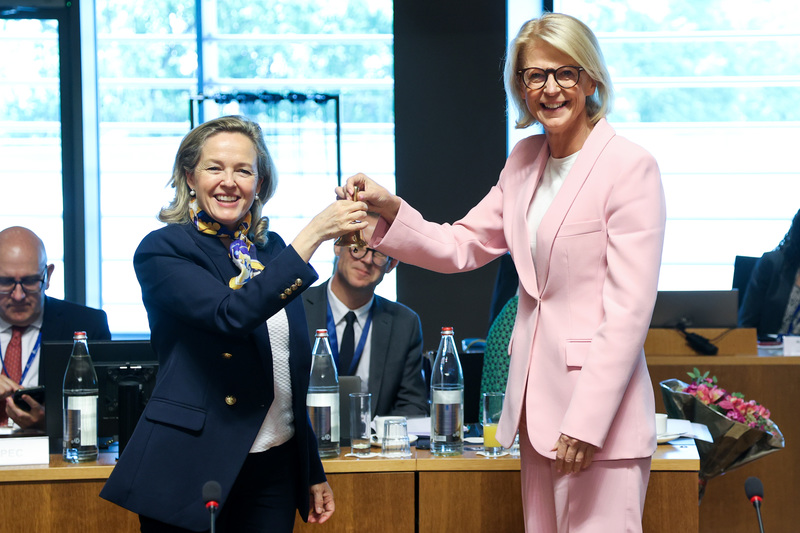
This was the final Council meeting in Ecofin formation under the Swedish presidency. Elisabeth Svantesson, Minister for Finance of Sweden, handed over the responsibility for Ecofin matters to her Spanish counterpart Nadia Calviño
Taxation: VAT in the digital age
Ministers held a policy debate on this legislative package and gave political guidance on a number of key issues which had so far been the subject of discussions at the level of experts of the member states.
Our VAT collection systems need to keep track with the digital transition, so that we can fight tax fraud effectively. Our approach for this file was to minimize frictions within the internal market and unnecessary administrative burden, both for businesses and for tax administrations. I welcome the support from the ministers.
Elisabeth Svantesson, Minister for Finance of Sweden
The Council exchanged views on the proposed reform of the economic governance framework. On 14 March, the Council had agreed orientations for this reform.
It is important that the Council’s priorities from March remain the guiding thread throughout the negotiations. This was highlighted by ministers in the discussions today.
Elisabeth Svantesson, Minister for Finance of Sweden
The EU’s economic governance framework is a set of common rules for national fiscal and economic policies which apply to all member states. It has been instrumental in safeguarding macroeconomic stability and growth in the Union and has helped member states achieve their economic and fiscal policy goals. These common rules serve to ensure the sustainability of public finances and promote convergence while addressing macroeconomic imbalances.
Council orientations for a reform of the EU economic governance framework (infographic)
Recovery and Resilience Facility
The Council adopted an implementing decision approving an amended recovery and resilience plan of Estonia. Estonia’s plan is now the first national plan which includes a REPowerEU chapter.
During 2023, it is expected that gradually each of the 27 member states will submit revised recovery and resilience plans to access the new REPowerEU grants, to request available loans, to take into account the updated RRF allocation, or to request the transfer of funds from other programmes.
The Council approved its country-specificrecommendations on the 2023 national reform programmes and it delivered its opinions on the updated stability or convergence programmes. Ministers approved the Council recommendations with a view to forwarding them for endorsement to the European Council.
I am very pleased that we agreed on country-specific recommendations today. This will further our overall objective to increase growth and strengthen our resilience. Given Russia’s war in Ukraine and the difficult economic situation, securing the resilience of our economies and pursuing responsible fiscal policies is fundamental.
Elisabeth Svantesson, Minister for Finance of Sweden
Introduced in 2011, the European Semester enables the EU member states to coordinate their economic, fiscal and employment policies throughout the year and address the economic challenges facing the EU.
Economic and financial impact of Russia’s aggression against Ukraine
Ministers discussed the economic and financial impact of Russia’s aggression against Ukraine. They focused in particular on Ukraine’s economic and financing situation. The Commission updated ministers on the state of play as regards the implementation of the EU’s macro-financial assistance for Ukraine.
Throughout 2023, to continue supporting Ukraine, the EU is providing an unprecedented support package called the macro-financial assistance plus (MFA +) instrument of up to €18 billion, in the form of highly concessional loans, of which €7.5 billion has already been disbursed to Ukraine in monthly tranches of €1.5 billion. Disbursement of the next tranche (€1.5 billion) is planned for later in June.
Ministers gave guidance for further work as regards the preparation of the G20 meeting of finance ministers and central bank governors meeting of 14-18 July 2023.
The G20 meetings of finance ministers and central bank governors provide a forum for key countries in the international financial system to discuss major international economic issues and to coordinate the global economy’s stable and sustainable growth.
The Council approved the biannual Ecofin report to the European Council on tax issues. This report provides an overview of the progress achieved in the Council during the term of the Swedish Presidency, as well as an overview of the state of play of the most important dossiers under negotiation in the area of taxation.
As an item without discussion, the Council took note of the eighth progress report on the implementation of the 74 common proposals endorsed by the EU and NATO councils on 6 December 2016 and 5 December 2017. The report elaborates on the progress achieved between June 2022 and May 2023, and highlights tangible progression in all areas of cooperation.
As an item without discussion, the Council adopted its position on a draft law that extends the deadline that will allow the Commission to provide financing of firefighting planes and helicopters. Because the rescEU reserves – which will include a fleet of firefighting planes and helicopters – cannot be completed before the end of 2024, the transitional period which allows the Commission to finance member states to allocate national aerial firefighting capacities has to be prolonged.
 Our VAT collection systems need to keep track with the digital transition, so that we can fight tax fraud effectively. Our approach for this file was to minimize frictions within the internal market and unnecessary administrative burden, both for businesses and for tax administrations. I welcome the support from the ministers.


