We use cookies to improve your browsing experience. Necessary cookies are required to support essential features of the Council's website. Optional cookies help us produce anonymous and aggregated statistical reports to better serve your needs.
With your permission, we will use cookies to produce aggregated, anonymous data about our visitors' browsing and behaviour on our website. We will use this data to improve your experience on our website.
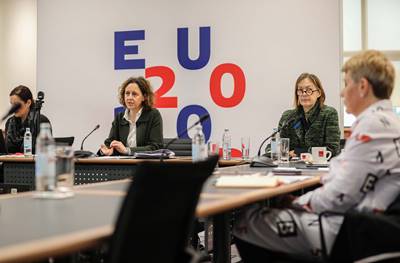
Video conference of ministers of culture, 19 May 2020
Main results
Ministers held an exchange of views about the impact of COVID-19 on the cultural and creative sectors. The discussion took place in the context of the gradual lifting of restrictions and the lessons learnt since the start of the pandemic. The discussion also focused on possibilities for resuming cultural programmes and activities without putting in jeopardy the health of artists and the audience.
The period ahead of us carries many unknowns, and a continuous exchange of information, as well as careful mapping and planning of further activities, are of utmost importance. This will ensure appropriate conditions for our further work, in particular in the context of the “new normal” at EU level.
Nina Obuljen Koržinek, minister for Culture of Croatia
The exchange of views was structured around the following questions:
Having implemented the initial measures to halt the decline of the cultural and creative sectors, which steps will the Member States undertake in the upcoming period, especially considering the anticipated gradual lifting of restrictions?
What are the main lessons learnt from the COVID-19 crisis as far as the cultural and creative sectors are concerned?
Ministers agreed that it was necessary to apply maximum flexibility in the implementation of the Creative Europe programme and its financing post-2020. In particular, they highlighted the need to ensure a level-playing field. Ministers suggested to include measures to support the cultural and creative sectors in the EU recovery initiatives. They also exchanged views on how various EU programmes could be used to support both sectors. The importance of digitalisation and development of online platforms was also highlighted. Ministers stressed the crucial role of media and reliable information and the need to ensure support for the audiovisual sector.
The Croatian presidency thanked member states for their contribution to finalising the Council conclusions on risk management in cultural heritage, Council conclusions on media literacy in an ever-changing world and Council conclusions amending the Work Plan for Culture (2019-2022). These conclusions will be adopted through a written procedure.
 The period ahead of us carries many unknowns, and a continuous exchange of information, as well as careful mapping and planning of further activities, are of utmost importance. This will ensure appropriate conditions for our further work, in particular in the context of the “new normal” at EU level.