Fit for 55
The European climate law makes reaching the EU's climate goal of reducing EU emissions by at least 55% by 2030 a legal obligation. EU countries have adopted new legislation to achieve this goal and make the EU climate-neutral by 2050.
What is the Fit for 55 package?
The Fit for 55 package is a set of laws aiming to reduce EU greenhouse gas emissions by at least 55% by 2030 and put the EU to the path to achieve climate neutrality by 2050.
The package:
- ensures a just and socially fair transition
- maintains and strengthens innovation and competitiveness of EU industry while ensuring a level playing field vis-à-vis third country economic operators
- underpins the EU's position as leading the way in the global fight against climate change
The Council as co-legislator
The proposals of the Fit for 55 package were presented by the European Commission and then discussed at technical level within the Council's working parties responsible for the policy areas concerned.
Later these were discussed by EU member states' ambassadors in Coreper to prepare the ground for agreements among the 27 member states. EU ministers, in various Council configurations, exchanged views on the proposals to reach agreement on a common position on each proposed act.
Following the ordinary legislative procedure, the Council then engaged with the European Parliament in negotiations to find a common agreement in view of the final adoption of the legislative acts.

Fit for 55: how the EU will turn climate goals into law (infographic)
What is included in the Fit for 55 package?
Interactive visual with icons linking to infographics. Each icon links to one infographic explaining one or two proposals included in the Fit for 55 package.
EU emissions trading system
The EU emissions trading system (EU ETS) is a carbon market based on a system of cap-and-trade of emission allowances for energy-intensive industries and the power generation sector. It is the EU's main tool in addressing emissions reductions.
The Fit for 55 package aimed to reform the EU ETS by making it more ambitious. New provisions include:
- extension to emissions from maritime transport
- faster reduction of emissions allowances in the system and gradual phasing-out of free allowances for some sectors
- implementation of the global carbon offsetting and reduction scheme for international aviation (CORSIA) through the EU ETS
- increase of funding for the modernisation fund and the innovation fund
- revision of the market stability reserve
In addition, a new self-standing emissions trading system is created for buildings, road transport and fuels for additional sectors.
The Environment Council adopted a general approach on the revision of the EU ETS in June 2022. In December 2022, the Council reached a provisional deal with the European Parliament. This included an increase in the overall ambition of emissions reductions by 2030 in the sectors covered by the EU ETS to 62%, compared to the 61% target proposed by the Commission.
In December 2022, the Council and the European Parliament reached also a provisional political agreement on the revision of the EU emissions trading system (EU ETS) rules applying to the aviation sector. The agreement ensured that aviation contributes to the EU's emission reduction objectives under the Paris Agreement.
The Council adopted a decision on the market stability reserve, part of the EU ETS, in March 2023. It formally adopted the revision of the EU ETS in April 2023.

Fit for 55: reform of the EU emissions trading system (infographic)
In December 2022 the Council adopted a decision on the notification of CORSIA offsetting requirements. CORSIA (Carbon Offsetting and Reduction Scheme for International Aviation) is a global scheme for offsetting CO2 emissions from international aviation, in which EU member states participate.
Social climate fund
The social climate fund aims to address the social and distributional impact of the new emissions trading system for buildings and road transport.
Based on social climate plans to be developed by the member states, the fund aims to provide support measures and investments for the benefit of vulnerable:
- households
- micro-enterprises
- transport users
The fund can also cover temporary direct income support. The fund is part of the EU budget and fed by external assigned revenues up to a maximum amount of €65 billion.
EU environment ministers agreed on the Council's negotiating position for the creation of the social climate fund in June 2022. In December 2022, the Council and the European Parliament reached a provisional political agreement on the proposal for the fund. The new rules were adopted by the Council in April 2023.

Fit for 55: a fund to support the most affected citizens and businesses (infographic)
Carbon border adjustment mechanism
The carbon border adjustment mechanism (CBAM) is the EU's tool to fight carbon leakage. This system puts a fair price on carbon emitted during the production of imported goods in the most carbon-intensive sectors – iron and steel, cement, fertilisers, aluminium, electricity and hydrogen - and encourages cleaner industrial production in non-EU countries.
The CBAM regulation was formally adopted by the Council in April 2023 and became fully operational on 1 January 2026.
In September 2025, the Council adopted a set of changes to simplify the CBAM and cut red tape as part of the Omnibus I legislative package. The regulation entered into force on 20 October 2025.
In December 2025, the European Commission proposed further measures to strengthen and expand the carbon border adjustment mechanism.
On 12 June 2026, the Council agreed its position on the proposal. The Council supports the CBAM's extension to selected downstream products while refining the list of products covered. It also supports the introduction of new anti-circumvention measures and clarifies the conditions under which temporary exemptions may be granted in exceptional circumstances.
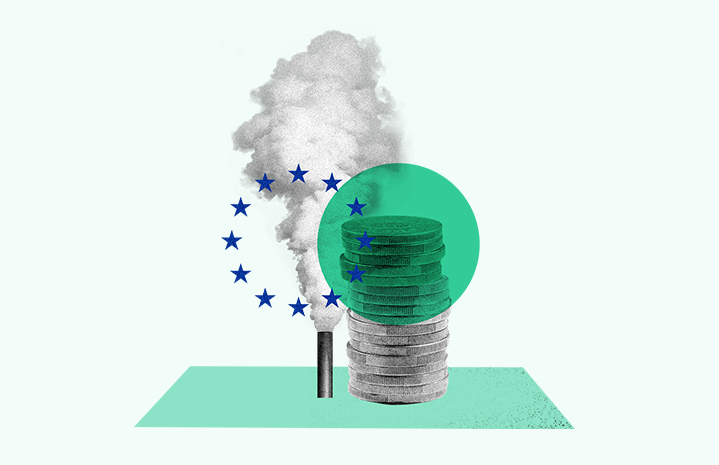
Carbon border adjustment mechanism explained
Member states' emissions reduction targets
The effort sharing regulation sets binding annual greenhouse gas emissions targets for member states in sectors that are not covered by the EU emissions trading system (EU ETS) or the regulation on land use, land use change and forestry (LULUCF). These sectors include:
- road and domestic maritime transport
- buildings
- agriculture
- waste
- small industries
The new rules, as part of the Fit for 55 package, will increase the EU-level greenhouse gas emissions reduction target for 2030 from 29% to 40%, compared with 2005, in the sectors concerned. They will also update the national targets accordingly.
EU environment ministers agreed on a Council negotiating position on the revised rules on 29 June 2022. In November 2022, the Council reached a provisional agreement with the European Parliament. The regulation was adopted by the Council in March 2023.

Fit for 55: reducing emissions from transport, buildings, agriculture and waste (infographic)
Emissions and removals from land use, land use change and forestry
The land use, land-use change and forestry (LULUCF) regulation sets a binding commitment for the EU to reduce emissions and increase removals in the land use and forestry sectors. With the Fit for 55 package, the provisions are made more ambitious.
The new rules set an increased EU-level target of at least 310 million tonnes of CO2 equivalent net removals of greenhouse gases for 2030. Binding national targets are defined for each member state.
The Environment Council adopted a general approach on the revised LULUCF regulation on 29 June 2022. A provisional agreement was reached with the European Parliament in November 2022. The regulation was adopted by the Council in March 2023.

Fit for 55: reaching climate goals in the land use and forestry sectors (infographic)
CO2 emission standards for cars and vans
Cars and vans account for 15% of the total EU emissions of carbon dioxide. The EU, as part of the 55 package, has adopted new rules regulating the CO2 emissions from these vehicles.
The regulation introduces progressive EU-wide emissions reduction targets for cars and vans for 2030 and beyond, including a 100% reduction target for 2035 for new cars and vans.
The Council adopted its general approach on the proposal in June 2022. An agreement with the European Parliament was reached in October 2022. The regulation was adopted by the Council in March 2023.

Fit for 55: why the EU is toughening CO2 emission standards for cars and vans (infographic)
Reducing methane emissions in the energy sector
The Commission presented the proposal for new EU rules on methane emissions reduction in the energy sector in December 2021, as part of the Fit for 55 package.
In December 2022, the Council reached agreement (‘general approach') on the proposal. In November 2023, the Council and the European Parliament agreed provisionally on the regulation. The Council adopted the new rules in May 2024.
The regulation aims to track and reduce methane emissions in the energy sector. The legislation is the first of its kind and is a crucial contribution to climate action, as methane is the second most important greenhouse gas after carbon dioxide.
It follows from the strategic vision set out in the EU Methane Strategy in 2020. At the COP26 UN Climate Conference in 2021, the EU launched the Global Methane Pledge in partnership with the United States, whereby over 100 countries committed to reducing their methane emissions by 30% by 2030 compared to 2020 levels.

Fit for 55: cutting methane emissions in fossil fuels (infographic)
Sustainable aviation fuels
Sustainable aviation fuels (advanced biofuels and electrofuels) have the potential to significantly reduce aircraft emissions. However, this potential is largely untapped as such fuels represent only 0.05% of total fuel consumption in the aviation sector.
The ReFuelEU Aviation regulation aims to reduce the aviation sector's environmental footprint and enable it to help the EU achieve its climate targets.
The Council agreed on a general approach on the proposal in June 2022. A provisional agreement was reached with the European Parliament in April 2023. The Council adopted the new regulation in October 2023.

Fit for 55: increasing the uptake of greener fuels in the aviation and maritime sectors (infographic)
Decarbonised fuels in shipping
Despite progress in recent years, the maritime sector still relies almost entirely on fossil fuels and constitutes a significant source of greenhouse gases and other harmful pollutant emissions. The goal of the FuelEU maritime initiative is to reduce the greenhouse gas intensity of the energy used on-board of ships by up to 80% by 2050. The new rules promote the use of renewable and low-carbon fuels in shipping.
The Council agreed on a general approach on the proposal in June 2022. In March 2023, the Council and the Parliament reached a provisional deal.
The Council adopted the new rules in July 2023, completing the legislative procedure.
Alternative fuels infrastructure
The main objective of the regulation on alternative fuels infrastructure (AFIR) is to ensure that citizens and businesses have access to a sufficient infrastructure network for recharging or refuelling road vehicles and ships with alternative fuels.
The new rules will enable the transport sector to significantly reduce its carbon footprint. They set a number of targets for 2025 or 2030 including:
- recharging stations for cars and vans to be installed every 60 km
- hydrogen refuelling stations serving both cars and lorries to be deployed from 2030 onwards in all urban nodes
- users of electric or hydrogen-fuelled vehicles to be able to pay easily at recharging or refuelling points
In June 2022, the Council agreed a common position (general approach) on the Commission's proposal for this regulation. The Council and the Parliament reached a provisional deal in March 2023.
The Council adopted the new rules in July 2023.

Fit for 55: towards more sustainable transport (infographic)
Renewable energy
The EU renewable energy directive was revised as part of the Fit for 55 package. The revision aimed to increase the share of renewables in the EU's overall energy consumption to 42.5% by 2030, with an additional 2.5% indicative top up that would allow the overall share to reach 45%.
The directive includes sectorial sub-targets and measures across sectors, with a special focus on sectors where progress with integrating renewables has been slower, in particular in the fields of transport, buildings and industry.
EU energy ministers agreed their joint position on the revised EU renewable energy directive on 27 June 2022. In March 2023, the Council and the European Parliament reached a provisional political agreement. The Council adopted the new rules in October 2023.

Fit for 55: how the EU plans to boost renewable energy (infographic)
Energy efficiency
The revised EU energy efficiency directive will reduce final energy consumption at EU level by 11.7% in 2030, compared to projections made in 2020.
The new rules will accelerate energy efficiency efforts by member states by increasing annual energy savings obligations and decreasing the energy consumption of public sector buildings.
On 27 June 2022, the Council adopted its 'general approach' on the proposed new rules. In March 2023, the Council presidency and the European Parliament negotiators reached a provisional political agreement on the revision of the directive.
The Council adopted the new directive in July 2023.

Fit for 55: how the EU will become more energy-efficient (infographic)
Energy performance of buildings
Buildings account for 40% of energy consumed and 36% of energy-related direct and indirect greenhouse gas emissions in the EU. The energy performance of buildings directive, revised in 2024, aims to make buildings in the EU more energy efficient by 2030 and beyond.
The main goals of the directive are:
- all new buildings will be zero-emission buildings by 2030
- existing buildings will be transformed into zero-emission buildings by 2050
In October 2022, the EU member states, meeting within the Council, agreed a common position ('general approach') on the Commission proposal for a revision of the directive. On 7 December 2023, the Council and the Parliament reached a provisional political agreement on the proposal. The new rules were adopted by the Council in April 2024.

Fit for 55: making buildings in the EU greener (infographic)
Hydrogen and decarbonised gas market package
The hydrogen and decarbonised gas market package aims to lower the carbon footprint of the gas market. The goal is to shift from natural gas to renewable and low-carbon gases and boost their uptake in the EU by 2030 and beyond.
The package consists of a regulation and a directive. These set common internal market rules for renewable and natural gases and hydrogen. They aim at creating a regulatory framework for dedicated hydrogen infrastructure and markets and integrated network planning. They also set rules for consumers protection and strengthen security of supply.
The Council set its position for negotiations (general approach) with the European Parliament on the two proposals in March 2023. In December 2023, the Council and the Parliament reached a provisional political agreement on the regulation for common internal market rules for renewable and natural gases and hydrogen. A provisional agreement on the directive was reached on 28 November 2023.
The Council adopted the package in May 2024.

Fit for 55: shifting from fossil gas to renewable and low-carbon gases (infographic)
Energy taxation
The proposal for a revision of the Council directive on the taxation of energy products and electricity aims to:
- align the taxation of energy products and electricity with the EU's energy, environment and climate policies
- preserve and improve the EU internal market by updating the scope of energy products and the structure of rates and by rationalising the use of tax exemptions and reductions by member states
- preserve the capacity to generate revenues for the budgets of the member states
The proposal is currently under discussion within the Council. In December 2022, EU finance ministers held a policy debate on the revision of the energy taxation directive. In December 2024, they held another policy debate on the revision and welcomed progress made so far.

Fit for 55: how the EU plans to revise energy taxation (infographic)
8 ways life in the EU is becoming greener
Shifting to a greener way of life is crucial to address the climate emergency and reduce dependency on fossil fuels, especially those from Russia. The EU and its 27 countries are working on new common rules under the Fit for 55 package to reduce the EU's carbon footprint. How will the new rules shape the way we live, work and travel? Read our story for some examples of what life in the EU will look like in 2030.

See also

European Green Deal

Climate change: what the EU is doing

Financing the climate transition
Last review: 12 June 2026