EU sanctions against Iran
The EU condemns human rights abuses in Iran, as well as Iran's nuclear proliferation activities and its military support for Russia's war of aggression against Ukraine. It has adopted a number of sanctions in this regard.
Repression and human rights violations in Iran
The EU has repeatedly condemned serious human rights violations in Iran, including the death in police custody of 22-year-old Mahsa Amini in September 2022, the execution of EU-Irani citizens in 2023 and 2024, the detention of human rights defenders, including the Nobel Peace Prize laureate Narges Mohammadi, and the casualties during the protests of January 2026.
The EU supports the fundamental aspirations of the people of Iran for a future where their universal human rights and fundamental freedoms are respected, protected and fulfilled.
The European Union strongly condemns:
- the widespread, brutal and disproportionate use of force by the Iranian authorities against peaceful protesters
- arbitrary detentions as a means of silencing critical voices
- the use of torture, cruel, inhuman and degrading treatment of detainees in Iranian prisons
- the practice of imposing and carrying out death sentences against protesters
- restrictions on communications, including internet shutdowns
The right to peaceful assembly and the right to freedom of expression, including the freedom to seek, receive and share information and ideas, online and offline, must be ensured.
The EU calls on Iran to eliminate, in law and in practice, all forms of systemic discrimination against women and girls in public and private life and to take gender-responsive measures to prevent sexual and gender-based violence in all its forms against women and girls and to ensure protection against such violence.
The EU urges the Iranian authorities to uphold their obligations under international law and demands that the perpetrators of violence and human rights violations be held accountable.
Latest EU statements on human rights in Iran:
- Iran: statement by the High Representative on behalf of the EU on the situation in the country (press release, 9 January 2026)
- Iran: statement by the High Representative on behalf of the EU on the arrest and detention of human rights defenders (press release, 30 December 2025)
Sanctions in response to human rights abuses in Iran
In 2011, the EU introduced a sanctions regime against Iran in response to serious human rights violations in the country. The sanctions have been renewed annually since then and were last extended until 13 April 2027.
Since October 2022, in view of the deteriorating human rights situation in the country, the EU has drastically increased sanctions.
Sanctions relating to human rights violations in Iran include:
- travel bans for individuals
- an asset freeze for individuals and entities
- a prohibition on making funds or economic resources available to those listed
- a ban on selling, supplying, transferring or exporting to Iran equipment that might be used for internal repression
- a ban on providing technical assistance, brokering services or financing to any person or body in Iran or for use in Iran (if they could be used in relation to internal repression)
- a ban on providing any telecommunications or internet monitoring or interception services to Iran
At present, 269 individuals and 53 entities are sanctioned under this regime.

Individuals sanctioned include:
- members of the Iranian parliament
- the Minister of the Interior, Eskandar Momeni
- the Minister of information and Communications Technology, Issa Zarepour
- governors and local politicians
- members of the Iranian security forces
- members of the Islamic Revolutionary Guard Corps (IRGC)
- members of the Iranian Law Enforcement Forces (LEF)
- the squad that arbitrarily arrested Mahsa Amini
- high-ranking officials and military personnel
- commanders and members of the police
- prison wardens and directors
- the Prosecutor General and other members of the judiciary
- members of the Supreme Council of Cyberspace
Entities sanctioned include:
- the Islamic Revolutionary Guard Corps (IRGC)
- the Iranian Ministry of Education and the Ministry of Culture and Islamic Guidance
- Iran's Morality Police
- the Law Enforcement Forces (LEF)
- the Supreme Council of Cultural Revolution
- the Supreme Council of Cyberspace
- prisons
- the state television broadcaster 'Press TV'
- news agencies
- mobile service providers
- software and IT companies
- the Iranian Audio-Visual Media Regulatory Authority
- entities involved in censoring activities, trolling campaigns on social media and spreading disinformation
Individuals and entities responsible for human rights abuses and repression in Iran are also sanctioned under the EU global human rights sanctions regime.
- Decision concerning restrictive measures directed against certain persons and entities in view of the situation in Iran (EU Official Journal)
- Regulation concerning restrictive measures directed against certain persons, entities and bodies in view of the situation in Iran (EU Official Journal)
- Sanctions against human rights violations
Islamic Revolutionary Guard Corps on the terrorist list
Following the political agreement reached by the Foreign Affairs Council on 29 January 2026, the Council decided on 19 February 2026 to designate the Islamic Revolutionary Guard Corps (IRGC) of Iran as a terrorist organisation.
The IRGC is therefore subject to restrictive measures under the EU counter-terrorism sanctions regime. This means that:
- all funds and other financial assets or economic resources of the IRGC in EU member states are frozen
- EU operators are prohibited from making funds and economic resources available to the IRGC
Iran's support for Russia's war against Ukraine
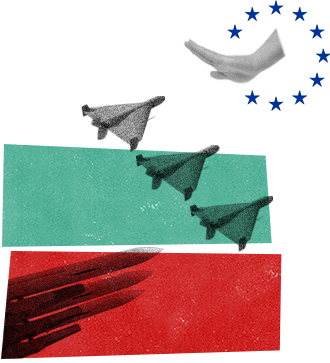
The European Union strongly condemns and considers unacceptable any type of military support provided by Iran, including deliveries of unmanned aerial vehicles (also known as drones), for Russia's war of aggression against Ukraine.
These weapons provided by Iran are being used indiscriminately by Russia against Ukrainian civilian population and infrastructure causing horrendous destruction and human suffering.
The EU also condemns Iran's military support for armed groups in the Middle East and Red Sea region.
Sanctions in response to Iran's involvement in Russia's war against Ukraine
The Council imposed three rounds of drone-related sanctions against Iranian individuals or entities in 2022 and 2023, under the sanctions regime applicable to actions undermining or threatening the territorial integrity, sovereignty and independence of Ukraine.
On 20 July 2023, the Council established a dedicated framework for sanctions in view of Iran's military support of Russia's war of aggression against Ukraine.
The scope of the framework was broadened on 14 May 2024, in view of Iran's military support of armed groups in the Middle East and Red Sea region and of the drone and missile attacks Iran carried out against Israel in April 2024.
The EU can target individuals and entities supplying, selling or transferring Iran's missiles and drones, as well as components used in the development and production of missiles and drones:
- in support of Russia's war of aggression against Ukraine
- used by armed groups and entities to undermine peace and security in the Middle East and the Red Sea region
- in breach of United Nations Security Council resolution 2216 (2015)
Sanctions include:
- travel bans for individuals
- an asset freeze for individuals and entities
- a prohibition on making funds or economic resources available to those listed
The EU has also introduced a ban on transactions with two ports that are owned, operated or controlled by sanctioned individuals and entities, or are used for the transfer of Iranian drones or missiles or related technology and components to Russia.
The individuals and entities sanctioned include companies manufacturing, procuring and selling components for drones, companies involved in the production of propellant used to launch rockets and missiles, shipping and trading companies, the Islamic Revolutionary Guard Corps Navy, the Islamic Republic of Iran Shipping Lines, Iranian airlines, and the Minister and Deputy Minister of Defence of Iran.
Currently 22 individuals and 27 entities are sanctioned under this regime.
The sanctions regime was last extended until 27 July 2027.
Freedom of navigation in the Strait of Hormuz
The EU urges all involved to fully respect the ceasefire across the Middle East region, cease all military operations and fully ensure freedom of navigation, as well as free and safe passage through the Strait of Hormuz, in line with international law, as reflected in the United Nations Convention on the Law of the Sea.
Iran’s actions against vessels transiting through the Strait of Hormuz are contrary to international law. Such actions infringe upon established rights of both transit and innocent passage through international straits.
Sanctions in response to Iran's actions in the Strait of Hormuz
On 22 May 2026, the Council decided to extend the scope of EU sanctions originally established to address Iran’s military support for Russia’s war of aggression against Ukraine, also targeting various armed groups in the Middle East and the Red Sea region.
Under this sanctions regime, the EU has sanctioned two individuals and one entity involved in Iran’s actions and policies threatening freedom of navigation in the Strait of Hormuz.
Iran's nuclear proliferation activities
In the European Council conclusions of 26 June 2025, the European Union reiterated its clear determination that Iran must never be allowed to acquire a nuclear weapon and recalled Iran's commitments in that respect as well as its international obligations.
The European Union is deeply concerned about the successive reports of the International Atomic Energy Agency (IAEA) documenting the alarming acceleration of Iran's nuclear programme, which constitutes a radical departure from its commitments under the Joint Comprehensive Plan of Action (JCPOA), in particular with regard to the expansion of its nuclear enrichment capacity and of its production of highly enriched uranium.
Iran's actions, which have no credible civilian purpose, carry very significant proliferation-related risks.
The European Union strongly urges Iran to reverse its alarming nuclear trajectory, to return to its political commitments in the field of nuclear non-proliferation without further delay, and to resume all JCPOA-related monitoring and verification measures, including those laid down in the JCPOA Additional Protocol.
UN and EU sanctions against Iran aim to persuade Iran to comply with its obligations.
Sanctions in response to Iran's nuclear proliferation
UN sanctions
Since 2006, the UN Security Council has adopted a number of resolutions requiring Iran to stop enriching uranium for the purpose of nuclear proliferation. Those resolutions have been progressively accompanied by sanctions in order to persuade Iran to comply.
The EU implements UN sanctions through the adoption of EU legislation.
EU sanctions
In addition to implementing UN sanctions, the EU has imposed its own wide range of sanctions against Iran. Such measures relating to Iran's nuclear proliferation activities include:
- travel bans for individuals
- an asset freeze for individuals and entities
- a prohibition on making funds or economic resources available to those listed
The measures also include economic and financial sanctions, covering the trade, financial and transport sectors.
Sanctions in the trade sector include:
- a ban on arms exports to Iran
- a ban on exports of dual-use goods and goods that could be used in nuclear enrichment-related activities
- a ban on imports of crude oil, natural gas and petrochemical and petroleum products
- a ban on the sale or supply of key equipment used in the energy sector
- a ban on the sale or supply of gold, other precious metals and diamonds
- a ban on certain naval equipment
- a ban on certain software
Sanctions in the financial sector include:
- freezing the assets of the Central Bank of Iran and of major Iranian commercial banks
- establishing notification and authorisation mechanisms for transfers of funds above certain amounts to Iranian financial institutions
Sanctions in the transport sector include:
- preventing access by Iranian cargo flights to EU airports
- a ban on the maintenance and service of Iranian cargo aircraft or vessels carrying prohibited materials or goods
Joint Comprehensive Plan of Action (JCPOA)
On 14 July 2015, Iran and the 'E3/EU3' agreed on a Joint Comprehensive Plan of Action. The plan set out a series of steps for the years that followed to ensure that Iran's nuclear programme would exist for exclusively peaceful purposes.
The UN Security Council adopted resolution 2231(2015) regarding the JCPOA in July 2015. The resolution:
- endorsed the JCPOA
- allowed for certain exemptions from existing sanctions
- defined the schedule and the commitments to be undertaken by all parties with a view to terminating sanctions against Iran
On 16 January 2016 (implementation day), the UN lifted some of its nuclear-related sanctions, as set out in resolution 2231 (2015), while the Council lifted all nuclear-related economic and financial EU sanctions against Iran. However, some restrictions remained in force.
In view of Iran's non-compliance with its commitments under the JCPOA, on 18 October 2023 the Council decided to maintain the EU's proliferation-related sanctions that had been scheduled to be lifted on transition day.
On 29 September 2025, the Council decided to reimpose all the nuclear-related economic and financial EU sanctions against Iran that had been lifted in 2016. The decision was taken after the reintroduction of the UN sanctions, following the UN Security Council's decision not to extend the lifting of sanctions on Iran.

Iran's nuclear agreement
See also

EU position on the situation in the Middle East

Timeline - Iran and the Middle East

Elimination of chemical weapons
Last review: 28 July 2026
