- Rådet for Transport, Telekommunikation og Energi
Rådet (transport, telekommunikation og energi (transport)), 2. juni 2022
Vigtigste punkter på dagsordenen
EU's transportministre anmodes om at vedtage generelle retningslinjer for de 3 relevante komponenter i Fit for 55-pakken, som sigter mod at reducere EU's drivhusgasemissioner med mindst 55 % senest i 2030.
Infrastruktur for alternative drivmidler
En reduktion i anvendelsen af fossile brændstoffer inden for transport er et af EU's centrale elementer for at opnå klimaneutralitet senest i 2050. For at nå dette mål skal der være nok ladestandere og tankstationer for biler, fly og skibe.
Forordningen om infrastruktur for alternative drivmidler (AFIR) fastsætter konkrete mål for udviklingen af en sådan infrastruktur i EU i de kommende år.
EU's ministre vil sigte mod at vedtage en generel indstilling til forslaget.

Fit for 55: øget udbredelse af grønnere brændstoffer i luftfarts- og søtransportsektoren (Infografik)
Bæredygtige brændstoffer til transport
Bæredygtige brændstoffer til transport kan spille en vigtig rolle i reduktionen af drivhusgasemissioner. Luft- og søfartssektoren er i øjeblikket næsten udelukkende afhængig af fossile brændstoffer.
Nye forordninger har til formål at sikre lige vilkår for bæredygtig lufttransport (ReFuelEU Aviation-initiativet) og for anvendelsen af vedvarende og kulstoffattige brændstoffer i søtransport (FuelEU Maritime). Målet med dem er at øge udbredelsen af bæredygtige brændstoffer for fly og skibe med henblik på at reducere deres miljøaftryk.
Rådet planlægger at nå til enighed om en generel indstilling til de 2 forslag.
Intelligente transportsystemer
Rådet sigter mod at vedtage en generel indstilling til revisionen af direktivet om intelligente transportsystemer (ITS-direktivet), som bør bidrage til den grundlæggende transformation af det europæiske transportsystem for at nå målet om bæredygtig, intelligent og modstandsdygtig mobilitet.
Digitalisering er en uundværlig drivkraft i denne transformation. Digitaliseringen vil gøre hele transportsystemet smidigt og mere effektivt. Den vil også øge niveauet af sikkerhed, pålidelighed og komfort yderligere.
Passagerskibe
EU's ministre vil søge at nå til enighed om en generel indstilling til at forbedre stabilitetskravene for ro-ro-passagerskibe med henblik på at skabe klare, enkle og ajourførte retlige rammer, som er nemmere at gennemføre, overvåge og håndhæve. De nye regler skal øge det overordnede sikkerhedsniveau for skibe i international fart.
Det transeuropæiske transportnet (TEN-T)
EU's ministre skal udveksle synspunkter om forslaget til en revideret forordning om det transeuropæiske transportnet (TEN-T) med henblik på at udstikke yderligere retningslinjer til Rådets forberedende organer om vejen frem.
Ambitionen med TEN-T-politikken er at sikre gnidningsløs, bæredygtig og effektiv transport i hele Unionen og samtidig styrke den sociale, økonomiske og territoriale samhørighed.
Ro-ro passenger ships
The Council adopted its general approach on the draft directive on improved stability requirements for ro-ro passenger ships. This proposal, although highly technical in nature, is important for increasing the safety level of these vessels and therefore for better protecting our citizens.
Ro-ro passenger ships operate numerous maritime routes within Member States, between Member States and with third countries. They are therefore of major importance for the mobility of passengers and goods in Europe.
Ministers supported this proposal, which ensures the level of safety of these ships by ensuring, as far as possible, consistency with the international standards for stability of damaged passenger ships, which were recently updated by the International Maritime Organization (IMO) under the 2020 SOLAS Convention. These new international standards must be supplemented in order not to lower the level of the requirements already in force in the Union for new small vessels. For that reason, the text of the Council’s general approach adhered to the logic of the Commission proposal by providing for a level of safety requirements equivalent to existing EU law.
Trans-European transport network (TEN-T)
Ministers held an exchange of views on the draft regulation on the development of the trans-European transport network (TEN-T), based on a progress report. They agreed that the policy on the development of the trans-European transport network is a key instrument of the Union’s transport policy. It must encourage sustainable and more efficient transport of people and goods while also strengthening the EU’s economic, social and territorial cohesion by creating a reliable, high-quality transport system free of physical interruptions, missing links and bottlenecks.
Ministers agreed on the principle of revising the regulation currently in force in order to facilitate the transition to sustainable modes of transport. They supported aligning the development of the TEN-T network with the EU’s climate and sustainable development objectives, strengthening the resilience of the TEN-T network and improving the effectiveness of its governance tools.
Ministers pointed out specific points requiring attention, with questions about certain elements of the Commission proposal, in particular the level of certain requirements and deadlines for implementation.
Underlining the importance of this proposal, which concerns infrastructure development in all EU member states, delegations noted that discussions in the Council have progressed significantly. However, given the scope of the revision, the Council has not yet reached agreement on this legislative proposal and the work of the Council’s preparatory bodies will have to continue.
Situation in Ukraine
Over lunch, ministers exchanged views on the situation in Ukraine following their informal video conference meeting on 8 April in order to provide a coordinated response in the field of transport to Russia’s war of aggression against Ukraine.
Since that meeting, various actions have been carried out at European level: a draft mandate from the Council to the Commission to negotiate an agreement to temporarily liberalise certain road freight operations between the European Union and Ukraine and Moldova has been adopted and should allow the Commission to start negotiations swiftly.
On 12 May, the Commission presented an action plan to help Ukraine export its agricultural products through the establishment of ‘solidarity lanes’ to optimise supply chains and controls between Ukraine and the EU, to establish new transport routes and to avoid bottlenecks. This action plan is based in particular on a platform for exchanges between stakeholders bringing together industry, logistics, representatives of member states and Ukrainian authorities. Short-term measures are also envisaged, including the identification of the logistical capacities available in the EU, as well as medium- and long-term measures to increase the capacity of infrastructure to accommodate larger flows of goods from Ukraine.
On 23 May, the Commission also adopted an emergency plan to strengthen transport resilience in times of crisis, building on experience from the public health crisis (COVID-19) or linked to Russia’s war of aggression against Ukraine. In the form of a toolbox, it is based on 10 measures: adapting legislation to crises; providing adequate financial support; creating green lanes to facilitate road freight transport flows; having a coordinated approach to restrictions on free movement within the EU; maintaining minimum transport links and passenger protection; exchanging information among member states; increasing cybersecurity; introducing emergency tests to check the resilience of the sector; co-operating with international partners.
In the light of these elements, and fully supporting all the initiatives and actions described above, ministers held an exchange of views on the various possibilities to remove obstacles and best implement the commitments made in the field of transport to meet the challenges posed by the war in Ukraine.
Any other business
Under any other business, the presidency briefed ministers on the state of play of the proposed decision on the implementation of the notification of offsetting requirements under the Carbon Offsetting and Reduction Scheme for International Aviation (CORSIA) for aircraft operators established in the EU. The Permanent Representatives Committee endorsed a mandate for negotiations with the European Parliament at its meeting on 20 May 2022.
The Dutch and Austrian delegations presented the second progress report on the platform on international rail passenger transport.
The Danish delegation expressed concerns about developments in the road freight transport sector in view of the strong growth in the number of driver attestations for third-country drivers.
-
Denne ressource er i øjeblikket kun tilgængelig på følgende sprog:
In addition, the Polish delegation presented a joint statement by nine member states (Bulgaria, Czechia, Estonia, Hungary, Latvia, Lithuania, Poland, Slovakia and Romania) on the actions needed at European level to enable the continuation and completion of infrastructure investments.
Moreover, the Greek delegation informed about the illegal seizure of two-Greek flagged vessels by Iranian armed groups in the Persian Gulf.
-
Denne ressource er i øjeblikket kun tilgængelig på følgende sprog:
As the last item, the incoming Czech presidency presented its work programme for the second half of 2022.

Fit for 55: på vej mod en mere bæredygtig transport (Infografik)
Mødedokumenter
Forberedende dokumenter
Pressemeddelelser
Presseinformation
Pressekontakter
-
Niels Timmermans Press officer
- +32 470 18 22 47
- +32 2 281 32 65
Hvis du ikke er journalist, bedes du sende din forespørgsel til informationsafdelingen.
Akkreditering og pressearrangementer
Du kan finde generelle oplysninger om akkreditering på denne side.
Medieakkreditering til internationale topmøder, der afholdes uden for Den Europæiske Union, vil blive varetaget af værtslandets offentlige myndigheder.
Hold dig opdateret
- Tilmeld dig vores e-mailnotifikationer og modtag opdateringer om dette og lignende møder.
- Følg @EUCouncilPress og få de seneste presseopdateringer.
- Hashtag på X: #TTE
Billeder og videoer

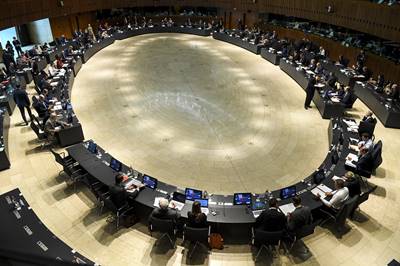
Øvrige samlinger: Rådet for Transport, Telekommunikation og Energi
Afholdte møder
Seneste gennemgang: 16. januar 2025
