- Rat (Verkehr, Telekommunikation und Energie)
Rat „Verkehr, Telekommunikation und Energie“ (Verkehr), 2. Juni 2022
Wichtigste Tagesordnungspunkte
Die Verkehrsministerinnen und ‑minister der EU werden ersucht, allgemeine Ausrichtungen zu den drei einschlägigen Komponenten des Pakets „Fit für 55“ anzunehmen, mit dem die Treibhausgasemissionen der EU bis 2030 um mindestens 55 % gesenkt werden sollen.
Infrastruktur für alternative Kraftstoffe
Die Verringerung des Einsatzes fossiler Kraftstoffe im Verkehrssektor ist einer der Schlüsselfaktoren, damit die EU bis 2050 Klimaneutralität erreichen kann. Um dieses Ziel zu erreichen, müssen genügend Ladepunkte und Tankstellen für Pkw, Flugzeuge und Schiffe vorhanden sein.
In der Verordnung über den Aufbau der Infrastruktur für alternative Kraftstoffe (AFIR) werden konkrete Ziele für den Aufbau einer solchen Infrastruktur in der EU in den kommenden Jahren festgelegt.
Die Ministerinnen und Minister der EU sind bestrebt, eine allgemeine Ausrichtung zu dem Vorschlag festzulegen.

„Fit für 55“: für mehr umweltfreundliche Kraftstoffe im Flug- und Seeverkehr (Infografik)
Nachhaltige Verkehrskraftstoffe
Nachhaltige Verkehrskraftstoffe können eine Schlüsselrolle bei der Verringerung der Treibhausgasemissionen spielen. Im Luft- und Seeverkehr werden derzeit fast ausschließlich fossile Kraftstoffe verwendet.
Mit neuen Verordnungen sollen gleiche Wettbewerbsbedingungen für einen nachhaltigen Luftverkehr (Initiative „ReFuelEU Aviation“) und für die Verwendung erneuerbarer und CO2-armer Kraftstoffe im Seeverkehr (Initiative „FuelEU Maritime“) gewährleistet werden. Ihr Ziel ist es, die Nutzung nachhaltiger Kraftstoffe durch Flugzeuge und Schiffe zu steigern, um so ihren ökologischen Fußabdruck zu verringern.
Der Rat plant, zu einem Einvernehmen über eine allgemeine Ausrichtung zu den beiden Vorschlägen zu gelangen.
Intelligente Verkehrssysteme
Der Rat beabsichtigt, eine allgemeine Ausrichtung zur Überarbeitung der Richtlinie über intelligente Verkehrssysteme (IVS) festzulegen; sie dürfte zum grundlegenden Wandel des europäischen Verkehrssystems im Hinblick auf die Verwirklichung des Ziels einer nachhaltigen, intelligenten und widerstandsfähigen Mobilität beitragen.
Die Digitalisierung ist ein unverzichtbarer Motor dieses Wandels. Die Digitalisierung wird das gesamte Verkehrssystem nahtlos und effizienter machen. Sie wird auch das Maß an Sicherheit, Zuverlässigkeit und Komfort weiter erhöhen.
Fahrgastschiffe
Die Ministerinnen und Minister der EU streben eine Einigung über eine allgemeine Ausrichtung zur Richtlinie zur Verbesserung der Stabilitätsanforderungen für Ro-Ro-Fahrgastschiffe an; damit soll ein klarer, unkomplizierter und aktueller Rechtsrahmen geschaffen werden, der einfacher umzusetzen, zu überwachen und durchzusetzen ist. Die neuen Vorschriften zielen darauf ab, das allgemeine Sicherheitsniveau für Schiffe auf Auslandfahrt zu erhöhen.
Transeuropäisches Verkehrsnetz (TEN-V)
Die Ministerinnen und Minister der EU werden einen Gedankenaustausch über den Vorschlag für eine überarbeitete Verordnung über das transeuropäische Verkehrsnetz (TEN-V) führen, um den Vorbereitungsgremien des Rates weitere Leitlinien für das weitere Vorgehen vorzugeben.
Ziel der Politik des transeuropäischen Verkehrsnetzes (TEN-V) ist es, einen nahtlosen, nachhaltigen und effektiven Verkehr in der gesamten Union zu gewährleisten und gleichzeitig den sozialen, wirtschaftlichen und territorialen Zusammenhalt zu stärken.
Ro-ro passenger ships
The Council adopted its general approach on the draft directive on improved stability requirements for ro-ro passenger ships. This proposal, although highly technical in nature, is important for increasing the safety level of these vessels and therefore for better protecting our citizens.
Ro-ro passenger ships operate numerous maritime routes within Member States, between Member States and with third countries. They are therefore of major importance for the mobility of passengers and goods in Europe.
Ministers supported this proposal, which ensures the level of safety of these ships by ensuring, as far as possible, consistency with the international standards for stability of damaged passenger ships, which were recently updated by the International Maritime Organization (IMO) under the 2020 SOLAS Convention. These new international standards must be supplemented in order not to lower the level of the requirements already in force in the Union for new small vessels. For that reason, the text of the Council’s general approach adhered to the logic of the Commission proposal by providing for a level of safety requirements equivalent to existing EU law.
Trans-European transport network (TEN-T)
Ministers held an exchange of views on the draft regulation on the development of the trans-European transport network (TEN-T), based on a progress report. They agreed that the policy on the development of the trans-European transport network is a key instrument of the Union’s transport policy. It must encourage sustainable and more efficient transport of people and goods while also strengthening the EU’s economic, social and territorial cohesion by creating a reliable, high-quality transport system free of physical interruptions, missing links and bottlenecks.
Ministers agreed on the principle of revising the regulation currently in force in order to facilitate the transition to sustainable modes of transport. They supported aligning the development of the TEN-T network with the EU’s climate and sustainable development objectives, strengthening the resilience of the TEN-T network and improving the effectiveness of its governance tools.
Ministers pointed out specific points requiring attention, with questions about certain elements of the Commission proposal, in particular the level of certain requirements and deadlines for implementation.
Underlining the importance of this proposal, which concerns infrastructure development in all EU member states, delegations noted that discussions in the Council have progressed significantly. However, given the scope of the revision, the Council has not yet reached agreement on this legislative proposal and the work of the Council’s preparatory bodies will have to continue.
Situation in Ukraine
Over lunch, ministers exchanged views on the situation in Ukraine following their informal video conference meeting on 8 April in order to provide a coordinated response in the field of transport to Russia’s war of aggression against Ukraine.
Since that meeting, various actions have been carried out at European level: a draft mandate from the Council to the Commission to negotiate an agreement to temporarily liberalise certain road freight operations between the European Union and Ukraine and Moldova has been adopted and should allow the Commission to start negotiations swiftly.
On 12 May, the Commission presented an action plan to help Ukraine export its agricultural products through the establishment of ‘solidarity lanes’ to optimise supply chains and controls between Ukraine and the EU, to establish new transport routes and to avoid bottlenecks. This action plan is based in particular on a platform for exchanges between stakeholders bringing together industry, logistics, representatives of member states and Ukrainian authorities. Short-term measures are also envisaged, including the identification of the logistical capacities available in the EU, as well as medium- and long-term measures to increase the capacity of infrastructure to accommodate larger flows of goods from Ukraine.
On 23 May, the Commission also adopted an emergency plan to strengthen transport resilience in times of crisis, building on experience from the public health crisis (COVID-19) or linked to Russia’s war of aggression against Ukraine. In the form of a toolbox, it is based on 10 measures: adapting legislation to crises; providing adequate financial support; creating green lanes to facilitate road freight transport flows; having a coordinated approach to restrictions on free movement within the EU; maintaining minimum transport links and passenger protection; exchanging information among member states; increasing cybersecurity; introducing emergency tests to check the resilience of the sector; co-operating with international partners.
In the light of these elements, and fully supporting all the initiatives and actions described above, ministers held an exchange of views on the various possibilities to remove obstacles and best implement the commitments made in the field of transport to meet the challenges posed by the war in Ukraine.
Any other business
Under any other business, the presidency briefed ministers on the state of play of the proposed decision on the implementation of the notification of offsetting requirements under the Carbon Offsetting and Reduction Scheme for International Aviation (CORSIA) for aircraft operators established in the EU. The Permanent Representatives Committee endorsed a mandate for negotiations with the European Parliament at its meeting on 20 May 2022.
The Dutch and Austrian delegations presented the second progress report on the platform on international rail passenger transport.
The Danish delegation expressed concerns about developments in the road freight transport sector in view of the strong growth in the number of driver attestations for third-country drivers.
-
Diese Publikation ist derzeit nur in folgender/folgenden Sprache(n) verfügbar:
In addition, the Polish delegation presented a joint statement by nine member states (Bulgaria, Czechia, Estonia, Hungary, Latvia, Lithuania, Poland, Slovakia and Romania) on the actions needed at European level to enable the continuation and completion of infrastructure investments.
Moreover, the Greek delegation informed about the illegal seizure of two-Greek flagged vessels by Iranian armed groups in the Persian Gulf.
-
Diese Publikation ist derzeit nur in folgender/folgenden Sprache(n) verfügbar:
As the last item, the incoming Czech presidency presented its work programme for the second half of 2022.

„Fit für 55“: für einen nachhaltigeren Verkehr (Infografik)
Dossiers
Vorbereitungsdokumente
Pressemitteilungen
Presseinfos
Ansprechpartner für Journalisten
-
Niels Timmermans Press officer
- +32 470 18 22 47
- +32 2 281 32 65
Wenn Sie kein Journalist sind, wenden Sie sich bitte an die Abteilung für Öffentlichkeitsarbeit.
Akkreditierung und Presseveranstaltungen
Allgemeine Informationen zur Akkreditierung finden Sie auf dieser Seite.
Die Medienakkreditierung für internationale Gipfeltreffen, die außerhalb der Europäischen Union stattfinden, wird von den Regierungsbehörden des Gastgeberlandes gehandhabt.
Bleiben Sie auf dem Laufenden
- Abonnieren Sie unsere E-Mail-Benachrichtigungen, um aktuelle Informationen über diese und ähnliche Sitzungen zu erhalten.
- Folgen Sie @EUCouncilPress, um aktuelle Pressemitteilungen zu erhalten.
- X-Hashtag: #TTE
Fotos und Videos

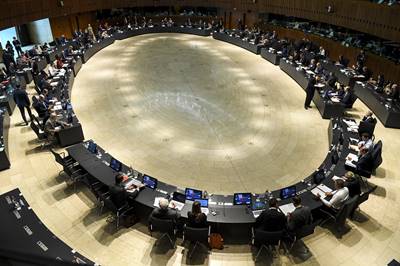
Sonstige Tagungen: Rat (Verkehr, Telekommunikation und Energie)
Frühere Tagungen
Letzte Überprüfung: 16. Januar 2025
