- Justice and Home Affairs Council
Informal video conference of justice ministers, 11 March 2021
Main results
Data retention
Ministers held an exchange of views on the retention of electronic communication data by service providers, which can disclose it to law enforcement and judicial authorities under certain strict conditions. The ministers considered, in particular, whether legislation should be adopted at EU level to ensure a harmonised legal regime or whether police and judicial cooperation should rely solely on national data retention laws.
Ministers reiterated their concern at the impact of the recent case-law of the European Court of Justice on criminal investigations. They highlighted the need to find a common approach on this issue which complies with the rulings of the court and fully respects fundamental rights, and a large majority considered that a common European legal framework would be needed to achieve a coherent response at EU level. The Presidency and European Commission will now reflect on the next steps.
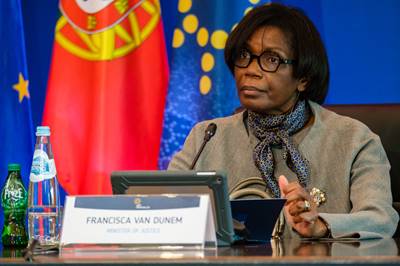
The retention of data is a crucial tool for our law enforcement authorities when carrying out investigations, and it is clear the current situation of uncertainty increases the risks to the security of our citizens. Today we reiterated our commitment to finding a common solution; one which allows our police and judicial authorities to carry out their work while fully ensuring the rights to privacy of our citizens. Francisca Van Dunem, Portuguese Minister for Justice
Fundamental rights
Ministers discussed how to strengthen the application of the EU Charter of Fundamental Rights, and welcomed the Commission strategy presented in December 2020 and the recent Council conclusions on this topic. They also highlighted the important role of the EU agency for fundamental rights (FRA).
The Commission Strategy and the Council conclusions focus on targeted, practical actions, such as training, awareness raising for the public, proper funding and monitoring of the relevant acts, through which the implementation of the Charter can be concretely enhanced.
Judicial training
Ministers were informed about the conclusions on boosting the training of justice professionals, adopted on 8 March 2021.
These conclusions welcome the ambitious European judicial training strategy for 2021-2024, presented by the Commission in December 2020, and emphasise that European judicial training should contribute to fostering respect for the rule of law and strengthening the European rule of law culture. The conclusions also highlight the close ties between judicial training and the digitalisation of justice in the EU.
In the conclusions, the Council calls on member states to encourage the use of training possibilities, invest in the digitalisation of judicial training, enhance training in EU law, emphasise the multidisciplinary approach of judicial training and provide support to the judiciaries beyond the EU, in particular those in the Western Balkans.
European Public Prosecutor's Office
Justice ministers were informed by the Commission about the state of play with regard to the implementation of the EPPO regulation. Work is ongoing in several areas in order to get the EPPO up and running as soon as possible.
In past months progress has been made on the appointment of the European Delegated Prosecutors, however nominations by a number of member states are still pending. Work is also ongoing on the EPPO’s relations with third countries and international organisations. This includes the notification of the EPPO as competent judicial authority under relevant UN conventions and in relation to the 1959 European convention on mutual assistance in criminal matters. It also concerns the identification of third countries with which the EPPO could conclude operational agreements.
Meeting files
Preparatory documents
- Agenda
- Background brief
- Current legislative proposals (information from the presidency)
-
This document is not public. You can send a request to access this document using the link below.Request access to document
- Non-paper from the Commission services and the European Public Prosecutor’s Office (EPPO) on the state of play of the setting up of the EPPO
-
This document is not public. You can send a request to access this document using the link below.Request access to document
-
This document is not public. You can send a request to access this document using the link below.Request access to document
-
This document is not public. You can send a request to access this document using the link below.Request access to document
Outcome documents
Press information
Press contacts
-
Laura Bérard Press officer
- +32 471 33 09 49
- +32 2 281 57 95
If you are not a journalist, please send your request to the public information service.
Accreditation and press events
For general information on accreditation, please visit this page.
Media accreditation for international summits held outside the European Union will be handled by the government authorities of the host country.
Stay tuned
- Sign up for our email alerts to receive updates about this and similar meetings.
- Follow @EUCouncilPress for the latest press updates.
- X hashtag : #JHA
Photos and videos

Other meetings: Justice and Home Affairs Council
Past meetings
Last review: 9 January 2025
