Sanctions against Myanmar
Following the military coup on 1 February 2021, and the subsequent military and police repression against peaceful demonstrators, the EU has drastically increased sanctions against Myanmar.
Support for the people of Myanmar
The EU has repeatedly condemned human rights violations in Myanmar, in particular following the abuses perpetrated by the Myanmar military against the Rohingya minority in 2018 and the military coup of 1 February 2021.
The EU is committed to supporting the people of Myanmar in their quest for a free, peaceful and democratic future.
The repressive actions of the Myanmar military, marked by the use of indiscriminate violence against its own population, are a grave violation of basic human rights and demonstrate a blatant disregard for the principles of justice and humanity.
Reports of widespread atrocities, including extrajudicial killings, arbitrary arrests, sexual and gender-based violence, physical abuse, torture, persecution of human rights defenders and journalists, aerial bombardments and shelling of populated areas, including the targeting of children and camps for internally displaced persons, all illustrate the military's systematic campaign of violence against the very people it is supposed to protect.
In the absence of progress in Myanmar, the EU stands ready to adopt further restrictive measures against those responsible for the serious human rights violations taking place in the country and for undermining democracy and the rule of law.
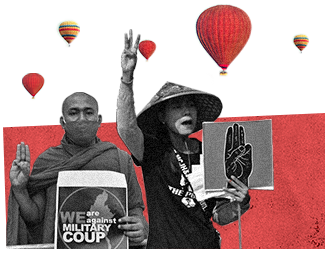
Sanctions in response to human rights violations in Myanmar
The EU introduced the first sanctions in response to human rights violations in Myanmar in 1996. The measures included an arms embargo, travel restrictions and the suspension of high-level bilateral governmental visits.
To encourage the transition towards more democracy , the EU lifted all restrictive measures against Myanmar on 22 April 2013. The arms embargo and the embargo on equipment which might be used for internal repression remained in force.
However, reacting to the systematic human rights abuses perpetrated by the Myanmar military against the Rohingya minority, the Council strengthened the arms embargo in April 2018 and adopted new sanctions against officials responsible for serious human rights violations.
Following the military coup on 1 February 2021, and the subsequent military and police repression against peaceful demonstrators, the EU has drastically increased restrictive measures.
So far, the Council has adopted eight packages of sanctions targeting Myanmar’s military regime, which is responsible for overthrowing the democratically elected government. Sanctions are crafted in such a way as to avoid harm to the people of Myanmar.
Restrictive measures relating to human rights violations in Myanmar include:
- travel bans for individuals
- an asset freeze for individuals and entities
- a prohibition on making funds or economic resources available to those listed
- an arms embargo
- an export ban on equipment that might be used for internal repression
- an export ban on dual-use goods
- a ban on providing technical assistance or financing military activities
- a prohibition of military training and cooperation with the Myanmar armed forces (Tatmadaw)
- a ban on equipment, technology and software to monitor or intercept internet or telephone communication
EU sanctions target persons or entities whose actions, policies or activities undermine democracy or the rule of law, or who threaten the peace, security or stability of Myanmar.
The list of sanctioned individuals includes:
- Min Aung Hlaing, Commander in Chief of the Myanmar armed forces
- members of the State Administration Council
- ministers and deputy ministers
- members of the judiciary
- high-ranking members of the Myanmar navy, armed forces and air force
- prominent businessmen supporting the regime
- members of the Union Election Commission
- politicians and administrators from the Yangon Region
- people responsible for scam operations
The list of sanctioned entities includes:
- State Administration Council
- military-controlled companies
- state-owned or private companies controlled by the armed forces
- departments of the Ministry of Defence
EU sanctions also target members of the Myanmar armed forces, the Myanmar police force and the border guard police responsible for:
- serious human rights violations
- obstructing the provision of humanitarian assistance to civilians in need
- obstructing the conduct of independent investigations into alleged serious human rights violations or abuses
The restrictive measures are annually renewed and were last extended until 30 April 2027.
More information on EU sanctions against Myanmar
Last review: 27 April 2026