"Kasutame küpsiseid, et teie sirvimiskogemust parandada. Nõukogu veebisaidi põhifunktsioonide toetamiseks tuleb kasutada vajalikke küpsiseid. Vabatahtlikud küpsised aitavad meil koostada anonüümseid statistilisi koondaruandeid, et paremini kasutajate vajadusi rahuldada.
Teie loal kasutame internetiküpsiseid, et saada meie külastajate sirvimise ja veebisaidil käitumise kohta anonüümseid koondandmeid. Kasutame neid andmeid selleks, et teha meie veebisaidi kasutamine võimalikult ladusaks.
Nõukogu (majandus- ja rahandusküsimused), 8. juuli 2025
Main results
Enlargement of the euro area
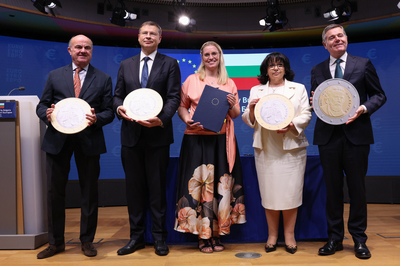
The Council today adopted the final three legal acts which pave the way for Bulgaria to introduce the euro on 1 January 2026.
This completes the process for Bulgaria to become the 21st member of the euro area and to benefit from using the EU’s common currency, the euro, as of next year.
From today, Bulgaria takes its place as the 21st member of the eurozone. This marks the culmination of a thorough process towards Bulgaria’s accession, comprising rigorous analysis and intensive preparation. I warmly congratulate Bulgaria and the Bulgarian people on this tremendous achievement.
Stephanie Lose, Danish minister for economic affairs
Bulgaria follows in the footsteps of Croatia which joined the euro area in January 2023. The European Council endorsed the adoption of the euro by Bulgaria at its meeting of 26 June 2025.
The Council today activated the national escape clause under the Stability and Growth Pact (SGP) for 15 member states to help facilitate their transition to higher defence spending at national level while ensuring debt sustainability.
The member states concerned are Belgium, Bulgaria, Croatia, Czechia, Denmark, Estonia, Finland, Greece, Hungary, Latvia, Lithuania, Poland, Portugal, Slovakia and Slovenia.
At this critical juncture, investment in our defence capabilities must remain our top priority. Today’s activation of the national escape clause will allow Member States to ramp up defence spending while maintaining sustainable public finances.
Stephanie Lose, Danish minister for economic affairs
The clause covers a period of four years and a maximum of 1.5% of GDP in flexibility. In practice, this activation means that a new excessive deficit procedure would not be opened for these 15 member states, even though they may run a government deficit exceeding the 3% reference value set in the Treaties, provided that this excess is due to increased defence spending.
The Danish presidency presented its work programme in the area of economic and financial affairs for the second semester of the year.
Under the slogan ‘A strong Europe in a changing world’, the Danish presidency intends to work for a secure Europe as well as a competitive and green Europe.
A strong and competitive European economy is a prerequisite for financing stronger European defence. And conversely, a secure Europe that can defend itself is a fundamental condition for investments in a competitive economy with strong growth. During our presidency, I want us to have substantial debates and deliver concrete results that strengthen security and competitiveness in Europe.
Stephanie Lose, Danish minister for economic affairs
A central priority for the Danish presidency will be to strengthen the EU’s economic resilience by ensuring the sound and sustainable public finances necessary to meet political priorities, including a swift and cost-effective reinforcement of European defence.
The Presidency will also work to make progress on the simplification agenda to reduce burdens on businesses and strengthen European competitiveness.
The Council today opened a new excessive deficit procedure (EDP) concerning Austria and revised Romania’s net expenditure path in view of its lack of effective action under its EDP, originally opened in 2020.
The EDP is a mechanism designed to ensure that EU member states maintain or return to discipline in their governments’ budgets. Their deficit should not exceed 3% of their gross domestic product (GDP) and their debt should not exceed 60% of their GDP. All member states have to respect these Treaty reference values.
As part of the preventive arm of the EU’s fiscal rules, the Council also endorsed the fiscal expenditure paths of Austria and Lithuania, as laid out in those countries’ national medium-term fiscal-structural plans. The maximum net expenditure path for Austria is aligned with that set out under its EDP.
Medium-term fiscal-structural plans are a cornerstone of the EU’s new economic governance framework, containing member states’ fiscal trajectory, together with envisaged reforms and investments.
Ministers held a policy debate on the single currency package. The package consists of complementary legislative proposals towards the possible introduction of a digital euro and safeguarding acceptance and access to cash in the EU.
During the discussion, ministers broadly supported the presidency’s ambition of finding agreement on the package by the end of 2025 and called for work to be taken forward at both political and technical level to achieve that goal.
In that context, ministers mentioned a number of areas in which progress should be made including regarding possible limits to the amount of digital euros that can be held by individual users, the decision-making process for launching the digital euro, user privacy, a fair compensation model, and the need to ensure that offline payments can be made using the digital euro from the outset.
At the same time, non-euro member states advocated for close communication and cooperation, with a view to fair and balanced arrangements for future possible distribution of the digital euro.
Finally, ministers made clear that the project to put in place a digital euro should complement and not replace the use of cash. In that vein, they expressed full support for the proposal to safeguard acceptance of cash as a payment method throughout the euro area and to guarantee access to basic cash services.
The Commission presented its proposal of 17 June to amend the EU’s securitisation framework,as part of the savings and investment union. Following the presentation, ministers had an initial exchange of views on the proposal.
The EU’s post-crisis securitisation framework has made the market safer and more transparent. However, its stringent requirements – particularly around compliance costs and capital treatment – have been criticised for dampening economic activity.
The Commission’s proposals aim to revitalise the securitisation market by reducing regulatory burdens, enhancing risk sensitivity, and improving supervisory consistency.
During the discussion, ministers welcomed the proposal as an important step to unlock investment, boost competitiveness, promote economic growth and support EU priorities.
At the same time, many member states highlighted the importance of striking the right balance between a thriving securitisation market that supports growth while preserving financial stability.
The Council adopted country-specific recommendations (CSRs) on the economic, social, employment, structural and budgetary policies of each member state.
This step is part of the 2025 European Semester process, which enables member states to coordinate their economic, employment and fiscal policies.
This year, member state recommendations pay particular focus to the issues of competitiveness and security. Moreover, the first recommendation in each CSR invites each member state to reinforce its overall defence spending and readiness, in line with the European Council conclusions of 6 March 2025.
Also under the European Semester, the Council today approved conclusions on the 2025 in-depth reviews under the macroeconomic imbalance procedure (MIP).
Ministers shared their views on the state of play of the economic and financial impact of Russia’s aggression against Ukraine. This is a recurring item on the agenda of ministers of finance and economic affairs.
The Council approved the Commission’s positive assessment of the amended recovery and resilience plans (RRPs) submitted by Austria, Belgium, Czechia, Denmark, Germany and Ireland.
To date, the EU has disbursed more than €317 billion from the facility to member states.