We use cookies to improve your browsing experience. Necessary cookies are required to support essential features of the Council's website. Optional cookies help us produce anonymous and aggregated statistical reports to better serve your needs.
With your permission, we will use cookies to produce aggregated, anonymous data about our visitors' browsing and behaviour on our website. We will use this data to improve your experience on our website.
Foreign Affairs Council (Development), 25/11/2019, 25 November 2019
Main results
Current affairs
The Council touched on the Global Refugee Forum, which will take place in Geneva on 17-18 December 2019. Development ministers were informed about the EU's wider engagement covering the entire range of areas of the Global Compact on Refugees.
The Council was also updated on the state of play of negotiations on the future partnership between the EU and the African, Caribbean and Pacific (ACP) countries, in view of Cotonou framework's expiration in 2020.
The EU wants to maximise the impact of its development aid
Financial architecture for development
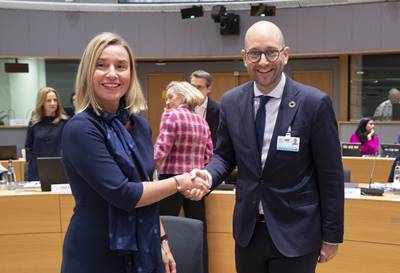
We need to maximise sustainable development results, through quality investments, and we are also interested in the leverage, visibility and ultimately a political return to the European Union.
Federica Mogherini, High Representative for Foreign Affairs and Security Policy
Development ministers had an exchange of views on the future financial architecture for sustainable development following the release of the Wise Persons Group's report on 8 October 2019.
The Chair of the Wise Persons' Group Thomas Wieser presented the final report on how to maximise the added value of the European financial architecture for development, taking into account existing national and international bodies involved. The President of the European Investment Bank (EIB) Werner Hoyer and the President of the European Bank for Reconstruction and Development (EBRD) Sir Suma Chakrabarti also attended the meeting and presented their views.
The report argues in support of consolidating and streamlining development finance and climate activities outside the EU into a single entity, a "European Climate and Sustainable Development Bank", in order to avoid overlaps and to strengthen the EU's presence, role and long-term capacity to deliver on its development priorities. The report also outlines several options on how to achieve this. In addition, it makes the case for taking more immediate steps to create a strong policy centre in the EU and to use the EU development budget in the forthcoming Multiannual Financial Framework as a catalyst for reforming the existing system.
During the discussion, ministers stressed the importance of working towards a common and strategic view, and improving the coherence and effectiveness of EU action, thereby giving greater visibility and impact to the EU as the largest donor in the world. Ministers also highlighted that work should be taken forward on short term measures as soon as possible and that longer term solutions should be based on in-depth analysis.
The Finnish presidency aims at adopting Council conclusions on the report by December 2019, taking into account the guidance provided by development ministers.
The Council discussed how the EU and member states can better cooperate to support development of countries in transition, paying particular attention to the cases of Ethiopia and Sudan. Ministers shared their experience and identified best practices, challenges and priorities which in the case of Ethiopia, focus on economic transition, including private sector engagement.
In a short exchange of views on Sudan, building on the discussions by foreign ministers on 11 November, the Council reaffirmed its support for the peace process and reiterated the importance of including women and youth to achieve long-term stability, as well as the urgency of accompanying the democratic transition with the necessary resources.
Over a working lunch, EU development ministers had an exchange of views with the Minister of Education of Ethiopia, Dr. Tilaye Gete. They looked at learning challenges in Africa from a gender equality perspective.
 We need to maximise sustainable development results, through quality investments, and we are also interested in the leverage, visibility and ultimately a political return to the European Union.