We use cookies to improve your browsing experience. Necessary cookies are required to support essential features of the Council's website. Optional cookies help us produce anonymous and aggregated statistical reports to better serve your needs.
With your permission, we will use cookies to produce aggregated, anonymous data about our visitors' browsing and behaviour on our website. We will use this data to improve your experience on our website.
Foreign Affairs Council, 09/12/2019, 9 December 2019
Main results
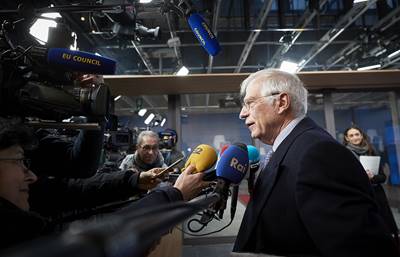
Josep Borrell, the new EU High Representative since 1 December, chaired the Foreign Affairs Council for the first time.
Current affairs
Ministers discussed the latest developments concerning the Turkey-Libya memorandum of understanding on delimitation of maritime jurisdiction and on security and military cooperation and expressed their concerns with the document. The Council also referred to the political situation in Libya, and in particular the Berlin process, which aims to find a sustainable solution to the situation in the country.
Ministers touched upon Ukraine, in the context of the Normandy-four summit which is taking place today in Paris. They also exchanged views on the situation in Iran, following the recent meeting of the Joint Commission of the JCPOA, as well as recent protests in the country. The High Representative briefed on the situation in Bolivia, Hong Kong and Moldova.
Foreign ministers discussed EU-Africa relations in preparation for next year's ministerial and summit-level meetings between the EU and the African Union (AU). The discussion feeds into the debate on a new comprehensive strategy for Africa.
One thing is clear, we cannot have a strategy for Africa without Africa. This has to be something that responds to ownership among Europeans, but mainly with the Africans. We have to reach out to our African partners, and I have asked foreign ministers to be fully engaged on this.
Josep Borrell, High Representative for Foreign Affairs and Security Policy
The Council addressed the political, economic, security and demographic aspects of the relationship. It also touched upon important cross-cutting issues such as climate change and digitalisation.
Ministers emphasised that 2020 will be a pivotal year in the relationship between Africa and the European Union. The next summit will be an important milestone in modernising and scaling up the EU's partnership with Africa.
The Council looked at the promotion and protection of human rights in the world, ahead of Human Rights Day on 10 December.
Foreign ministers assessed the EU's work on human rights, the instruments at its disposal and its priorities for the coming months. They also reaffirmed the EU's leadership in the protection and promotion of human rights worldwide.
The Council reflected on how to improve the EU toolbox on human rights, and the High Representative announced the launch of preparatory work on a possible horizontal sanctions regime to address serious human rights violations.
Ministers also focused on the shrinking space for civil society and the crackdown against human rights defenders in many parts of the world. In this context, the new Action plan for human rights and democracy (2020-2024) was raised. It will set the EU's level of ambition and priorities for the next five years.
Ministers also touched on gender equality and women's rights in view of Beijing +25.
Work ahead: priorities and working together more effectively
Over a working lunch, EU foreign ministers informally discussed the Foreign Affairs Council's working methods. The new High Representative shared his perspective on his priorities as well as on how the EU can work together more effectively to deliver operational outcomes.
 One thing is clear, we cannot have a strategy for Africa without Africa. This has to be something that responds to ownership among Europeans, but mainly with the Africans. We have to reach out to our African partners, and I have asked foreign ministers to be fully engaged on this.