We use cookies to improve your browsing experience. Necessary cookies are required to support essential features of the Council's website. Optional cookies help us produce anonymous and aggregated statistical reports to better serve your needs.
With your permission, we will use cookies to produce aggregated, anonymous data about our visitors' browsing and behaviour on our website. We will use this data to improve your experience on our website.
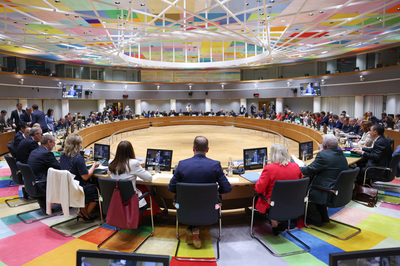
Ministers held a policy debate on the Regulation on a European Chips Act 2.0, presented by the European Commission on 3 June 2026, which aims to strengthen Europe's semiconductor industry, reduce foreign dependencies and boost local demand for chips.
The EU has shown that it can mobilise billions for semiconductors — but investment alone is not enough if we remain dependent on chips made elsewhere. The next chips act must turn ambition into real sovereignty. In the global race for AI and advanced technologies, Europe cannot afford to be just a customer. We must be a frontrunner.
Peter Burke, Ireland’s Minister for Enterprise, Tourism and Employment
Member States broadly welcomed the objectives of the Chips Act 2.0 and stressed the need to strengthen Europe’s semiconductor ecosystem, resilience and competitiveness. The discussion highlighted the importance of reducing strategic dependencies while maintaining open markets and cooperation with trusted international partners. Delegations called for a consistent approach across the semiconductor value chain involving all Member States, including SMEs, start-ups and emerging ecosystems, and emphasised the need to focus investment on areas where Europe has strong capabilities and potential for leadership. Delegations proposed several key priority areas including power semiconductors, photonics, quantum technologies, advanced packaging, chip design, mature technologies and advanced materials. Several ministers also underlined the need to accelerate the transition from research and innovation to industrialisation and market uptake, mobilise public and private investment, secure access to critical raw materials and strengthen skills and talent. At the same time, they called for simple, proportionate and predictable rules, avoiding unnecessary administrative burdens, and for close coordination with other EU initiatives and funding instruments.
The Commission informed ministers of the state of play of the review of the draft Guidelines. The draft Guidelines, made public on 30 April 2026, aim to consolidate more than two decades of antitrust enforcement and case law into a single framework that prioritizes global competitiveness, innovation, and long-term economic resilience. Following a public consultation period that concluded in June 2026, final adoption of the Guidelines is expected by the end of the year.
Member States broadly welcomed the revised draft guidelines, recognising the need to modernise the framework to reflect evolving market realities, and strengthen the EU’s competitiveness. The discussion highlighted broad support for taking greater account of innovation, scale-up opportunities, resilience, sustainability, and efficiencies. Many ministers welcomed the proposed innovation shield for start-ups and scale-ups. At the same time, several ministers stressed that these new criteria should complement, rather than replace, effective competition enforcement and the protection of consumers and SMEs. Finally, a number of ministers called for greater clarity with concrete analysis of economic benefits for the internal market, and guidance for market operators to ensure legal certainty, predictability and transparency.
Embedding economic security in EU competitiveness policy – lunch debate
During lunch, ministers held an informal debate on the issue of “embedding economic security in EU competitiveness policy”.
Any other business
Under any other business, ministers were informed about 11 issues:
The Irish presidency informed ministers about the state of play of the following legislative proposals:
- Industrial accelerator act - Regulation on the 28th regime for company law (EU Inc.) - Regulation establishing the European competitiveness fund
The Commission informed ministers about the state of play of different critical raw materials projects.
The Austrian, Czech, Hungary and Polish and Slovak delegations briefed ministers on the review of the EU Emissions Trading System (ETS) from a Competitiveness Perspective.
The French, German, Italian, Slovak, Spanish and Polish delegations presented their ideas towards a European action plan for the household appliances sector.
The German delegation briefed ministers about the meeting of the ministerial alliance for energy intensive industries that took place in the margins of the COMPET council.
The Czech, French, Hungarian, Italian, Dutch, Portuguese, Slovak and Slovenian delegations called for a swift implementation of the key recommendations issued by the EU critical chemicals alliance.
The Polish Czech, Hungarian and Slovak delegations informed ministers on extended producer responsibility under the urban wastewater treatment directive as a barrier to the competitiveness of the European industries.
The Latvian and Bulgarian delegations informed ministers on a more responsive ‘de minimis’ framework.
The Belgian, French, Dutch and Polish delegation informed ministers about the forthcoming European product regulation.
The Austrian, Belgian, Czech, Dutch, French, German, Italian, Latvian, Luxembourgish, Polish and Slovak delegations presented their views on the General Block Exemption Regulation (GBER).
The Polish delegation informed ministers about the Influence of Regulation on packaging and packaging waste (PPWR) on the Single Market.