We use cookies to improve your browsing experience. Necessary cookies are required to support essential features of the Council's website. Optional cookies help us produce anonymous and aggregated statistical reports to better serve your needs.
With your permission, we will use cookies to produce aggregated, anonymous data about our visitors' browsing and behaviour on our website. We will use this data to improve your experience on our website.
Economic and Financial Affairs Council, 12 December 2025
Main results
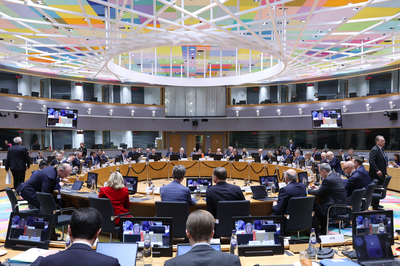
During the Council meeting, ministers agreed on a temporary measure to apply customs duty to the influx of small parcels entering the EU. The Council also took stock of progress made on the single currency package, which includes the digital euro initiative and measures to strengthen the legal tender of euro cash in the EU. At the informal ministerial dinner preceding the meeting, ministers discussed financing for Ukraine.
The Danish presidency has worked hard to deliver on our two priorities, namely a stronger and more secure Europe, and a more competitive Europe.
On security, we have ensured progress on our steadfast financial support for Ukraine, essential for both Ukraine and for Europe’s security, hopefully paving the way for a decision at the European Council. We have also ensured flexibility for member states to ramp up defence expenditures within our fiscal rules.
On competitiveness, we have adopted principles on simplifying financial regulation, an overview of economic consequences of EU proposals and a working method to minimise burdens on businesses, while achieving the benefits from common EU rules. We have found solutions on the digital euro and the securitisation file, as the first major initiative under the savings and investment union. Finalisation and formal Council agreement on these two initiatives are expected in a few days.
Stephanie Lose, Danish minister for economic affairs
Imports of small parcels
The Council today agreed to apply a fixed customs duty of €3 on small parcels valued at less than €150 entering the EU, largely via e-commerce, from 1 July 2026.
This temporary measure responds to the fact that such parcels currently enter the EU duty free, leading to unfair competition for EU sellers, health and safety risks for consumers, high levels of fraud and environmental concerns. The €3 duty will be applied to each different type of item, according to their tariff headings, contained in a consignment.
The measure will stay in place until the permanent arrangement for such parcels, agreed in November 2025, enters into force.
The Council took stock of the state of play on the single currency package, which includes the legislative framework underpinning the digital euro initiative and a regulation clarifying aspects of the legal tender status of euro cash.
The Presidency recognised and welcomed the strong progress towards a Council negotiating position on the package. That position is expected to be adopted before the end of the year and, once finalised, the Council will be ready to enter into interinstitutional negotiations with the European Parliament.
The Council adopted implementing decisions approving targeted amendments submitted by Austria, Cyprus, Czechia, France, Greece, Latvia, Malta, Poland,Portugal and Slovenia to their recovery and resilience plans.
The RRF is the EU’s large-scale financial support programme in response to the challenges the COVID-19 pandemic has posed to the European economy. It is the centrepiece of NextGenerationEU, a temporary recovery instrument that allows the Commission to raise funds to help repair the immediate economic and social damage caused by the pandemic.
To benefit from the facility, member states must submit recovery and resilience plans (RRPs) to the Commission, setting out the reforms and investments they intend to implement by the end of August 2026.
To date, around €378 billion has been disbursed from the RRF.
Ministers approved conclusions on the simplification of financial regulation.
In its conclusions, the Council sets out the contribution that simplification of the EU’s financial services legislation could make to the EU’s overall competitiveness, economic performance and security. It recognises the shared responsibility of all actors involved in the development of legislation in this field to deliver on this goal.
The conclusions also set out a list of concrete guiding principles for this work and outlines the next steps that could be taken by relevant actors in achieving this goal, at all legislative phases and different levels of rules.
During the ECOFIN meeting, the Council also discussed the economic consequences of EU legislation ahead of the expected approval of conclusions on the same subject at the General Affairs Council on 16 December. This topic is set to become a recurring item at the ECOFIN Council.
Following a Commission presentation, ministers discussed the alert mechanism report 2026, published on 25 November 2025, which initiates the European semester’s annual macroeconomic imbalance procedure.
They also exchanged views on the draft euro area recommendation, issued on the same day. This recommendation addresses key issues for the functioning of the euro area. The draft text will be discussed and amended as necessary by member states before Council endorsement early next year.
The Council exchanged views on the Commission’s recent report on the excessive deficit procedure, published 25 November 2025.
The report is a key element of the stability and growth pact, which defines rules for the monitoring and coordination of national fiscal and economic policies and comprises a preventive and a corrective arm.
Ministers also endorsed the recast code of conduct on the implementation of the pact, prepared and agreed by the economic and financial committee (EFC).
The code of conduct provides guidance in the wake of the new economic governance framework in place since 30 April 2024.