We use cookies to improve your browsing experience. Necessary cookies are required to support essential features of the Council's website. Optional cookies help us produce anonymous and aggregated statistical reports to better serve your needs.
With your permission, we will use cookies to produce aggregated, anonymous data about our visitors' browsing and behaviour on our website. We will use this data to improve your experience on our website.
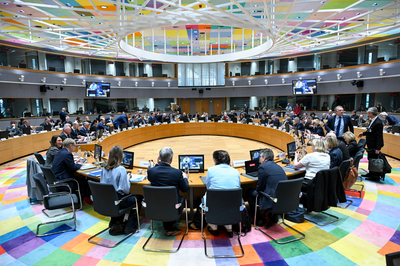
Justice and Home Affairs Council (Home Affairs), 5 March 2026
Main results
Migration
Ministers exchanged views on the external dimension of migration. Strengthening cooperation with key third countries remains a central pillar of the EU’s migration policy. In this context, discussions focused on Lebanon and Libya, two key transit countries along the Eastern and Central Mediterranean migration routes. Many ministers reaffirmed their support for Lebanon and are in favour of a more structured cooperation with the country, once necessary reforms in various other areas are implemented. On Libya, several ministers underlined the importance of supporting cooperation at technical level, highlighting that preventive actions, combatting smugglers' networks and enhancing voluntary returns remain priorities.
The Commission gave an update on the implementation of the asylum and migration pact, ahead of its entry into application on 12 June 2026. The pact will make the common European asylum system more effective with faster procedures and clearer rules regarding both sharing responsibility and solidarity among member states. It will also contribute to reducing the migratory pressure on all member states.
Furthermore, the Commission presented the EU migration and asylum strategy, which sets out the Commission’s strategic view on migration and asylum policy for the next five years. Ministers also took stock of progress on the revised Eurodac system, which is expected to be fully ready for launch on 12 June.
To mark the launch of the pact, the Cyprus Presidency announced it will host a ministerial conference on 12 June in Nicosia.
We are in the final stretch before the asylum and migration pact enters into application on 12 June. Ensuring a smooth launch of the pact is one of our highest priorities, so that it can start delivering tangible results: stronger and more secure external borders, faster procedures and greater solidarity between member states.
Nicholas A. Ioannides, Deputy Minister for Migration and International Protection of the Republic of Cyprus
Ministers of home affairs discussed the overall state of the Schengen area. The Commission presented the Schengen Barometer and briefly touched upon the recently published EU visa strategy.
As part of the implementation of the Schengen Council cycle priorities for 2025-2026, ministers discussed how to encourage voluntary returns, especially at an early stage of the process. While member states agreed this remains the preferable option, they also underlined that voluntary returns work better when combined with robust measures for forced returns. Ministers also exchanged views on how to use incentives for returns and reintegration support more strategically.
Ministers also approved the revised post-2026 roadmap for the interoperability of the EU’s large-scale IT systems for justice and home affairs, including milestones on the launch of the revised Visa Information System and the EU Visa Application Platform. The interoperable IT systems will improve the external border management and ensure greater internal security of the Schengen area.
Ministers exchanged views on the future of Europol and gave political guidance to the Commission as input for a legislative proposal expected in June 2026 on the overhaul of Europol’s mandate to better support member states.
The Council confirmed that the upcoming legislative proposal should aim to increase Europol’s role as a central hub for the exchange and analysis of information, including through the use of new technologies. Ministers confirmed the proposal should also reinforce Europol’s cooperation with other EU agencies and bodies by strengthening interoperability. The Council also discussed the role that Europol should play in addressing hybrid threats.
Many member states favoured maintaining the current scope of the agency’s mandate as regards crime areas. Finally, ministers confirmed that the existing governance model of Europol could be strengthened without creating new structures.
Ministers discussed over a working lunch the impact of the current developments both in SyriaandIran on the EU's internal security. The discussions focused on the current threats and on the rapidly evolving situation in both countries. Ministers took stock of the main security concerns stemming from the current situation in northeast Syria, particularly in the camps, prisons and detention facilities. Discussions also included the fast-escalating situation in Iran, in the context in which military reactions targeted various countries in the region over the past days, posing a serious threat to the stability of the region and beyond. Possible actions to mitigate the identified risks to the internal security of the EU and its member states were outlined.
The EU Counterterrorism Coordinator, the External Action Service, Europol and Frontex contributed to the discussion.
EU drugs strategy
The Council approved conclusions on the EU Drugs strategic framework and endorsed the EU drugs strategy proposed by the Commission on 4 December 2025.
Under other business, Estonia presented an initiative regarding a coordinated response to the threat to European internal security posed by Russian combatants and former combatants. Lithuania underlined the importance of referring to hybrid threats as an objective in the financial instrument dealing with internal security of the new MFF.
The Commission presented an agenda on preventing and countering terrorism and violent extremism, which builds on the European internal security strategy (ProtectEU) published in April 2025.
The Commission also gave an update on the situation in Ukraine related to temporary protection status.