Political reflection on the future of the European Union
-
1 January
EU heads of state or government met in Rome, Italy, on 25 March 2017, to celebrate the 60th anniversary of the Rome Treaties. This was an occasion to reflect on the state of the European Union and look at the future of the integration process.
In the Rome Declaration, adopted at the end of the celebrations, the leaders set out a joint vision for the years to come. They pledged to work towards:
- a safe and secure Europe: where all citizens can move freely; with secured external borders and an efficient migration policy
- a prosperous and sustainable Europe: promoting sustained and sustainable growth, with a strong single market
- a social Europe: fighting unemployment, discrimination, social exclusion and poverty
- a stronger Europe on the global scene: developing existing partnerships and building new ones, committed to strengthening its common security and defence
The Rome Declaration concluded the political reflection process that had started in Bratislava on 16 September 2016, following the results of the UK referendum in June 2016.
-
2017
25 March60th anniversary of the Rome Treaties
EU heads of state or government met in Rome, Italy, on 25 March 2017, to celebrate the 60th anniversary of the Rome Treaties. This was an occasion to reflect on the state of the European Union and look at the future of the integration process.
At the end of the celebrations the leaders adopted and signed the Rome Declaration setting out a joint vision for the years to come. "We have united for the better. Europe is our common future," they said in the Declaration.
Leaders declared that, aware of the concerns of the EU citizens, they commit to the Rome Agenda, and pledged to work towards:- a safe and secure Europe
- a prosperous and sustainable Europe
- a social Europe
- a stronger Europe on the global scene
-
2017
1 MarchThe White Paper on the future of Europe
The document was published by the European Commission ahead of the 60th anniversary of the Treaties of Rome. It sets out five scenarios, each offering a glimpse into the potential state of the Union by 2025 depending on the choices Europe will make.
The scenarios look at how Europe will change in the next decade, from the impact of new technologies on society and jobs, to doubts about globalisation, security concerns and the rise of populism.
-
2017
31 JanuaryInformal summit of EU heads of state or government in Malta
The informal summit, hosted by the Maltese Prime Minister Joseph Muscat and chaired by European Council President Donald Tusk, was an occasion for the 27 leaders to prepare for the upcoming 60th anniversary of the Rome Treaties on 25 March 2017.
The discussions built upon the political reflection on the future of the EU with 27 member states, launched immediately after the UK voted to leave the European Union on 23 June 2016 and continued in Bratislava on 16 September 2016.
-
2017
31 JanuaryLetter on the future of Europe
"United we stand, divided we fall", said Donald Tusk ahead of the Malta summit.
In his letter sent to the 27 heads of state or government, President of the European Council identified three main threats, which threaten the stability of Europe. These include:
- new geopolitical situation: an increasingly assertive China, Russia's aggressive policy towards Ukraine and its neighbours, wars, terror and anarchy in the Middle East and in Africa (with radical Islam playing a major role) and "worrying declarations" by the new American administration all make our future highly unpredictable
- internal situation: a rise of the nationalist, increasingly xenophobic sentiment in the EU itself
- state of mind of the pro-European elites: decline of faith in political integration, submission to populist arguments and doubt in the fundamental values of liberal democracy
In the letter, President Donald Tusk called on the leaders to stay united.
"It must be made crystal clear that the disintegration of the European Union will not lead to the restoration of some mythical, full sovereignty of its member states, but to their real and factual dependence on the great superpowers: the United States, Russia and China. Only together can we be fully independent", Tusk said.
-
2016
13 DecemberCouncil agrees negotiating position on trade defence instruments
The Permanent Representatives Committee (Coreper) agreed on the Council's negotiating position on a proposal to modernise the EU's trade defence instruments.
The proposed regulation amends current anti-dumping and anti-subsidies regulations to better respond to unfair trade practices. The purpose is to shield EU producers from damage caused by unfair competition, ensuring free and fair trade.
-
2016
7 DecemberAgreement on systematic checks at external borders
The Permanent Representatives Committee (Coreper) approved a compromise text agreed with the European Parliament on an amendment to the Schengen Borders Code to reinforce checks against relevant databases at external borders.
-
2016
7 DecemberEuropean Border and Coast Guard Agency launches rapid reaction pool
The rapid reaction pool is made of 1 500 officers committed by EU member states and Schengen associated countries. In a crisis situation, they will be put at the immediate disposal of Frontex, which can deploy them within five working days.
-
2016
6 DecemberCouncil agrees to extend the European fund for strategic investments
The Council agreed its stance on a proposal to extend the lifespan of the European fund for strategic investments (EFSI), the EU's flagship initiative under its 'investment plan for Europe'.
The agreed compromise involves extending the EFSI in terms of both duration and financial capacity, mobilising at least half a trillion euros of investments by 2020. It also introduces a number of operational improvements to take account of lessons learned from the first year of implementation.
-
2016
6 DecemberCommon set of proposals to implement the EU-NATO joint declaration
The Council adopts conclusions on the Implementation of the EU-NATO Joint Declaration, endorsing 40 proposals in the 7 areas. These proposals are endorsed on the same day by the North Atlantic Council.
-
2016
14 NovemberImplementation plan on security and defence
EU foreign and defence ministers discuss the implementation plan on security and defence under the EU global strategy. They set out the level of ambition and the way forward on the future development of EU security and defence policy.
-
2016
30 OctoberCETA signature
Donald Tusk, President of the European Council, Jean-Claude Juncker, President of the European Commission, and Justin Trudeau, Prime Minister of Canada met in Brussels for the 16th EU-Canada summit. They signed the EU-Canada Comprehensive Economic and Trade Agreement (CETA) and the Strategic Partnership Agreement (SPA) and issued a joint declaration on the EU-Canada partnership.

-
2016
20 OctoberEuropean Council, 20-21 October 2016
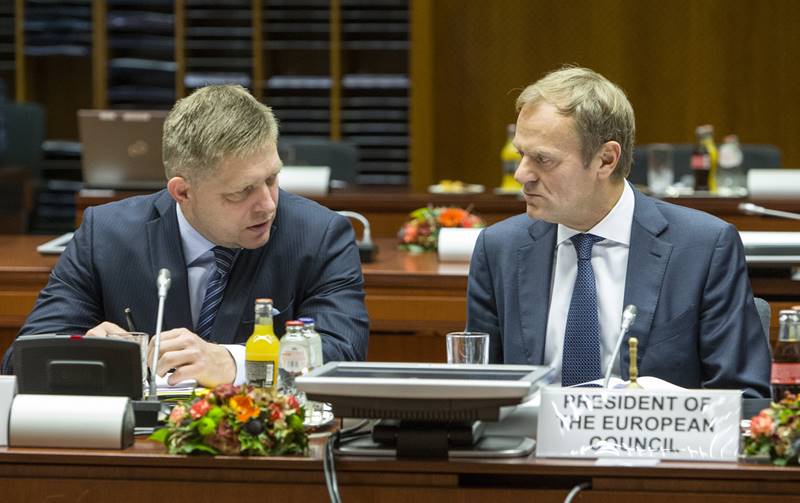
Leaders took stock of the state-of-play regarding the Bratislava Roadmap. Prime Minister Fico briefed them on the results so far, including the Paris Agreement ratification and the launch of the European Border and Coast Guard.
-
2016
6 OctoberLaunch of the European Border and Coast Guard Agency
The European Border and Coast Guard Agency was officially launched on 6 October 2016. The launch event took place at the Kapitan Andreevo Border Checkpoint at the Bulgarian external border with Turkey.
"We are creating a new reality at our external borders. This is a tangible outcome of the joint commitment agreed in the Bratislava Roadmap, as well as a practical display of unity among member states," said Robert Fico, Prime Minister of Slovakia and holder of the rotating Presidency of the Council. "It will help us to get back to Schengen," he added.
The European Border and Coast Guard Agency will closely monitor the EU's external borders and work together with member states to quickly identify and address any potential security threats to the EU's external borders.
-
2016
5 OctoberEU ratifies the Paris Agreement
The EU officially ratified the Paris Agreement, which also triggered its entry into force. Representatives of the Council presidency and the European Commission deposited the official documents for ratification with the UN's Secretary-General.
The agreement enters into force 30 days after the ratification by at least 55 countries accounting for at least 55% of global greenhouse gas emissions. This threshold was achieved after the ratification by the EU and 7 of its member states.
The entry into force will take place before the beginning of the Marrakesh climate change conference on 7-18 November 2016.

-
2016
16 SeptemberBratislava summit, 16 September 2016
The heads of state or government of the 27 met in Bratislava to begin a political reflection on further development of an EU with 27 member countries.
Leaders agreed on the Bratislava Declaration and Roadmap, which set out the objectives for the coming months:
- restoring full control of the external borders
- ensuring internal security and fighting terrorism
- strengthening EU cooperation on external security and defence
- boosting the single market and offering better opportunities for young Europeans
-
2016
18 AugustConsultations ahead of the Bratislava summit
In August and September 2016 President Tusk consulted all the EU leaders ahead of the meeting in Bratislava.
"I have no doubt that the three main challenges are uncontrolled irregular migration, terrorism, and the fears of globalisation," said President Tusk before his meeting with Swedish Prime Minister Stefan Löfven in Stockholm. "My ambition is that in Bratislava we can agree on the main priorities and what we need to do about them in the next few months."
On 8 September, President Tusk also travelled to London to exchange views with British Prime Minister Theresa May.
-
2016
29 JuneInformal meeting of the 27 EU heads of state or government, 29 June 2016
The 27 leaders met informally to discuss the way forward after the referendum in the UK on 23 June 2016.
"We are determined to remain united and work in the framework of the EU to deal with the challenges of the 21st century and find solutions in the interest of our nations and peoples," they said in the joint statement.
Leaders agreed on the following principles:
- there can be no negotiations with the UK before the notification of Article 50
- in the future, UK should be a close partner of the EU
- agreements will have to be based on a balance between rights and obligations
- access to the single market requires acceptance of all four freedoms
The 27 leaders agreed to meet again in September 2016 to continue talks on the future of the EU.
