We use cookies to improve your browsing experience. Necessary cookies are required to support essential features of the Council's website. Optional cookies help us produce anonymous and aggregated statistical reports to better serve your needs.
With your permission, we will use cookies to produce aggregated, anonymous data about our visitors' browsing and behaviour on our website. We will use this data to improve your experience on our website.
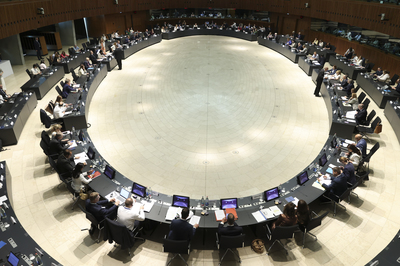
Environment ministers discussed progress on the amendment of the regulation on CO2 emission standards for cars and vans, the role of a nature as an economic asset and the way forward on the water resilience strategy and the REACH regulation.
The Cyprus presidency, guided by our motto 'An autonomous Europe, open to the world', has delivered tangible progress on the EU’s climate and environment agenda, balancing ambition with competitiveness, and reinforcing the EU’s capacity to respond effectively to environmental challenges while strengthening its global leadership in key international processes. A thriving economy, environmental stewardship and climate neutrality are complementary pillars, essential for a prosperous future for all Europeans.
Maria Panayiotou, Minister of Agriculture, Rural Development and Environment of the Republic of Cyprus
CO2 emission standards for cars and vans
Ministers discussed the proposal for a regulation amending the rules on CO2 emission performance standards for new cars and vans. The Council took stock of the progress made on negotiations within the Council during the Cyprus presidency, including on the good progress on the provisions on vehicle labelling. These provisions will oblige distributors to provide information to consumers,notably on CO2 emissions, fuel and electric consumption and electric range.
Ministers focused their interventions on the main outstanding issues in the proposal: the proposed emission reduction targets for 2030 and 2035 and the new flexibilities introduced for manufacturers to help the car sector navigate the clean transition, inter alia, super credits for small electric vehicles “made in the EU”, credits for low-carbon steel “made in the EU” and fuel credits, including more broadly the role of renewable fuels.
The proposal on the revision of the CO2 emission performance standards for new cars and vans was presented as part of the automotive package that also includes a proposal on clean corporate vehicles and proposals to simplify automotive legislation (automotive omnibus).
The Council took stock of the progress made on the water resilience strategy, adopted by the Commission on 4 June 2025. The strategy aims to address the growing challenges of water scarcity, drought, and floods across Europe, exacerbated by climate change. In 2022, Europe experienced its worst drought in 500 years, impacting over 40% of the continent.
Environment ministers shared challenges faced and lessons learned over the past year, particularly as regards the promotion of water efficiency. Looking ahead, they also discussed digital solutions for the water sector and ways to attract greater private investment and make better use of innovative financing instruments.
Ministers discussed the risks of biodiversity loss for businesses, competitiveness and the economy and how to manage them. They acknowledged that biodiversity loss is not only a crisis for ecosystems, but also a direct threat to economic prosperity, competitiveness, and resilience. Businesses will need to thrive within nature’s boundaries rather than at its expense, in order to secure resources, supply chains and infrastructure.
In concrete, the Council examined ways to unlock the potential of ecosystem services and to incentivise the transition to a nature-positive economy, including predictable and measurable funding and the use of nature credits as a mechanism to reward nature stewardship.
EU chemicals policy: the future of REACH legislation
Ministers exchanged views on the future of the REACH regulation. This law covers the registration, evaluation, authorisation and restriction of chemicals, ensuring a high level of protection for human health and the environment.
Discussions focused on ways to address the compliance gap and strengthen enforcement, especially concerning chemical substances imported from third countries and online sales. In the absence of a full revision of the regulation, ministers discussed ways to modernise and simplify the existing rules while providing clarity and certainty for operators and authorities, including through secondary legislation.
Ahead of COP31 and before handing over to the incoming Irish presidency, the Cyprus presidency took stock of actions taken to strengthen the EU’s negotiating position in international climate meetings.
These actions include developing a first multiannual EU COP vision, launching early discussions on COP31 priorities, strengthening coordination and climate diplomacy, and improving cross-sectoral cooperation and information-sharing, in an effort to adjust EU’s approach to the changing geopolitical realities.
Member states reaffirmed the importance of preserving the unity of the European Union and ensuring a coordinated response to safeguard both the integrity of the process and the interests of the Union as a whole.
The presidency and the Commission briefed ministers on the 15th conference of the parties to the Convention on the conservation of migratory species of wild animals held in Brazil in March 2026. Information note
The Commission provided information on the upcoming 17th conference of the parties to the UN Convention to combat desertification (UNCCD COP 17).
Austria, Italy, Luxembourg and Spain presented the outlook and results of 34 years of implementing LIFE regulation. Information note
The Czech Republic, Bulgaria, Italy, Latvia, Poland, Romania, Slovakia and Slovenia highlighted implementation challenges of the packaging and packaging waste regulation. Information note
Germany, Denmark, France, the Netherlands and Slovenia called for a coordinated EU approach to tackle ultra-fast fashion. Information note
France provided information on international negotiations on the global plastics treaty. Information note
France raised the issue of member states coordination in combating invasive alien species and preventing their spread. Information note
France publicly called for greater consistency between energy sector provisions and the European grids package. Information note
Italy, Bulgaria and the Czech Republic informed ministers about high-voltage switchgear and the action needed for a strong secure European power electricity grid.
The Netherlands raised the issue of implementing the Global Stocktake, presenting results and follow-up to the first conference on the transition away from fossil fuels. Information note
Croatia reported on the MED9 meeting of environment ministers (Šibenik, Croatia 18 – 19 May 2026), with a focus on water supply resilience and marine environment protection. Information note
Belgium, Luxembourg and the Netherlands informed ministers on the Benelux non-paper on the upcoming circular economy act. Information note
Ireland presented its work programme for the next semester as the incoming Council presidency.