We use cookies to improve your browsing experience. Necessary cookies are required to support essential features of the Council's website. Optional cookies help us produce anonymous and aggregated statistical reports to better serve your needs.
With your permission, we will use cookies to produce aggregated, anonymous data about our visitors' browsing and behaviour on our website. We will use this data to improve your experience on our website.
Foreign Affairs Council (Defence), 19 November 2024
Main results
Let me take a look at what we did during these last five years. First, we put the European Peace Facility into action. And through it, we have provided support to over 20 countries around the world, not just Ukraine. […] Second, we agreed on the Strategic Compass. […] This was approved more or less at the same time that Russia launched its aggression against Ukraine. At that time, nobody was talking about security and defence. It was the first time we launched the idea that security and defence had to be very high on the EU agenda. Third, we strengthened our capacities on cyber and hybrid threats. We improved our defence capacities and strengthened the European defence industry. Together with my fellow Commissioner Breton, we published the European Defence Industrial Strategy, and we put the defence industry as a priority in the development of the industrial sectors. We launched important missions and operations for crisis management in the Red Sea, the Mediterranean, Mozambique, Moldova and Armenia and we trained about 70 000 Ukrainian soldiers. Denmark abandoned its opt-out from defence and joined the European Defence Agency. New partners from outside the EU are looking to enhance cooperation on security and defence.
Josep Borrell, High Representative for Foreign Affairs and Security Policy
EU support to Ukraine
The Foreign Affairs Council, in its Defence configuration, discussed EU military support for Ukraine.
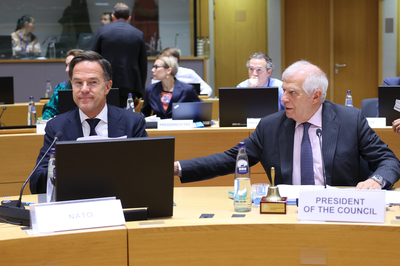
After the EU-27 internal discussion, EU Defence Ministers exchanged views with NATO Secretary-General, Mark Rutte, who joined in person for the first time, with the Defence Minister of Ukraine, Rustem Umerov, and with advisor to President Zelenskyy on Strategic Affairs, Alexander Kamyshin, via VTC.
The fate of the Ukrainians will determine the destiny of the European Union. And if Putin is successful in Ukraine, we will pay a very high bill, it will be much more expensive than any kind of military support that we could provide today.
Josep Borrell, High Representative for Foreign Affairs and Security Policy
During the discussion, the High Representative stressed that military support from the EU and its member states has now reached more than €45 billion, and that the EU has almost achieved its objective of delivering 1 million artillery ammunition rounds to Ukraine.
EU Defence Ministers touched on the European Peace Facility, use of the second tranche of so-called windfall profits (i.e. net profits stemming from unexpected and extraordinary revenues accruing to central securities depositories in the EU, as a result of implementing the EU’s restrictive measures), and of continued training support through the EU Military Assistance Mission in support of Ukraine (EUMAM Ukraine).
Defence readiness and preparedness
The Council held a discussion on defence readiness and preparedness, against the backdrop of the report “Strengthening Europe’s civil and military preparedness and readiness” tabled on 30 October by Sauli Niinistö – former President of the Republic of Finland and Special Adviser to the President of the European Commission – who attended the Council meeting to exchange views with EU Defence Ministers.
The High Representative stressed that the EU needs to spend more, better and also in a more European way. He also highlighted that the European Investment Bank can play a crucial role in supporting defence initiatives, and that it is imperative that the EU implements the European Defence Industrial Strategy without delay and adopts the European Defence IndustryProgramme by mid-2025.
In the ensuing discussion, EU Defence Ministers reviewed their efforts to strengthen the EU’s defence readiness and overall preparedness against crises.
The ministerial discussion will feed into preparations for the forthcoming White Paper on the future of European Defence.
Council conclusions
The Council approved conclusions on the Permanent Structured Cooperation (PESCO) strategic review.
EU Ministers of Defence met in the European Defence Agency (EDA) Steering Board, chaired by High Representative Borrell in his capacity as Head of Agency.
In addition to the EDA’s 2025 general budget, staff establishment plan and three-year planning framework, ministers approved the 2024 Coordinated Annual Review on Defence (CARD) report, which presents key findings and recommendations based on an analysis of member states’ defence spending and defence plans, including their alignment with the 2023 EU Capability Development priorities.