We use cookies to improve your browsing experience. Necessary cookies are required to support essential features of the Council's website. Optional cookies help us produce anonymous and aggregated statistical reports to better serve your needs.
With your permission, we will use cookies to produce aggregated, anonymous data about our visitors' browsing and behaviour on our website. We will use this data to improve your experience on our website.
Competitiveness Council (Internal market and industry), 29 September 2025
Main results
European Competitiveness Fund
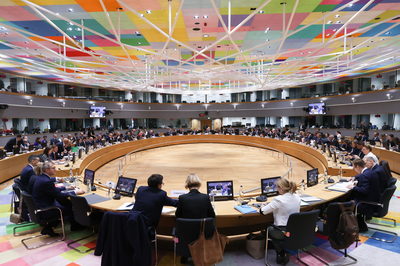
Ministers held a policy debate on the European Competitiveness Fund (ECF), one of the main elements of the 2028-2034 long-term EU budget (the forthcoming multiannual financial framework, MFF). Member states welcomed the ECF as a key instrument that may help to close the current investment gap, provide financial support to companies, leverage private capital and mitigate investment risks.
Most of delegations called for an urgent implementation of the ECF and insisted that Member States must be fully involved in the decision making and governance of the ECF. Most delegations underlined the need to take into consideration the needs of both businesses and investors. This implies ensuring simplified, transparent, and efficient procedures that limit the administrative burdens to a bare minimum. Many called for particular focus to be paid to SMEs. There were also many calls for focus on excellence as well as on measures to ensure geographical balance.
Ministers held a political debate on simplification measures following the presentation, by executive vice-president Séjourné, of the first progress report on this issue. While efforts are being made to reduce administrative burdens (namely with the so-called omnibus packages), new legislative proposals still pose significant costs to businesses. Ministers reflected on the right balance between necessary new legislation and unnecessary administrative burdens for businesses, and the role of the Competitiveness Council to ensure that new rules are proportionate to the objectives of the legislation. Most ministers welcomed the simplification report and the omnibus approach for reducing existing burdens, although some interventions recalled that simplification does not mean deregulation.
For future legislation, many delegations called for the application of better regulation principles, like the systematic use of impact assessments (including SME tests and competitiveness checks), ex-post evaluations, consultations with stakeholders or reality checks. Several delegations recalled the need to have digital by default and to generalize the principle one-in-one-out, meaning that any new legislation should remove an existing one (some delegations even suggested to move to one-in two-out). There was a general agreement that the COMPET councils should continue to monitor the current simplification efforts and be vigilant to avoid future additional burdens.
The Danish Presidency is committed to cutting red tape and reducing burdens for European businesses. At the same time, we must make sure that new EU legislation does not introduce unnecessary burdens. I was happy to hear EVP Séjourné present his view on this important task today. We will continue our close cooperation towards a stronger and more competitive Europe.
Morten Bødskov, Minister for Industry, Business and Financial Affairs
During lunch, ministers exchanged views on the single market strategy. Enrico Letta, former Italian prime minister, president of the Jacques Delors Institute and author of the report “Much more than a market” took part in the discussion. Ministers expressed their views on digital initiatives to deliver a burden-reducing digital shift based on companies’ needs, and the implementation of ambitious digital initiatives across member states and businesses.
Under any other business, ministers were informed of six issues:
The Austrian delegation together with Czechia, Croatia, Greece, Luxembourg, the Netherlands and Slovenia made an information point on ‘bringing an end to unjustified territorial supply constraints’
The Commission made a presentation on the state of play of the Omnibus simplification packages
The Dutch delegation made an information point on the 2025 semiconductor declaration for a revised EU Chips Act
The Commission briefed ministers on the third strategic dialogue with the automotive industry that took place in Brussels on 12 September
The French delegation had an information point on reconciling the 2040 climate target with European industrial competitiveness
The German, French and Italian delegations made an information point on the Commission announcement of the Industrial Decarbonisation Accelerator Act (IDAA)