We use cookies to improve your browsing experience. Necessary cookies are required to support essential features of the Council's website. Optional cookies help us produce anonymous and aggregated statistical reports to better serve your needs.
With your permission, we will use cookies to produce aggregated, anonymous data about our visitors' browsing and behaviour on our website. We will use this data to improve your experience on our website.
The Foreign Affairs Council exchanged views on the Russian aggression against Ukraine.
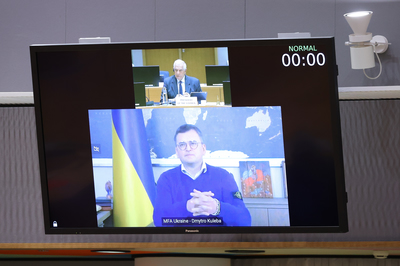
Before the Council discussion, the Foreign Minister of Ukraine, Dmytro Kuleba, briefed EU ministers via video conference about the latest developments on the ground and Ukraine's current priorities.
The Council reconfirmed that the EU stays united in its support to Ukraine, and discussed about continued military support to Ukraine. In this regard ministers welcomed the decision to launch the EU Military Assistance Mission to Ukraine to provide at least 15 000 Ukrainian soldiers with training.
Ministers also discussed overall approach to Russia.
We will continue to isolate Russia internationally, impose restrictive measures against Russia. We stand ready to continue reinforcing restrictive measures against Russia, and target third countries involvement, especially those who are providing arms and military support, Iran and Belarus.
Josep Borrell, High Representative for Foreign Affairs and Security Policy
The Council focused on ensuring accountability for violations of international law and war crimes committed in Ukraine, working closely with NATO and partners worldwide to defend the rules-based international order, and enhancing the EU's resilience - in particular on energy security and critical infrastructure - countering Russia’s hybrid threats, and information manipulation.
The EU is supporting the civil society, human rights defenders and independent media inside and outside Russia, though EU's immediate support focuses on helping Ukraine to resist Russia’s increased systematic targeting of civilians and civilian infrastructure.
Lastly, the Council also touched on the issue of food security. The Black Sea Grain Initiative has helped relaunch grain shipments from Ukraine's Black Sea ports and further reducing food prices globally. The international community now needs to ensure the renewal of this initiative beyond the 19 November deadline.
EU sanctions in response to Russia’s military aggression against Ukraine (infographic)
Great Lakes
The Council held a discussion on the possible elements of a renewed EU approach to the Great Lakes region in Africa.
The Great Lakes region is a geostrategic hotspot that has the potential to become a powerhouse for development on the entire African continent: a region of many challenges and many opportunities.
Ministers agreed on the need to renew the EU's strategy on the region as early as at the December Foreign Affairs Council, in order to support the region to move from tensions to trust, from trafficking to trade, and from competition to regional integration.
Western Balkans
The Council exchanged views on Western Balkans, and expressed concern about the numerous crises which are looming in the region, and the immediate damaging impact of Russia's aggression against Ukraine.
The shockwaves of this war are hitting the Western Balkans. To counter that we are stepping up our engagement, as the Western Balkans remain our geostrategic priority. I want to insist on the basic idea that the future of Western Balkans lies in the EU. This our message ahead of the next EU-Western Balkans Summit on 6 December.
Josep Borrell, High Representative for Foreign Affairs and Security Policy
The High Representative briefed ministers about his engagement as facilitator of the Belgrade-Pristina Dialogue with Prime Minister Kurti and President Vučić to defuse the unnecessary and counterproductive tensions between Kosovo and Serbia. He stressed that this is the most serious crisis since 2013, and both parties need to urgently show readiness to find a way forward to lower tensions. It is not acceptable for either party to violate or ignore their Dialogue obligations.
Ministers concurred that both parties in Dialogue need to show more flexibility, and there needs to be timely and clear progress. Kosovo Serbs need to return to institutions. Kosovo authorities must show more flexibility on licence plates and work on the implementation of the agreement on the Association/Community of Serb Majority Municipalities without delay.
The Council also discussed about the hybrid threats directed at the region and condemned the attack against Albania and the one against Montenegro’s IT infrastructure in August. Ministers agreed to step up the EU's work with and support for partners on cyber-defence.
Current affairs
EU ministers had an exchange of views on Iran and the unabated repressive reaction of the public authorities to the public discontent. In this regard, the Council adopted restrictive measures against 29 individuals and 3 entities, in view of their role in the death of Mahsa Amini and the violent response to the recent demonstrations in the country. Ministers also insisted on Iran to stop providing arms that Russia is using to commit atrocities against the Ukrainian people.
The Council also discussed Lebanon, and the deepening political vacuum in the country. It is crucial for the country to urgently conclude Presidential elections to unlock long-overdue economic reforms and get international support. The Council did not rule out any option to unblock the current political stalemate, including possible sanctions.
Other Council decisions
The Council imposed additional restrictive measures in view of the continued threat posed by the proliferation and use of chemical weapons.
Before the beginning of the Council meeting, EU Foreign Affairs Ministers had an informal discussion with the Leader of Belarusian democratic forces Sviatlana Tsikhanouskaya, and reconfirmed EU solidarity with the people of Belarus.
The Council also adopted without discussion the items on the list of non-legislative A items.
 We will continue to isolate Russia internationally, impose restrictive measures against Russia. We stand ready to continue reinforcing restrictive measures against Russia, and target third countries involvement, especially those who are providing arms and military support, Iran and Belarus.