- EU Council bibliography
- 19 Feabhra 2018
'How did we get into this mess?'
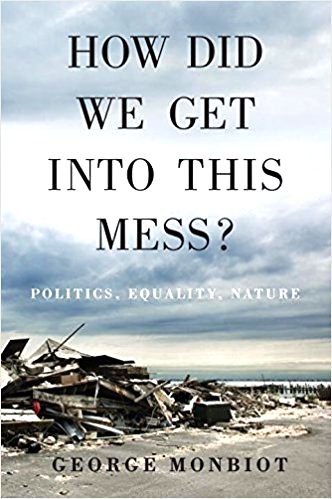
The author George Monbiot is a British political activist and scholar. In How did we get into this mess? he also comes across as an untired campaigner for social, economic and environmental justice, without, however, analysing the chances and costs of building the better world he calls for. His book is comprised of 51 essays written and published over the course of the past decade. In his writings, Monbiot attempts to address an array of the modern world's problems, such as hyper-consumption, the political values crisis, unequal wealth distribution, environmental devastation and the exploitation of workers, and also name and shame those he finds responsible for this "état des choses".
But what might at first seem to be an interesting take on the disorder and complexities of contemporary life swiftly turns into a plain and universal manifesto for those dissatisfied with the status quo. Somewhat divisive and at times apocalyptic in tone, the book touches on many important subjects yet Monbiot rarely does more than scratch the surface. Full of uni-polarized critique, How did we get into this mess? seems to be aimed mostly at emphasising contrasts between the modus operandi of the powerful and the rest of the world who are their victims.
Although the author tends to cite relevant research results and present the viewpoints of some prominent academics in his work, the data sourced for the book mostly vocalizes and prove his points rather than serving to provide a neutral, deep and cool-headed analysis. Therefore, it is hard to call his account, which embraces a true myriad of contemporary topics, an even-handed one. Nor does Monbiot choose to exercise restraint when it comes to overgeneralizations, which ultimately catalogues his work as hardly journalistic, which is contrary to how it is being promoted by the publisher. Because of the degree of repeated finger-pointing in his essays, the writings also sometimes feel predictable, leaving the reader with a grasp of new observations but not much new food for thought after every next piece.
While Monbiot points out in his book that without naming and challenging power, political freedom withers and dies, at times he seems to be forgetting that freedom's preservation requires well-informed and balanced reflections as well. Without them, a more multi-faceted, inclusive and constructive discourse on the mess the world seem to be in is simply less likely to materialize.
If you are interested in reading the book, it is available at the Library, so just drop in and take a look or borrow it!
Find out more about George Monbiot here.
- The Library of the Council is located in room JL 02 GH of the Justus Lipsius building, Rue de la Loi/Wetstraat 175, 1048 Brussels (Froissart entrance) – opening hours Monday to Friday 10.00 – 16.00.
- It is open to all staff of the Council of the European Union and the European Council, trainees, Permanent Representatives of Member States, staff of other EU institutions and bodies, as well as researchers and students upon request. Access to some Library holdings may be restricted to on-site consultation.