We use cookies to improve your browsing experience. Necessary cookies are required to support essential features of the Council's website. Optional cookies help us produce anonymous and aggregated statistical reports to better serve your needs.
With your permission, we will use cookies to produce aggregated, anonymous data about our visitors' browsing and behaviour on our website. We will use this data to improve your experience on our website.
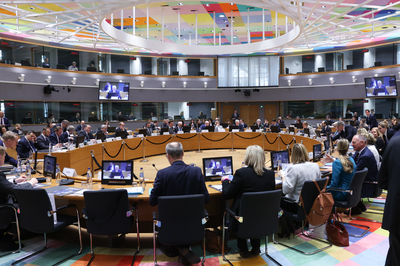
Justice and Home Affairs Council (Home Affairs), 5 March 2025
Main results
Home affairs
EU border management
At their meeting today, home affairs ministers agreed on a joint position (general approach) on a regulation allowing for the progressive start of operations of the Entry/Exit System, an IT system for registering the entry and exit into the Schengen area of non-EU nationals who are travelling to the EU for a short stay. This law will make it possible for member states to start the EES progressively during a six month transition period before fully launching the new system.
Once members of the European Parliament (EP) reached their position, the Council and EP can start negotiations to settle on the final law.
Ministers also approved a revised roadmap for the roll-out of the so-called interoperability architecture, an interconnected system of IT tools used for border management and law enforcement. According to the roadmap, which was adopted by the management board of eu-LISA, the EU agency in charge of building the IT infrastructure, the EES will start in a progressive manner in October 2025. The revised Eurodac, an EU biometric database that assists with the identification of asylum seekers, will enter into operation in June 2026. And the European Travel and Authorisation System (ETIAS) finally will be launched in the last quarter of 2026.
Ministers examined the impact of the regime change in Syria on migration. They, on the one hand, discussed how member states can assist those Syrians who express a firm wish to go home. On the other hand, ministers addressed the enforcement of return decisions for Syrian nationals who pose a security threat or are convicted criminals.
The fall of the Assad regime is a turning point for the many Syrians in Europe. While the difficult situation on the ground makes a large-scale return difficult, it is important to look for concrete solutions to send people back, in accordance with relevant international law, who are convicted criminals and pose a threat to public safety.
Tomasz Siemoniak, Polish Minister of the Interior and Administration
As regards the voluntary returns, many member states expressed their support for go-and-see-visits which would allow Syrians living in the EU to assess the situation in their home country on the ground without losing their protection status. Several ministers supported also the establishment of an EU framework for such visits.
There was also broad agreement that solutions should be found to return Syrian nationals who pose a security threat or are convicted criminals.
According to UNHCR, as of February 2025 over 12 million Syrians remain forcibly displaced. 7,4 million Syrians are internally displaced including some 650 000 newly displaced Syrians since 8 December 2024. 4,7 million Syrians have sought refuge outside Syria mainly in neighbouring countries. Around 1,2 million Syrians are benefitting from refugee status or subsidiary protection in the EU and another 130.000 applied for asylum and are waiting for a decision.
Ministers exchanged views on the implementation of the priorities of the Schengen Council cycle and in particular how to increase the effectiveness of return systems. Ministers addressed challenges such as a lack of resources, a lack of cooperation by countries of origin and transit and the insufficient use by member states of information exchange tools (e.g. SIS) . They also debated how the EU can support member states in addressing them.
The Council also adopted a decision setting out recommendations based on the 2024 thematic Schengen evaluation on returns. These recommendations propose solutions to address the main bottlenecks identified in the thematic evaluations, focusing on the key stage of the return process. They emphasise the importance of adequate and proactive planning of resources, efficient coordination and coherence of actors and procedures at both national and European levels.
The Commission presented the Schengen Barometer, a situational update on the state of the Schengen area.
In the margins of the Council, EU ministers of home affairs met with their counterparts of the Latin American Committee on Internal Security (CLASI). CLASI is currently composed of 16 Latin American countries and is the EU’s privileged partner to enhance law enforcement cooperation with Latin America and the Caribbean. The exchange – the third at ministerial level since 2022 and 2023 – focussed on addressing common internal security threats, including the fight against transnational serious and organised crime and illicit drug trafficking.
EU and CLASI home affairs ministers agreed on a joint declaration and a roadmap to implement operational cooperation priorities in 2025-2026. The cooperation priorities include:
Strengthen the exchange of information between law enforcement in both regions
Strengthen the sharing of information regarding drug trafficking
Develop actions against the most threatening criminal networks
Enhance cooperation of CLASI countries with key agencies from the justice and home affairs area
Assess continuously the security vulnerabilities of ports of both regions and the measures put in place to counter the infiltration of organised crime
Promote the implementation of the 'follow the money' approach, targeting the economic infrastructure of organised crime
Ministers also exchanged views on the impact of the current geopolitical situation on EU’s internal security – the focus of the discussion was on Syria and Ukraine. The Presidency also presented a report on the fight against drug trafficking and organised crime.
The Commission presented its action plan on cable security. The action plan, adopted on 21 February 2025, is a reaction to various incidents related to undersea cables that occurred in the Baltic Sea.
The Commission has proposed a range of measures that address prevention, detection, response, recovery and deterrence aspects. A key action to improve detection of cable incidents is about enhancing threat-monitoring capabilities that allow earlier alerts and responses. To enhance the response and recovery when incidents occur, the Commission proposes to establish an EU reserve of vessels that would be used for the repair of damaged cables.
In recent months we have seen a worrying number of incidents with undersea cables in the Baltic Sea. We need to take decisive actions, fast, as a whole EU. The action plan on cable security is a good step forward to better protect our underwater infrastructures.
Tomasz Siemoniak, Polish Minister of the Interior and Administration
The Commission gave an overview of the state of play of the implementation process of the Pact on Migration and Asylum. The Pact entered into force more than 9 months ago and will become applicable in less than 16 months.
The Portuguese minister informed about her participation in the 42nd session of the Arab Interior Ministers Council.