We use cookies to improve your browsing experience. Necessary cookies are required to support essential features of the Council's website. Optional cookies help us produce anonymous and aggregated statistical reports to better serve your needs.
With your permission, we will use cookies to produce aggregated, anonymous data about our visitors' browsing and behaviour on our website. We will use this data to improve your experience on our website.
Transport, Telecommunications and Energy Council (Transport), 4 December 2023
Main results
The Council adopted its position (‘general approach’) on parts of the road and maritime safety legislative packages, on the revised regulation on breaks and rest periods in the occasional passenger transport sector and on the proposed regulation on the accounting of greenhouse gas emissions of transport services.
The Council also took note of a progress report on the Commission proposal to amend the directive on weights and dimensions for heavy duty vehicles. Finally, the presidency informed ministers on the state of play of other legislative files.
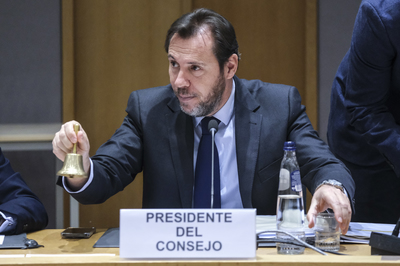
It was a very successful meeting: we reached 8 agreements on key legislative files, including the driving licences reform, the cross-border exchange of information on traffic offences and the maritime safety directives. This will allow the Council to enter talks with the European Parliament and, eventually, conclude these files under the current legislature.
Òscar Puente, Spanish minister of transport and sustainable mobility
Road safety
The Council adopted a general approach on a fourth reform of the driving licences legislation aiming to improve road safety and facilitate free movement. The reform covers the improvement of driving skills, knowledge, and expertise, for example by updating the elements included in driving tests and introducing an EU-wide scheme for accompanied driving for B licence. Measures to reduce dangerous behaviour are also introduced, including updated rules on physical and mental fitness, as well as an EU-wide probationary period scheme for novice drivers. The proposal also introduces the possibility of digital driving licences together with a framework for administrative cooperation between member states’ competent authorities and provides for a simplification of administrative processes and requirements.
The Council also adopted a general approach on cross-border exchange of information on traffic offences, which aims to further improve road safety by extending the scope of the directive to other road-safety-related traffic offences, ensure non-resident drivers’ respect the traffic rules when driving in other member states by strengthening mechanisms for mutual assistance between member states to facilitate the identification of the concerned person and the enforcement of fines of traffic offences. It also aims to improve the protection of the fundamental rights of non-resident drivers.
Ministers agreed on the importance of these pieces of legislation highlighting their contribution to the EU’s vision for “zero deaths, zero serious injuries” on European roads by 2050. The Council’s positions will serve as negotiating mandates in future talks with the European Parliament.
The Council adopted its position on four proposals regarding port state control, ship-source pollution, compliance with flag state requirements and investigation of accidents in the maritime transport sector, all submitted as part of the legislative package on maritime safety. The proposals aim to modernise EU rules on maritime safety and reduce water pollution by ships, equipping the EU with new tools to support clean and modern shipping.
Regarding marine accidents, there was a need for alignment with the IMO code for the investigation of accidents. Furthermore, the Council’s position expands the scope of the directive to include small fishing vessels. The Council amendments also focus on ensuring the independence of the accident investigation bodies, as well as the confidentiality of the findings.
The Council’s position on the directive on port state control focuses on ensuring that the rules are aligned with the Paris MoU’s agreed procedures and includes additional provisions of IMO Conventions that are already in force. Rules for the fair share of inspections, postponements of inspections, as well as refusal of accesses, were also addressed. A voluntary regime of control of large fishing vessels was also introduced. The text also introduces a modification on the risk profile where the Council has agreed on the inclusion of an environmental parameter. Deficiencies related to social aspects via implementation of the ILO Convention are also included in the risk profile. Finally, the Council’s position also refers to the use of electronic certificates encouraging their use.
The directive on flag state requirements was the most complex file to negotiate. The Council’s position contains several modifications compared to the original Commission proposal. The position aligns the text with the IMO instruments implementation code (‘III Code’). It addresses the necessary human resources to ensure compliance at the level of the flag state administration, data to be reported to the Commission and the voluntary use of a database to exchange information on electronic certificates using an information database. The Council’s position has incorporated controls which may be carried out on a risk-based approach. Finally, it addresses capacity building to carry out the necessary administrative tasks and contains derogations for landlocked member states.
The Council’s position on the ship-source pollution directive introduces an administrative sanction system creating a separation from the new environmental crimes directive. The Council’s position further aligns the text with the MARPOL Convention and allows member states to adapt the administrative sanction regime to their national legislation. The position further provides flexibility in relation to recording and reporting obligations to avoid excessive administrative burdens in the member states and allows landlocked member states to derogate from some of the provisions.
The Council’s positions secure a level playing field for the sector while improving implementation and enforcement through digitalisation and greater EU cooperation. Fully aligning themselves with these objectives, ministers concurred that the revised directives set the baselines for a safer and cleaner maritime transport in Europe. The Council’s positions will serve as negotiating mandates to enter talks with the European Parliament.
The Council adopted its position on a revised regulation on rest periods and breaks for drivers in the occasional passenger transport sector. The new rules aim to better reflect the nature of the sector and the related work patterns, providing for a certain degree of flexibility on the distribution of breaks and the starting times for rest periods, without shortening the minimum guaranteed rest times or amending the limits on driving time. Ministers highlighted the social dimension of the proposal since professional drivers work under high pressure and need protection of their breaks and rest times. They also underlined that drivers in this sector have a different work rhythm from those in freight or regular passenger transport, due to high seasonality and varying driving distances. The Council’s position will serve as a negotiating mandate for future talks with the European Parliament.
Accounting of greenhouse gas emissions of transport services
The Council adopted a position on a regulation on the accounting of greenhouse gas emissions of transport services. Part of the ‘greening freight transport’ package, the proposal aims to improve the calculation of and provision of information on the greenhouse gas emissions of transport services so that customers can choose the most sustainable transport options.
The Council’s position has now included flexibility for small and medium sized companies, acceptance of verified data and already accredited verifiers, for example in the maritime sector and aviation, following the recent legislation stemming from the ‘Fit for 55’ package. In addition, the Commission would have to develop a tool to assist small and medium sized companies. Lastly, the Council’s text leaves open the possibility to include lifecycle emissions in the future. The Council’s position will serve as a negotiating mandate to enter talks with the European Parliament.
The Council took note of a progress report on a Commission proposal on maximum authorised weights and dimensions for heavy duty vehicles, also submitted as an integral part of the ‘greening freight transport’ package. The proposal aims to provide incentives for the road transport sector to invest in zero-emission technologies and energy-efficient solutions. Ministers agreed on the importance of the proposal to support the transport sector’s transition to greener solutions.
The presidency informed the Council on the state of play of other legislative proposals, including the revision of the regulation on EU guidelines for the development of the trans-European transport network (TEN-T), the Single European Sky 2+ (SES2+) ‘package’ and the directive on the EU-wide effect of certain driving disqualifications.
The Croatian, Cyprus, Greek, Italian, Maltese, and Portuguese delegations informed the Council about issues of concern for the maritime freight sector linked to the implementation of the emissions trading scheme (ETS) directive.
The Netherlands and Austrian delegations addressed the issue of fatigue among European pilots.
The Polish, Slovak and Hungarian delegations informed the Council about the impact on the transport sector of the EU-Ukraine agreement on the carriage of freight by road.
The Italian delegation brought to the Council’s attention the strategic role of the Alpine region for European transport connectivity.
The Belgian delegation presented its priorities and work programme for the first half of 2024.
Informal lunch
Over an informal lunch, ministers held an exchange of views on the financing of the trans-European transport (TEN-T) network infrastructure. Ministers concurred that the TEN-T policy is a key instrument for the development of coherent, connected, and high-quality transport infrastructure across the EU strengthening the EU's economic, social, and territorial cohesion through seamless transport systems across borders, without missing links or bottlenecks. In this context, ministers explored how the ‘Connecting Europe Facility’ (CEF) financial instrument could better deliver the highest possible EU added value, by focusing on cross-border connections, and providing for the most effective means of transport policy in Europe. They also discussed possible priorities under CEF in the upcoming Multiannual Financial Framework (MFF) for the period 2028-2034.
 It was a very successful meeting: we reached 8 agreements on key legislative files, including the driving licences reform, the cross-border exchange of information on traffic offences and the maritime safety directives. This will allow the Council to enter talks with the European Parliament and, eventually, conclude these files under the current legislature.