Greener transport
Making the transport sector more sustainable is important in order to achieve the goal of climate neutrality by 2050. The European Union therefore aims to make mobility more sustainable while ensuring connectivity.
Why transport is important in reaching climate goals
When they adopted the European Climate Law, the EU countries committed to making the EU climate-neutral by 2050. To achieve this goal, by 2030, the EU will reduce its greenhouse gas emissions by at least 55% compared to 1990 levels. It will also continue to progressively cut emissions until 2050.
To do its part, the transport sector needs to undergo a transformation which will involve a 90% reduction in greenhouse gas emissions (compared to 1990 levels) by 2050.
Transport accounts for one quarter of EU greenhouse gas emissions
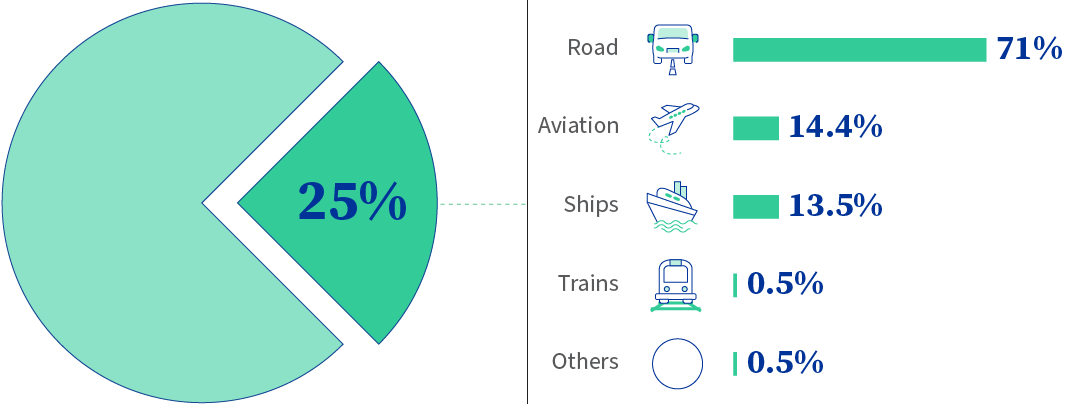
Progress in reducing emissions has been slower in transport than in other economic sectors. While emissions have decreased significantly in other sectors, transport emissions have risen in recent years. Making passenger and freight transport in the EU more efficient and less dependent on fossil fuels is therefore crucial.
How is the EU trying to reduce transport emissions?
Fit for 55 package
The Fit for 55 package is over a dozen legislative proposals designed to reduce greenhouse gas emissions by at least 55% by 2030, compared to 1990 levels. It aligns EU laws with climate targets, while also promoting cleaner technologies, energy efficiency and sustainable transport.
The package comprised updates and new rules across various sectors, including energy, industry, buildings and mobility. The proposals ranged from carbon pricing reforms to renewable energy targets. Several proposals directly impacted transport, such as:
- revisions to the EU Emissions Trading System (ETS)
- the introduction of a new ETS for road transport and buildings
- new CO2 emission standards for cars and vans (all new vehicles to be zero-emission by 2035)
- the promotion of alternative fuels and infrastructure
The proposals were adopted by the Council throughout 2023 and 2024.
Greening freight transport
Greening freight transport is another key step toward cutting emissions, as freight makes up over 30% of transport-related CO2 emissions and volumes are expected to grow. In July 2023, the European Commission proposed a package to make freight transport more efficient and sustainable, promoting greener options like railways and inland waterways.
In December 2023, the Council adopted its position on part of the package: a new regulation to improve how greenhouse gas emissions from transport services are calculated and shared, helping customers make more eco-friendly choices.
In June 2024, the Council agreed on its position on another part of the package: a regulation to improve how railway infrastructure is used across the EU. Its goal is to boost efficiency through better planning, coordination and cross-border management of rail capacity. This is expected to play a major role in shifting more freight to rail.
In November 2025, the Council and Parliament reached a provisional agreement to set out a single method for calculating data on greenhouse gas (GHG) emissions of passenger and freight transport, in order to ensure better comparability of these emissions.
- Green freight package: Council adopts its position on the accounting of greenhouse gas emissions of transport services (press release 4 December 2023)
- Greening freight package: Council adopts position for a more efficient management of rail infrastructure capacity and traffic (press release, 18 June 2024)
- Passenger and freight transport: provisional agreement boosts transparency and comparability of data on greenhouse gas emissions (press release, 5 November, 2025)
- European Green Deal
Transport policy by mode
Learn more about what the EU does in relation to air, rail, road and maritime transport.




Related content
Last review: 5 November 2025