"Upotrebljavamo kolačiće kako bismo poboljšali vaše iskustvo pretraživanja. Neophodni kolačići služe tome da se omoguće ključne značajke internetskih stranica Vijeća. Neobvezni kolačići pomažu nam u izradi anonimnih i zbirnih statističkih izvješća kako bismo bolje ispunili vaše potrebe.
S vašim dopuštenjem upotrebljavat ćemo kolačiće kako bismo dobili zbirne, anonimne podatke o pretraživanju i navikama posjetitelja na našim internetskim stranicama. Te ćemo podatke iskoristiti kako bismo poboljšali vaše iskustvo na našim internetskim stranicama.
Ahead of the sombre four-year anniversary of Russia’s full-scale invasion of Ukraine, the Council held a discussion on Russia’s war of aggression against Ukraine.
Tomorrow, we will mark a brutal and senseless anniversary. Ukraine is paying a heavy price for Russia's fatal miscalculation, but also Moscow has failed to achieve any of its strategic objectives. Its military is bogged down, its economy is in rapid decline, and Ukrainians are resisting and holding firm.
Kaja Kallas, High Representative for Foreign Affairs and Security Policy and President of the Foreign Affairs Council
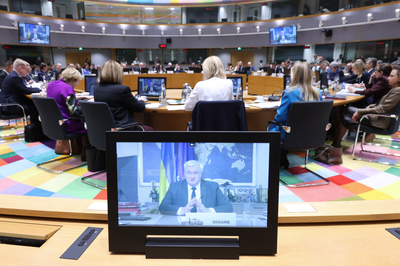
The ministerial discussion started with a VTC intervention of the Ukrainian Minister of Foreign Affairs, AndriiSybiha, who provided an overview of the situation on the ground and Ukraine’s most urgent priorities.
The ensuing EU27 discussion focused on ways to further increase pressure on Russia and support Ukraine. Work on a 20th package of restrictive measures against Russia is still ongoing but the Council decided to prolong the restrictive measures adopted in response to the illegal annexation by Russia of certain non-government-controlled areas of Ukraine for another year, until 24 February 2027. Furthermore, the Council adopted restrictive measures on eight additional individuals responsible for serious human rights violations in Russia.
In addition the High Representative announced that she had decided to limit the maximum size of the Russian mission in the EU to 40 people, and is working with the European Commission to keep numerous former Russian soldiers out of the Schengen area.
Regarding support for Ukraine, the Council approved a revision to the Ukraine plan in order to take into account two exceptional contributions by Sweden to the Ukraine Facility, which consist of approximately €260 million of non-repayable support. The Council also touched on the issue of the €90 billion Ukraine Support Loan for the years 2026-2027.
The Council then discussed developments in the US-led peace negotiations, and how the EU can support the diplomatic track and contribute to security guarantees.
Europe has clear and legitimate interest in how Russia's war ends. For European interests not to become collateral damage, we must be clear about what we expect from Russia. Respect for borders, end of sabotage, paying of war damages, and the return of Ukrainian kidnapped children aren't just far-fetched asks, they should be a baseline.
Kaja Kallas, High Representative for Foreign Affairs and Security Policy and President of the Foreign Affairs Council
EU foreign affairs ministers discussed the situation in the Middle East in light of the latest developments concerning Gaza and the West Bank, Iran and Syria.
Gaza and the West Bank
Over lunch, Ministers exchanged views with the High Representative for Gaza, Nickolay Mladenov, on next steps for the implementation of the Comprehensive Plan to end the Gaza Conflict and the role of the recently established Board of Peace. The discussion contributed to clarifying possible avenues for EU engagement, including on governance and security arrangements, without prejudice to future decisions.
At the start of the subsequent discussion, ministers were also joined by Alexander De Croo, Administrator of the United Nations Development Programme (UNDP), who briefed the ministers on its recent visit to the region and the dire humanitarian situation in Gaza, as well as the role of UNDP.
Real progress in Gaza hinges upon disarming Hamas and the subsequent withdrawal of the Israeli forces. […] The European Union supports Gaza's future.
Kaja Kallas, High Representative for Foreign Affairs and Security Policy and President of the Foreign Affairs Council
Ministers discussed the EU’s contribution to the implementation of the Comprehensive Plan to end the Gaza Conflict, in line with UN Security Council Resolution 2803, following the US announcement of 14 January on the launch of the second phase of the plan.
Following up on the inaugural meeting of the Board of Peace held on 19 February in Washington D.C., ministers exchanged views on possible EU contributions across the humanitarian, governance, security and reconstruction strands of the plan, while recalling their concerns on the charter of the Board.
They also expressed deep concern at the dire humanitarian situation in Gaza, including the issue of NGO registrations, as well as touching upon the enhanced CSDP engagement, namely through the redeployment of EUBAM Rafah and the scale-up of EUPOL COPPS in support of the training of the Palestinian police and criminal justice actors.
On the West Bank, the Council discussed the recent measures adopted by the Israeli government to amend land registration and property acquisition procedures. Ministers voiced serious concern that these decisions represent a breach of international law and further undermine efforts towards a peaceful resolution and a two-state solution.
Ministers also reconfirmed the EU’s support to the Palestinian Authority, while stressing the importance of continued reform efforts.
Foreign affairs ministers also took stock on the situation in Iran, in light of ongoing US-Iran talks and the recent EU decision of 19 February 2026 to list the Islamic Revolutionary Guard Corps (IRGC) as a terrorist organisation. Ministers reiterated concerns over Iran’s nuclear programme, while reaffirming the need to preserve channels for dialogue to avoid risks of military escalation or internal destabilisation.
The window of diplomacy is very narrow. Of course, we have many concerns with Iran, its nuclear programme, its ballistic missiles and support for terrorists that are also a threat to Europe. But any military intervention risks hard-to-control consequences.
Kaja Kallas, High Representative for Foreign Affairs and Security Policy and President of the Foreign Affairs Council
Ministers discussed the situation in Syria, in light of the ongoing transition process, including recent the agreement between the transitional authorities and the Syrian Democratic Forces, while underlining the fragility of the security situation.
The Council confirmed its readiness to support an inclusive political transition and sustainable reconstruction, including through enhanced EU engagement. Ministers also discussed the recent escalation of violence in the northeast of the country and highlighted the continued security risks linked to camps and detention facilities hosting former Da’esh fighters and their families. They stressed the need to create the conditions for safe returns of refugees and the importance of EU’s contribution towards rehabilitation and reintegration programmes.
Ahead of the Foreign Affairs Council, an informal exchange took place over breakfast on hybrid threats and foreign information manipulation and interference (FIMI).
Today's wars are not only fought with tanks and drones, they are also fought with lies and algorithms. FIMI is a weapon aimed at the heart of our democracies. […] We cannot afford to lose the information battle. […] Today, ministers reconfirmed the need for clearer communication of our values and what Europe stands for, reinforcing sanctions on FIMI networks and strengthening cooperation with law enforcement.
Kaja Kallas, High Representative for Foreign Affairs and Security Policy and President of the Foreign Affairs Council
The Council adopted the extension of the mandate of EU’s maritime security operation to safeguard freedom of navigation in relation to the Red Sea crisis (EUNAVFOR ASPIDES) until 28 February 2027.
Općenite informacije o akreditaciji možete pronaći na ovoj stranici.Akreditacije za medije za međunarodne sastanke na vrhu koji se održavaju izvan Europske unije odgovornost su vladinih tijela zemlje domaćina.