Conciliation Committee
What is the Conciliation Committee?
In the ordinary legislative procedure, a conciliation committee can be convened when the Council does not approve the Parliament's amendments to a legislative proposal at second reading. The conciliation phase is the last chance to come to an agreement between the two co-legislators.
If no agreement is reached in the Conciliation Committee, the law will not be adopted.
The committee is composed of representatives of the 27 member states and an equal number of members of the European Parliament (MEPs). It is co-chaired by the president of the Parliament and the rotating presidency of the Council. The Commission also takes part in the meetings and tries to reconcile the different positions.
The provision for the Conciliation Committee is provided for by Article 294 of the Treaty on the Functioning of the European Union (TFEU).
Not a frequent occurrence in recent times
Since 1999 only 9% of legislation adopted under the ordinary legislative procedure has been through conciliation.
Currently, more than 90% of laws under the ordinary legislative procedure are adopted at the end of the first or beginning of the second reading.
There were no conciliation procedures between 2014 and 2025.
In 2026 a Conciliation Committee was convened for the first time in over 10 years, for a proposal on air passenger rights.
How does conciliation work?
The Conciliation Committee must be convened no later than six weeks (or eight, if an extension has been requested) after the end of the second reading of the proposed law. The aim is to achieve agreement on a joint text on the basis of the positions adopted by the two institutions at the second reading.
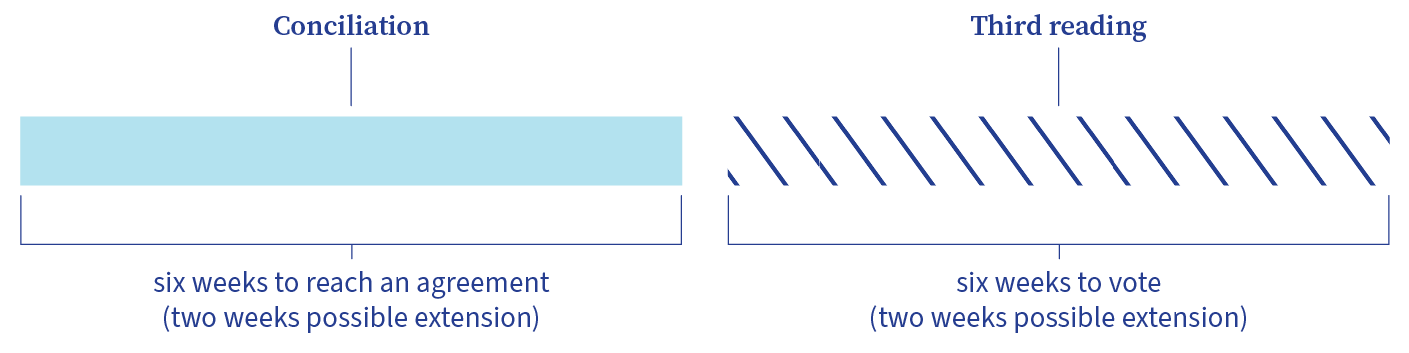
The Conciliation Committee has six weeks to agree on a joint text. This period can be extended by a maximum of two weeks if requested by the Parliament or the Council.
If no agreement is reached within this timeframe, the proposed legislation will not be adopted.
If a joint text is agreed on, it will still have to go through the process of being adopted by the Parliament and the Council. This is done at the third reading of the legislative proposal. In this third reading, the wording of the joint text cannot be changed. Both institutions have six weeks to vote on the act in question. That period can be extended by maximum two weeks.
To be adopted, the text has to be passed:
- by an absolute majority in the Parliament
- by a qualified majority in the Council
If either the Parliament or the Council does not vote on the joint text or rejects it within the period, the proposed legislation will not be adopted.
In that case, the Commission can submit a new legislative proposal on the same subject.
See also

The ordinary legislative procedure

The Council's role in EU decision-making

Qualified majority
Last review: 5 June 2026