Special legislative procedures
What are the special legislative procedures?
Special legislative procedures apply to specific cases where the Council alone adopts legislation. In these cases, the Parliament does not act as a co-legislator, but it must be consulted or give its consent.
These procedures are used for specific areas such as single market exemptions, competition law and measures to combat discrimination.
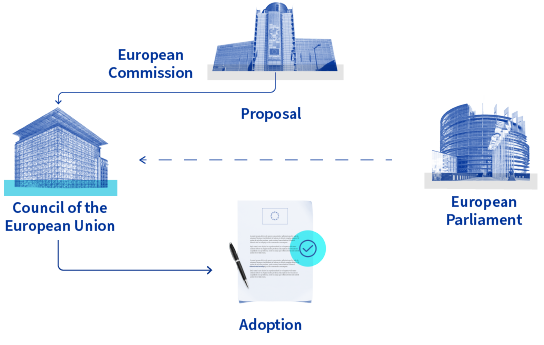
Consent or consultation of the Parliament
There are two types of special legislative procedure: the consent procedure and the consultation procedure.
In both cases, the legislative proposal normally comes from the European Commission, with only a few exceptions. They differ, however, in the degree to which the European Parliament is involved.
Consent procedure
The European Parliament may approve or reject a legislative proposal by an absolute majority vote, but it cannot amend it.
The Council may adopt a law only after obtaining the Parliament's consent. The Council cannot overrule the Parliament's decision.
Consultation procedure
The European Parliament issues an opinion on a legislative proposal. It may approve the proposal, reject it or propose amendments.
The Council is not legally obliged to follow the Parliament's opinion, but it must receive it before adopting the law.
Which procedure is used when
Consent procedure
The consent procedure is used for:
- new EU laws to combat discrimination
- certain international agreements negotiated by the EU
- decisions on a serious breach of fundamental rights
- EU action in areas where the EU does not normally have the power to act
Consultation procedure
The consultation procedure is used in cases such as:
- measures to prevent distortion of competition in the single market and single market exemptions
- the harmonisation of turnover taxes, excise duties, and other forms of indirect taxation
- recommendations and opinions adopted by the Council and the Commission
Legal basis
The special legislative procedures are defined in Article 289(2) of the Treaty on the Functioning of the European Union.
See also

The Council's role in EU decision-making

The ordinary legislative procedure

Implementing and delegated acts
Last review: 9 April 2026
