Organic farming
Organic farming produces food by means of natural methods that have a limited environmental impact. The EU wants 25% of its farmland to be organic by 2030 and has clear rules to support that goal.
What organic farming means
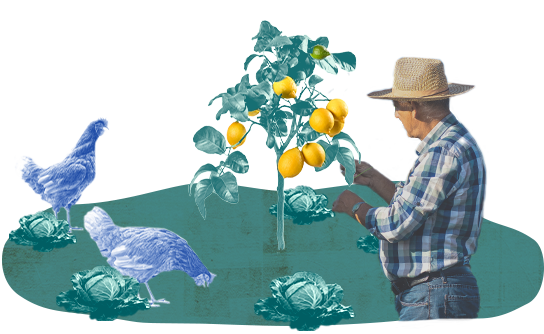
Organic farming is an agricultural method using natural processes and substances that have a limited impact on the environment and climate. It aims to:
- support biodiversity
- ensure high standards of animal welfare
- encourage local production
- preserve rare and native breeds
To achieve this, the EU organic framework sets strict standards.
Key practices

Limiting synthetic pesticides and fertilisers

Banning genetically modified organisms (GMOs)
Rotating crops to keep soils healthy

Open-air access and organic feed for animals
Reaching 25% organic farming by 2030
The EU aims to see 25% of agricultural land used for organic farming by 2030.
Organic farming is growing quickly
Between 2012 and 2022, the share of organic farmland in the EU rose by 79%, from 9.5 million hectares to 16.9 million hectares.
Chart comparing organic land’s percentage share of total agricultural land for 2012 and 2022, and the 2030 goal.
The first bar, on the left, represents the year 2012. It is dark green, relatively low and labelled 6%. The second bar, in the centre, represents the year 2022. It is also dark green, noticeably taller than the 2012 bar and labelled 11%.
The third bar, on the right, represents a future target for the year 2030. It is bright green, significantly taller than the other two bars and labelled 25%.
This growth has gone hand in hand with stronger consumer demand and greater recognition of the EU organic logo. Retail sales of organic products in the EU exceeded €45 billion in 2022, and the EU organic logo is now the best-known food logo in Europe.
EU rules for organic farming
The main EU law on organic production – Regulation 2018/848 – has applied since 2022. It sets high standards for how organic food is produced, processed and labelled, and helps ensure fair competition and consumer trust.
Key elements include:
- production methods that limit synthetic pesticides and fertilisers, protect soil fertility and biodiversity and use energy and resources carefully
- strong animal welfare rules, including outdoor access and conditions that respect animals' natural behaviour
- clear labelling, with the EU organic logo required on all prepacked organic food produced in the EU and the protected use of terms such as 'bio' and 'eco'
- yearly controls for every operator in the supply chain, from farmer to retailer, by authorised control bodies
- group certification, so that small farmers can be certified together, reducing costs and paperwork

Support for organic farming is embedded in the EU's common agricultural policy (CAP). Under the CAP strategic plans, about €19 billion are allocated to supporting organic farming in the EU. Each hectare of organic land receives an average of €148 per year in specific support. This is in addition to any other income support that the farmer may receive.
In March 2021, the European Commission presented an action plan to develop organic production in the EU.
In July 2021, EU ministers agreed on Council conclusions on the action plan and stressed that organic farming helps make European agriculture more sustainable, creates jobs and secures incomes.
They also stressed the need to balance demand and supply, to consider each EU countries' situation, and to involve public and private stakeholders in achieving the action plan's goals.
Making EU rules on organic farming simpler and clearer
The EU is updating the organic regulation with the goal of:
- simplifying and clarifying the rules
- increasing trust in the EU organic logo
- reducing red tape, particularly for small operators
- keeping trade with key non‑EU partners running smoothly
In December 2025, the European Commission proposed targeted changes, including on imported organic products and labelling, small operators and farmers, cleaning and disinfection products and rules for livestock and aquaculture.
The changes are expected to cut direct administrative costs by €47.8 million a year – €45.9 million in savings for farmers and other operators and €1.9 million in savings for administrations.
On 11 May 2026, representatives of EU countries' governments in the Special Committee on Agriculture (SCA) agreed on a common position to start talks with the European Parliament. The committee prepares the Council's work on all matters relating to the common agricultural policy.
The Council and Parliament must both agree on the final text before the new organic rules can apply in practice.
Imported organic products and labelling
Organic products imported from non‑EU countries would be able to continue using terms such as 'organic' if their organic farming rules are recognised as equivalent to EU standards. However, they would only be able to use the EU organic logo if they meet extra requirements, for example, on living soil, animal welfare and processing methods.
The organic rules of 11 non-EU countries, including Argentina, Canada, New Zealand and the United States, are currently recognised as equivalent to EU standards, but that recognition ends on 31 December 2026. To avoid disrupting trade, their recognition would be extended until 31 December 2036.
Small operators and farmers
Small operators that sell unpacked organic products, such as loose fruit and vegetables, directly to consumers, and small online retailers of pre-packed organic products, would not need a certificate unless their sales exceed 10 000 kg per year or their turnover exceeds an average of €40 000 per year on over five years.
Group certification for small farmers would also become easier.
Cleaning and disinfection products
Organic processors would have more flexibility in their daily work on cleaning and disinfection. They would be allowed to use standard products available on the market, rather than being limited to a list of products authorised by the European Commission.
Livestock and aquaculture
The reform would introduce a minimum slaughter age for organic quail.
Rules on outdoor access for poultry would change, so that young birds are only allowed outside once they have enough feathers to control their body temperature.
The process of converting from conventional to organic farming would become simpler and more consistent across the EU.
For farm animals on land and in aquaculture, the waiting time after using veterinary medicines before products can be sold as organic would be aligned.
See more

Greening agriculture

The common agricultural policy explained

New genomic techniques for plant breeding
Last review: 23 July 2026